Air Fryer Combo Appliances: The Real Pros and Cons Before You Buy
Air fryer combo appliances: The real pros and cons before you buy
An air fryer combo can save counter space and add modes, but only if its capacity and accessories fit your routine.
Basket models suit smaller portions; oven-style units offer room for larger foods but take more room. Crowding limits airflow, so cook in batches for crisp results.
Check cleaning needs, replacement-part costs, and safety certifications.
Pressure-cook frozen chicken by the manual, then verify it reaches 165°F. Keep-warm and pizza reheating may help; learn to weigh the trade-offs before choosing.
Counter-Space Trade-Offs
Air-fryer combos can replace several countertop appliances by air frying, baking, roasting, toasting, and reheating in one unit, but they aren’t necessarily compact. Before buying, measure the counter area and compare it with the appliance’s footprint, including space needed around it. Oven-style models can occupy substantial counter or cupboard space, so check the manufacturer’s clearance guidance and plan for ventilation.
Then assess usable cooking capacity, not just exterior size: a small basket may require several batches, while a larger oven-style cavity can cook more at once. Consider where you’ll keep the unit when it’s not in use. If you must lift it into a cabinet after every use, its bulk may reduce convenience. Count only appliances you’ll stop using when estimating space saved.
Air Fryer Meets Multicooker
Beyond counter space, some combos pair air frying with multicooker functions such as steaming, sautéing, and slow cooking. These hybrids switch between fast convection crisping and controlled wet-heat modes; a fan browns food with little oil while the inner pot simmers or steams. You can use one appliance for crisp finishes and dishes that need gentler cooking, but mode changes may require swapping the basket for a pot or crisper plate.
| Mode | Best use | Trade-off |
|---|---|---|
| Air-fry | Crisping; browning | Needs space around food |
| Steam | Vegetables; moist cooking | Adds water and cleanup |
| Slow-cook | Stews; tender meals | Takes longer than air-frying |
Check whether your model supports both functions independently; shared chambers and accessories can limit capacity, convenience, or results. Compare controls and replacement-part availability.
Pressure-Cooking Frozen Chicken
If your combo appliance includes a pressure-cooking function, you can cook frozen chicken without thawing it first, but follow the manual for the model-specific method and timing.
Frozen pieces take longer to cook under pressure than thawed chicken, so don’t substitute thawed-chicken times. Arrange the pieces with enough space for steam to circulate, and keep the contents below your cooker’s stated fill limit. Once the cycle ends, check the thickest part of each piece with a food thermometer; it must reach 165°F (74°C) before you serve it.
Pressure cooking can make chicken tender quickly, but it won’t crisp the skin. If your manual permits, transfer the cooked chicken to the appliance’s air-fry function and crisp it afterward. Check every piece before serving.
Basket-Style Versus Oven-Style Combos
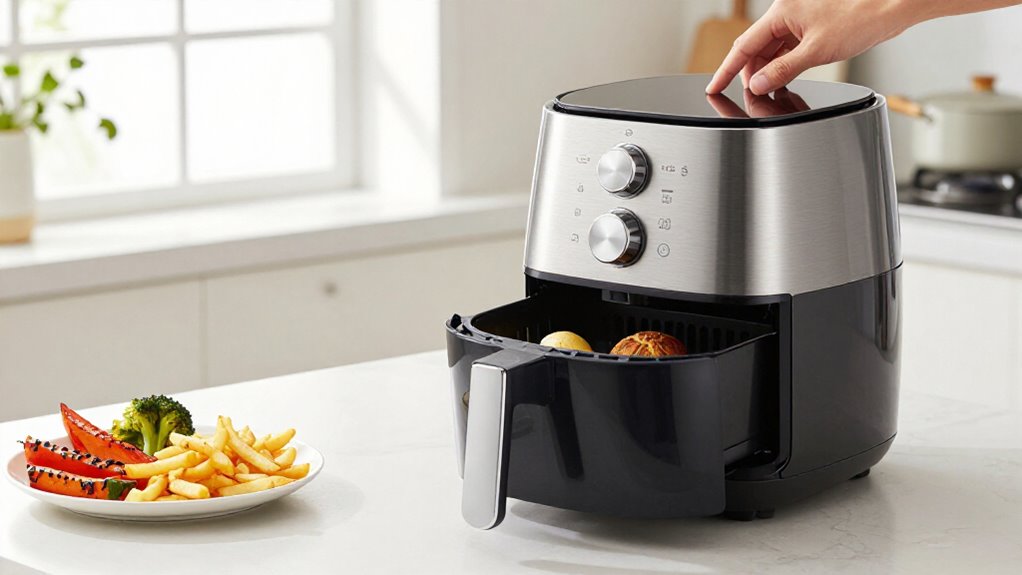
Basket-style combos usually take less counter space and crisp food quickly, but their limited capacity may require you to cook larger meals in batches. Oven-style models offer more room for items such as a whole chicken, though they need more counter space. You’ll also clean more racks, trays, and interior surfaces with an oven-style combo.
Cooking Capacity
Capacity depends on the combo’s design: basket models typically hold 2–6 quarts, making them practical for small portions but often requiring multiple batches for larger meals. Crowding the basket can restrict airflow, so food may cook unevenly or lose crispness. Keep pieces in a loose layer when even browning matters; that may mean cooking separate portions.
Oven-style combos offer racks and a roomier cavity, letting you fit larger items such as a whole chicken or prepare more food at once. However, their air-fry modes generally work on one shelf at a time, so extra rack space doesn’t always translate to simultaneous cooking. Some multi-basket models let you cook different foods at once, but their capacity remains divided among baskets.
Choose based on your usual portions and whether you value one-batch volume or a compact basket for smaller servings. Check usable dimensions, not just advertised capacity, before deciding whether a dish will fit comfortably inside.
Counter Space Needs
How much counter space you have may determine which combo suits your kitchen. Basket-style air fryers are often compact enough to sit on a countertop, but their bulky shape still needs storage space when you put them away. Their typical 2–6-quart capacity can also mean cooking in multiple batches.
Oven-style combos generally take up more counter space because they replace a countertop oven. You’ll need room for the unit, clearance to open its door, and access to trays. In return, racks and a larger cavity can fit bigger portions than a small basket model. Before choosing either style, measure your available counter and storage areas. Compare those measurements with the appliance’s dimensions, then weigh its footprint against the capacity your household needs most often.
Ease of Cleaning
Although both styles need regular cleaning, basket-style combos are usually easier to maintain. You can remove the basket and crisper plate to wash them separately; some models let you put these parts in the dishwasher.
But check the manual first. Fine stainless-steel mesh can trap crumbs and grease, making scrubbing tedious, while enamelled perforated trays typically wipe clean more easily.
With oven-style combos, you may need to clean the air-fry basket, oven shelf, drip tray, and interior. Splatters can spread grease across the cavity, so wipe it after cooking.
Grease buildup may cause smoke or unpleasant smells next time. A pyrolytic self-cleaning cycle can help if your model includes one. Basket-style units have hard-to-reach elements and fans; oven-style models require wiping the full interior.
Cooking for a Crowd
When you’re cooking for a crowd, an oven-style combo can handle larger batches than a compact basket model, which may require several rounds. Check usable capacity: overcrowding blocks airflow, while air-fry mode may work best on just one shelf at a time. If you cook in batches, plan how you’ll keep earlier servings warm and account for the added time.
Batch Cooking Capacity
For a crowd, a small 2–6-quart air-fryer basket may require several batches, stretching out serving time. Compare usable cooking area, not headline capacity: racks, tray dimensions, and airflow determine what you can cook evenly. Oven-style combos can fit a whole chicken or roast, but air-frying usually uses one shelf at a time.
A conventional oven handles larger quantities in one go; a benchtop unit may finish a small batch faster, then keep you cooking. Don’t pack pieces tightly: gaps improve airflow and crisping, but reduce each load. Check dimensions.
| Factor | Basket | Oven-style combo |
|---|---|---|
| Capacity | 2–6 qt | Often larger cavity |
| Crowd pace | Repeat batches | More food per run |
| Crispness | Leave gaps | Avoid crowding shelf |
| Best check | Usable area | Tray and rack dimensions |
Serving Size Limits
Most air-fryer baskets hold 2–6 quarts, so cooking for a crowd often means working in batches. Crowding the basket can obstruct airflow, leaving food unevenly cooked and less crisp. If you fill it to serve everyone at once, you may get poorer results than the advertised capacity suggests.
For occasional small gatherings, a benchtop combo may be adequate; you’ll need to divide larger portions and allow time for repeated cooking cycles. If you regularly serve a crowd, compare usable oven volume, not just basket size. An oven-style combo can accommodate larger items such as a whole chicken or roast, and cook more food at once. However, it typically uses only one shelf at a time, so check whether that capacity matches your usual portions.
Keeping Food Warm
A keep-warm function can hold finished batches while later ones cook, helping you serve a crowd without letting food cool. Check your model’s instructions for the safe holding time and temperature; the setting isn’t a substitute for timely serving or safe food handling.
It won’t expand the appliance’s cooking space. Air fryers have limited capacity, so you may still need several rounds, and repeated batches can stretch meal preparation.
If your combo has multiple baskets, you can cook different foods at once and coordinate sides with a main dish. For a large quantity, a conventional oven may be more practical because it can cook more food in one go. Compare actual capacity and warm-hold guidance before relying on this feature for a crowd.
Reheating Leftover Pizza
An air-fryer combo can bring leftover pizza back to life with a crispier base and edges than a microwave, which may leave the crust soft or the middle cold. For a crisper result, its circulating hot air warms slices quickly, though timing depends on your appliance and the slice thickness. Check early; continuing too long can dry the cheese or burn the crust.
Arrange slices in a single layer, leaving space around each one so air can circulate and heat the base more evenly. If your basket is compact, it may hold only a few slices, so you might need multiple batches for a larger serving. Still, reheating pizza alone may not justify a combo if you rarely use its other cooking modes elsewhere.
Thermal-Fuse Safety Concerns
Although a thermal fuse is designed to cut power if an appliance overheats, there’s no evidence that air-fryer combos face unique fuse risks. Some reports mention fire hazards in poorly made air fryers, but they don’t show that combo units—or their fuses—are especially affected. A viral 2021 video showed an air fryer catching fire, but it didn’t establish the cause or prevalence. A thermal fuse’s purpose is to interrupt power during overheating; available information gives no failure rates or model-specific details.
Before purchase, check your model’s safety certifications, recall history, and instructions; generic fuse claims aren’t a substitute. Keep vents clear and clean residue and grease as directed. If your unit repeatedly overheats, stop using it and contact the manufacturer for guidance.
Overfilling the Cooking Basket
Even when a combo appliance advertises a large capacity, its usable air-frying area may be smaller than expected. Check the basket’s dimensions and arrange food in a single layer, with gaps for hot air to circulate. A crowded load can cook unevenly and lose crispness, even if the advertised volume seems generous.
- Leave space between pieces instead of packing them tightly.
- Shake, toss, or flip food halfway through, following your appliance’s instructions.
- Cook oversized batches in separate rounds; don’t stack food to make it fit.
- With oven-style combos, use one shelf for air frying and avoid crowding it.
- Measure your usual portions against the actual basket or shelf before choosing a model. That check helps you judge realistic batch size, not just stated capacity.
Check Replacement-Part Availability
Once you’ve checked the usable cooking space, find out whether the manufacturer sells replacement parts for that exact model.
Combo appliances may use model-specific baskets, trays, racks, or other components that won’t fit standard air fryers. Confirm availability by full model number, and ask how long the manufacturer expects to support it. Check that you can order parts in your region before buying.
Compare each part’s price with the appliance’s cost: a specialized tray may cost around $115, while some oven air-frying trays cost about $200. Factor these expenses into ownership costs, especially if a worn component could limit use. Check which removable parts are dishwasher-safe and whether replacement coatings are available.
Clear warranty terms and responsive customer-service support matter; verify both before committing.
Conclusion
An air fryer combo can save counter space and replace several appliances, but you’ll trade some speed and capacity for versatility. Choose a multicooker if you want pressure cooking, including frozen chicken; choose basket- or oven-style based on portions and how you cook. Check pizza-reheating performance, safety features, and replacement-part availability before buying.
Don’t overfill the basket, and confirm the footprint fits your counter. Compare your cooking needs with the appliance’s limits before deciding.