The Air Fryer Combo Glossary: Every Function Name Decoded
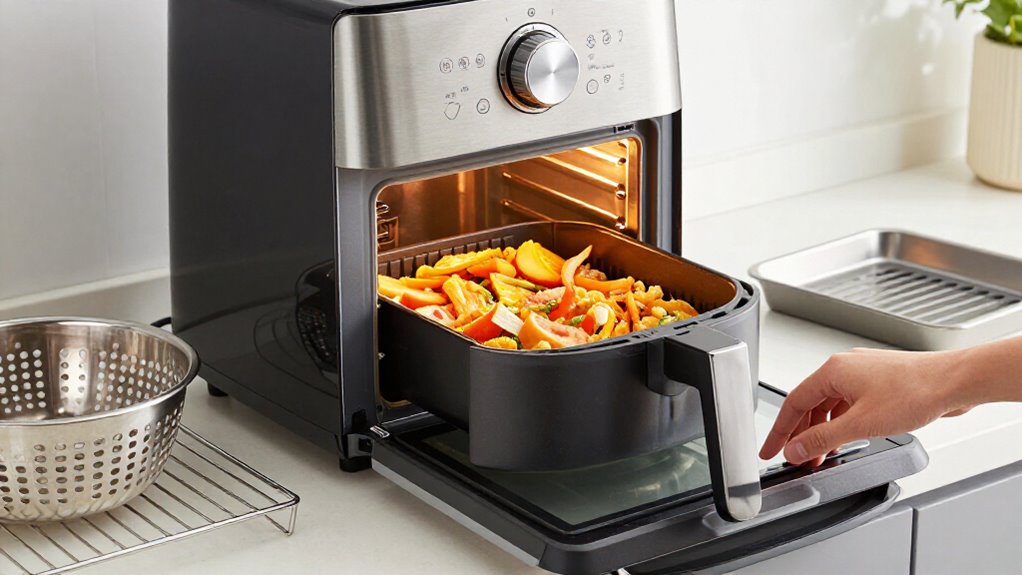
Decode each air-fryer combo label by checking the heat source, fan intensity, and cooking sequence your model uses.
Air Fry circulates hotter, faster air for crisping; Bake uses gentler heat for batters, while Roast cooks larger portions and Broil browns from above.
Presets store settings, but manual controls let you adjust time and temperature.
Combo names aren’t standardized, so check your manual, avoid overcrowding, and monitor food. The guide below explains what each setting means.
Match Labels to Cooking Modes
Air fryer combo labels describe how the appliance directs heat and airflow. Match each label to its cooking method rather than treating the names as interchangeable. Air Fry combines high heat with a powerful fan, up to 450°F, to crisp pieces, frozen foods, or items quickly.
Bake uses gentler heat and airflow, helping batters and doughs cook through without excessive drying or rapid browning. Roast applies high heat, often with a less powerful fan than Air Fry, so larger meat portions and vegetables brown outside as they cook. Reheat warms cooked food at lower temperatures, typically 250–350°F, limiting added browning. Broil concentrates intense heat from the top element to brown surfaces or melt cheese. Dehydrate runs low and slow, around 150°F, to dry fruit or jerky.
Preset Versus Manual Controls
Once you’ve chosen a cooking mode, decide whether to use a preset or set the controls yourself.
Presets store time and temperature, and some models also set fan speed or heating elements. Manual controls let you adjust supported values independently, which helps when a recipe or portion differs. You can often fine-tune a preset after selecting it; don’t assume every model offers the same adjustments.
| Control | What you set |
|---|---|
| Preset | Stored cooking parameters |
| Manual | Time and temperature |
| Optional | Fan or element settings |
| Multi-basket | Separate settings; synced finish |
Choose manual settings when you need precise control over a tested recipe or want to compensate for quantity and thickness. Check unit-specific adjustments and verify doneness before serving.
Decode Combo-Mode Labels
Combo-mode labels tell you which heating methods run together and how they affect cooking. Air Fry and Bake balance forceful airflow with gentler heat, while Roast and Broil or Air Fry and Grill pair thorough cooking with surface browning. Steam and Crisp combines moisture with dry heat, so you can cook food through while finishing it with a crisp exterior.
Combo Mode Basics
Although “combo” sounds like two functions running together, appliances use the label for different cooking sequences. Check your model’s manual to identify which methods it pairs, their order, and the time and temperature. Some programs switch between stages; others apply a preset combination throughout, so don’t assume both functions operate simultaneously.
In a two-stage cycle, a bake may cook batter through before an air-fry finish browns its surface. Because labels and sequences vary by appliance, the name doesn’t guarantee identical heating. A combined air-fry-and-bake setting may still run a strong fan; delicate batter or lightweight toppings can shift or cook unevenly. Combo programs set time and temperature automatically. If food browns too quickly or needs more time to cook through, adjust the settings.
Air Fry and Bake
The Air Fry and Bake labels describe distinct heating styles, even when a combo program uses both in sequence.
Air Fry drives a strong fan across high heat, often up to 450°F, to brown and crisp food quickly. You can use it for frozen or already-cooked items. Its fan can shift lightweight toppings or unset batter, so don’t use Air Fry for delicate baking.
Bake uses gentler heat and airflow, giving batters and doughs time to set. Choose it for cakes and delicate bakes. In one side-by-side test, a boxed cake at 350°F took 27 minutes on Bake, emerging moister and more evenly colored than on Air Fry.
Since air frying browns faster than conventional oven baking, check baked goods early; 325°F may limit surface browning.
Roast and Broil
Roast and Broil use different heat patterns: Roast cooks larger foods through with high heat and gentler airflow, while Broil directs intense heat from the top element to brown surfaces or melt cheese.
Choose Roast for a large cut of meat; gentler airflow lets the center cook before the exterior browns. Select Broil when a dish is cooked or nearly done and needs a quick finish. In basket models, the top element sits above the food, so place the surface or topping you want browned beneath it.
Stay nearby: a compact chamber can brown food faster than a conventional oven, especially thin or sugary toppings. Broil briefly and check often; choose Roast when larger pieces need time to cook through. Follow your model’s guidance on tray placement and settings.
Air Fry and Grill
Air Fry uses a powerful fan and high heat, often up to 450°F, to crisp and brown food quickly, while Grill typically directs intense heat from above to char the surface.
On a combo panel, “Air Fry + Grill” means the fan circulates hot air while top heat adds surface browning. You’ll get color and crisping, but the label doesn’t guarantee the same performance across brands; check your manual for rack position and settings. Arrange food in one layer with gaps so air can move around each piece.
Turn or shake pieces midway to even out browning, then check them early because the combined heat can over-brown food. A little oil can add crispness; it’s optional. Secure loose toppings and pieces: the fan can shift them during cooking.
Steam and Crisp
When a combo mode pairs steam with circulating hot air, steam keeps food moist while the fan dries its surface for browning and crisping. This combination suits you when you want a tender interior and a crisp finish, not the dry, all-over browning you get from air frying alone.
Steam supplies moisture during cooking; then circulating hot air removes surface moisture, allowing the exterior to brown and develop a crisp texture. Your appliance may control these phases automatically, or the label may describe simultaneous operation; don’t assume every model uses the same sequence. Check its manual for the recommended temperature and timing, and confirm whether you need to add water to a reservoir before starting. That guidance helps you use the mode as intended.
Reheat and Dehydrate
Use Reheat to warm cooked food gently, typically at about 250°F to 350°F, and Dehydrate to slowly remove moisture at low heat, around 150°F. These labels describe different thermal tasks, not interchangeable ways to crisp food. Select Reheat when you want leftovers warmed through without the intense surface heat of air-fry mode. Check your food before the cycle ends; combo models can vary in temperature and timing, so the displayed setting may not match every appliance’s performance.
Choose Dehydrate when you want to dry fruit, jerky, or similar foods. The low heat runs for an extended period, gradually drawing out moisture rather than browning the surface. Don’t expect the crisp, browned exterior that high-heat air frying produces. Assess texture as food loses moisture.
Preset Label Clues
Although preset names can sound like distinct cooking technologies, labels such as “chicken” or “French fries” usually just select a time and temperature.
Treat food names as program labels, not separate heating systems. “Air fry” signals high heat and a powerful fan, often suited to frozen foods or small pieces that benefit from rapid crisping. “Bake” points to gentler fan-assisted heat; batter and dough can dry out or brown unevenly under stronger airflow.
“Roast” generally combines high heat with a less powerful fan, helping larger meat or vegetable pieces cook through while their surfaces brown. “Reheat” typically uses a lower setting, about 250°F to 350°F. “Dehydrate” signals low, slow heat near 150°F. Programming varies by model; the label describes intent, not a universal recipe.
Choosing the Right Mode
Preset names describe intended results, but choosing a mode means matching its heat and airflow to the food. Choose Air Fry for frozen or already-cooked foods and small pieces; its strong fan and high heat brown surfaces quickly. Select Roast for larger meats and vegetables that need time to cook through before their exteriors brown.
Use Bake for moist batters and doughs; its gentler fan is less likely to scatter lightweight food or dry it out.
Pick Reheat to warm cooked food at a lower temperature, typically around 250–350°F, rather than crisp it aggressively. Choose Broil when you want intense top heat to brown one side or melt cheese. Select Dehydrate for low-and-slow drying at around 150°F. Consult your manual for exact preset behavior.
Combo Labels That Mislead
Don’t assume “air fry” and “convection” use identical fan speeds, or that “bake” reproduces every function of a conventional oven. “Crisp” may describe a result rather than a distinct setting, and combo names vary by brand. Check each mode’s manual description to confirm its heat source, airflow, and intended use.
Air Fry Versus Convection
Air fry and convection both circulate hot air, so an “air fry” label usually means a faster, more intense convection setting, not a fundamentally different cooking method. Air fry typically combines a stronger fan with high heat, sometimes reaching 450°F, to crisp and brown food quickly. A gentler convection setting can cook foods more gradually and evenly.
Don’t assume the label guarantees a specific fan speed or temperature; manufacturers vary. Check your manual or compare each mode’s recommended settings. Strong airflow can shift lightweight food or batter: in one grilled-cheese test, air fry blew off the top slice and browned unevenly, while bake kept the sandwich in place and melted the cheese more evenly.
Choose air fry for cooked or frozen foods and small pieces; use gentler convection for moist batter or dough that could brown or dry too fast.
Bake Doesn’t Mean Oven
In one test, a cake at 350°F finished in 20 minutes on Air Fry, but browned unevenly and nearly dried out. Bake took 27 minutes and produced a moister cake with even color.
If the top colors too quickly, try 325°F. You can use Bake for grilled cheese: it held the top slice in place and melted cheese evenly, while Air Fry shifted bread and browned it unevenly.
Crisp Isn’t a Setting
Bake can produce gentler, more even results, but a “Crisp” label doesn’t necessarily select a separate cooking method. Your appliance may use heating elements and circulating air as its air-fry function; “Crisp” may simply apply a preset temperature and timer.
Air-fry cycles combine a fan with high heat, sometimes reaching 450°F, to brown food. Check your manual before treating the label as a distinct mode.
For browning, dry food’s surface and leave gaps around pieces so air can move. Don’t overcrowd the basket. Strong airflow can dislodge toppings or delicate coatings.
If you’re making grilled cheese or cooking batter, choose Bake: its gentler airflow may heat more evenly without scattering ingredients. Adjust time and temperature to suit the food, and inspect it as it cooks.
Combo Names Vary by Brand
Because “combo” isn’t a standardized cooking function, brands use it for different designs, from dual-drawer fryers to air-fryer toaster ovens and microwave–air-fryer appliances. A dual-zone label means two independently controlled drawers, not one spacious basket; each drawer is narrower than a single basket with the same total capacity. Oven-style models may offer two-rack cooking, but their wider, shallower cavity can crisp less effectively than a basket fryer.
The name also won’t identify the active mode: air fry drives a stronger fan, while gentler bake suits batters and doughs. Check the function list and controls before buying. Presets such as “chicken” or “fries” may only set temperature and time, so don’t assume they trigger a distinct cooking process. Compare drawer dimensions, rack positions, and mode descriptions against your cooking needs; advertised capacity alone won’t show usable space or guarantee the airflow and browning you expect from each appliance.
Reheating Leftover Pizza
Start checking after a few minutes. The compact cooking chamber heats quickly, so your pizza may be ready sooner than it would in a full oven. Check the center and toppings for warmth, then continue in brief increments if needed. This gradual approach helps you avoid overheating the cheese or drying the crust.
If you’re aiming for a crisper base, select Air Fry instead. Its stronger fan and higher heat can brown pizza quickly.
Basket Overfill Risks
When you overfill the basket, food blocks the airflow needed for crisping and tends to steam instead. For browning, arrange pieces in a single layer with air gaps between them. The basket’s usable capacity may be smaller than its quart rating suggests, so don’t judge a load by volume alone.
A full basket can leave food underneath pale or unevenly cooked because the heating element sits above the food and circulating air can’t reach every surface. Don’t confuse the solid drawer with the perforated cooking basket or crisper plate: the drawer catches drips, while the perforations let hot air reach food. If everything won’t fit in one layer, cook in batches. Shake or turn pieces midway through each cycle to promote more even browning.
Steam-Bake Moisture Retention
Steam-bake combines circulating heat with added moisture, helping food retain a tender interior as its surface cooks. Use this setting when moisture retention matters more than a deeply crisp finish.
- Moisture slows surface drying, so browning and crisping may take longer than with dry air-fry heat.
- Choose it for bread, cakes, and other baked goods that need a tender interior.
- Expect a softer exterior; don’t select steam-bake when deep crisping is your priority.
- Follow your appliance’s directions for adding water; reservoirs and steam systems vary by model.
Check the manual before filling a reservoir, and use the specified amount and location. During cooking, circulating heat transfers energy while moisture limits evaporation from the food’s surface, supporting a moist crumb without promising a crisp crust.
Conclusion
Once you decode each label, you can choose a mode that matches the food and result you want. Presets offer speed, while manual controls give you finer control over time and temperature.
Treat combo names as clues, not guarantees; verify what each function activates. Keep the basket loose, reheat pizza with room for airflow, and use steam-bake when you want moisture retention. Your manual confirms the appliance’s exact behavior and limits before you start cooking.