Countertop Oven Capacity and Wattage Chart: A Quick Buying Reference
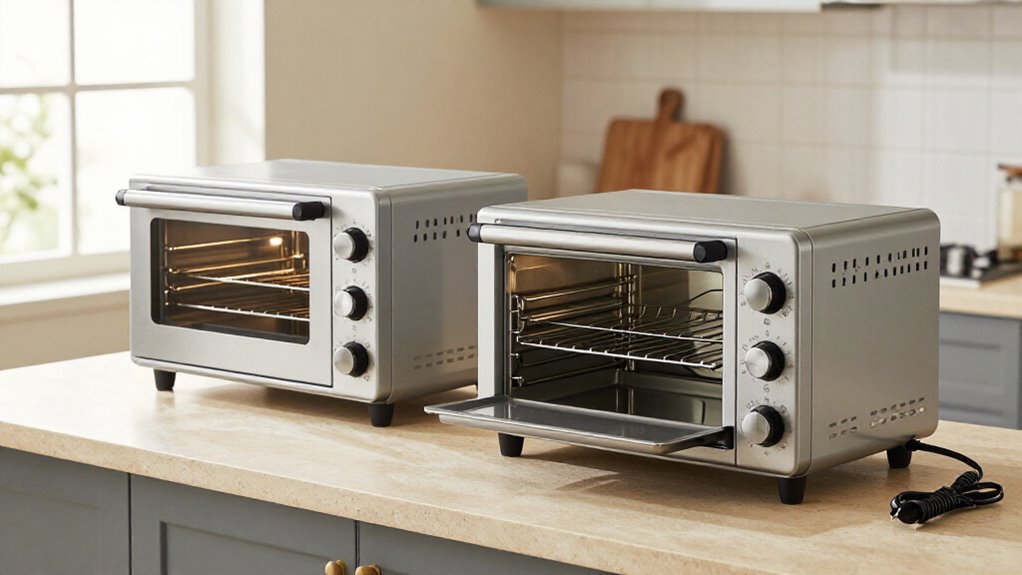
A countertop oven’s wattage shows its electrical draw; capacity shows what you can cook. At 1,150 watts, a compact BLACK+DECKER fits a 9-inch pizza, while 1,800-watt models range from quarter-sheet-pan ovens to units with two racks.
Don’t assume more watts mean faster cooking: cavity size, heating design, and convection matter.
Check interior clearance, not just quarts; 1 US liquid quart equals 0.946 liters. Compare dimensions, outlet limits, and cookware fit; the guide below helps you choose.
Capacity-and-Wattage Pairings
Capacity doesn’t rise in lockstep with wattage, so compare interior dimensions with the foods you plan to cook.
Compact ovens pair lower power with limited space: the 1,150-watt BLACK+DECKER fits a 9-inch pizza or four bread slices. The 1,400-watt Our Place Wonder Oven still can’t fit a 12-inch pizza or large sheet pan. At 1,525 watts, the Tovala suits one or two servings, but a quarter-sheet pan won’t sit flat inside.
Many midsize ovens draw 1,800 watts, yet their area varies: the GE Profile fits a quarter-sheet pan, while the Breville Joule Pro accommodates a 13-inch pizza. For more capacity at that wattage, consider the Ninja Foodi XL Pro with two racks or the Breville Smart Oven Pro, which can cook a whole chicken.
Quart-to-Liter Conversion Guide
For a quick conversion, multiply US liquid quarts by 0.94635 to get liters, or liters by 1.05669 to get quarts. Use the US liquid-quart standard for countertop-oven labels unless a manufacturer specifies dry quarts. For example, 6 qt converts to 5.68 L; report both units when comparing listings. The factor works in either direction, but round consumer-facing figures to two decimal places. For technical calculations, retain more digits and round only the final result.
| Quarts | Liters | Example |
|---|---|---|
| 2 qt | 1.89 L | Small |
| 6 qt | 5.68 L | Larger |
Check regional labels: an Imperial quart equals 1.13652 L, not the US value. Dry quarts use about 1.10122 L each, so don’t apply the liquid-quart factor when a listing says dry. US liquid quarts apply; verify labels.
Rated vs. Usable Capacity
Although the rated capacity offers a quick size comparison, it doesn’t tell you how much food will fit in practice.
Check usable capacity by reviewing the cavity’s shape, rack positions, and clearance around cookware. Countertop ovens commonly fit pans up to 9 × 13 inches without handles, but smaller models may not fit a quarter-sheet pan. A 12-inch pizza can touch the door or back wall in a compact oven, reducing usable space.
Check tested fit details: the GE Profile fits a quarter-sheet pan and casserole dish; the Café Couture fits a standard 9 × 13-inch pan without handles. Match capacity to typical meals: a small oven may suit one or two servings, while larger models can hold a whole chicken or a 13-inch pizza.
Model-Specific Wattage Examples
Compare wattage across the Breville Joule and Compact ovens, GE Profile, Tovala Smart Oven, and Anova Precision Oven. Check each model’s nameplate for input watts, since specifications and operating modes can affect power draw. Match the rating to your cooking needs and outlet capacity.
Breville Joule Oven Wattage
Breville doesn’t state the wattage for the Joule Smart Countertop Oven or Joule Oven Air Fryer Pro in the specifications provided here. For these models, you shouldn’t treat another Breville oven’s rating as a reliable substitute. Several other Breville countertop ovens listed in this reference draw 1,800 watts, but that figure doesn’t confirm either Joule model’s electrical demand.
Before comparing the Joule ovens with other countertop units, check the rating label on the specific appliance or consult Breville’s specifications for its exact model. Use the confirmed wattage to assess expected power draw and whether your outlet or circuit can support the oven alongside other appliances. If you can’t find a clear rating, contact Breville rather than estimating from the product name, cooking functions, or a similar model. Verify it before purchase and circuit planning.
Breville Compact Oven Wattage
The Breville Smart Oven Air Fryer Compact is rated at 1,800 watts and measures 15.7 × 16.9 × 10 inches. That rating gives you a useful benchmark when checking whether your kitchen circuit can support the oven alongside other appliances. On a standard 120-volt supply, 1,800 watts is near the upper end of typical countertop oven draw, so use a suitable outlet and avoid sharing the circuit with other high-draw devices.
Don’t assume every Breville compact model has the same wattage: the available specification gives no separate rating for other compact models. The Smart Oven Pro is also listed at 1,800 watts, but it’s a different model. Check the exact model’s nameplate or product specifications before buying, and compare its dimensions with your counter space and cookware needs.
GE Profile Oven Wattage
GE Profile countertop ovens provide a similar wattage benchmark to the Breville models: both the UltraFast Smart Air Fry Oven and Smart Oven P9OIAAS6TBB are rated at 1,800 watts.
That shared rating gives you a comparison, but it doesn’t indicate capacity or features. The UltraFast measures 17 × 18.25 × 11.25 inches and includes a crumb tray, rack, baking pan with rack insert, and air-fry basket. The P9OIAAS6TBB measures 19.6 × 17.3 × 11.5 inches and offers 11 cooking functions, with room for a quarter-sheet pan and casserole dish.
At 1,800 watts, either model draws power for countertop cooking; check your outlet and avoid sharing a circuit with other appliances. Compare dimensions with your counter space, then match interior room and accessories to your cookware and tasks before you buy, especially if you cook larger batches regularly.
Tovala Smart Oven Wattage
At 1,525 watts, the Tovala Smart Oven sits between basic toaster ovens and higher-powered countertop convection models.
Its listed dimensions—12.32 × 18.5 × 11.75 inches—give you a useful size reference when comparing countertop fit and rated power. The oven combines convection, steam, toast, broil, and reheat modes within its 1,525-watt rating.
That figure is the model’s stated wattage; it doesn’t identify separate draws for each cooking mode. Treat it as the unit’s overall rating when checking whether your outlet and circuit can support another appliance running at the same time.
The available information gives no separate wattage figures for other Tovala models, so don’t assume they share this rating. Before buying, compare the oven’s external dimensions with your counter space and outlet.
Anova Precision Oven Wattage
Rated at 1,800 watts, the Anova Precision Oven 2.0 matches the listed power of several other full-size countertop ovens. At this rating, it draws substantial power while heating, so check that your 120-volt outlet and circuit can handle the load. A dedicated outlet can help prevent a breaker trip when you run the oven alongside other appliances.
The 2.0 measures 22.9 × 14.1 × 20.0 inches and weighs 51.8 pounds. Those dimensions make it a large, high-capacity model for its wattage, so measure your counter space and allow for the required clearance before buying. Its 1,800-watt rating indicates electrical draw, not a guaranteed cooking speed; capacity, airflow, and cooking mode also affect results. The supplied specifications don’t state the original Anova Precision Oven’s wattage, so don’t assume it matches the 2.0.
Estimate Preheat Time by Wattage
Countertop ovens can preheat in as little as five minutes, but wattage alone won’t tell you how quickly a model will heat. Most countertop models use about 1,800 watts, yet two ovens with similar ratings may reach temperature at different speeds.
To estimate preheat time, consider cavity size. A smaller oven may warm faster than a larger model with lower wattage because it has less space to heat. Higher wattage can speed heating, but it doesn’t guarantee a shorter preheat. Convection circulates hot air and can help food cook faster; it doesn’t provide a wattage-to-preheat calculation.
Treat advertised times as approximate. One tested oven’s claim that it needed no preheating proved inconsistent. Check the manual, then allow extra time when a recipe depends on a fully heated cavity.
Confirm Outlet Amperage Limits
After estimating preheat time, check whether the oven’s circuit can handle its draw. Most countertop ovens plug into standard 110-volt household outlets, so you generally won’t need a special receptacle or electrician. But verify the appliance’s input wattage and the circuit’s breaker rating before use. Estimate current by dividing watts by volts: an 1,800-watt oven draws about 16.4 amps at 110 volts.
That figure doesn’t prove the circuit has enough capacity. Check what else shares the circuit, since another running appliance can push total demand beyond its limit and trip the breaker. Consult the oven manual and your circuit or breaker rating to confirm compatibility. Don’t assume a standard outlet guarantees adequate amperage. If ratings or circuit allocation aren’t clear, ask an electrician.
Kitchen Fit Examples
Match the oven’s exterior footprint to your counter and its interior to the cookware you use.
A compact model such as the Our Place Wonder Oven measures 11.6 by 10.6 by 11.5 inches and suits a tight kitchen, but it won’t fit a 12-inch pizza or large sheet pan. The Tovala Smart Oven measures 12.32 by 18.5 by 11.75 inches and handles meals for up to two, yet a quarter-sheet pan won’t sit flat inside.
The larger GE Profile Smart Oven, measuring 19.6 by 17.3 by 11.5 inches, offers more room for everyday baking and air frying. The Café Couture measures 17 by 18.5 by 14 inches and fits a standard 9-by-13-inch pan without handles, though it takes substantial counter space. Check the interior footprint and rack position first against your usual pans, pizza, or casserole dish; don’t rely on exterior size alone.
Avoiding Wattage Misreadings
Although many countertop ovens use about 1,800 watts, compact models may draw less: the 4-slice BLACK+DECKER is rated at 1,150 watts, and the Our Place Wonder Oven at 1,400. Don’t treat higher wattage as proof of better cooking: a larger cavity needs more power, so compare the rating with usable capacity. Wattage measures power draw, not cooking speed alone; oven size, heating technology, and convection affect preheat and cook times.
Before buying, check the model’s specification rather than assuming every countertop oven matches these examples.
- Use wattage and capacity together when comparing models.
- Expect higher draw from larger interiors; it doesn’t automatically mean faster results.
- In the U.S., standard 110-volt outlets power countertop ovens; you won’t need a range’s 220-volt outlet.
Cord Length and Clearance
Before buying, check that the cord reaches your outlet and that your counter can accommodate the oven’s footprint and door swing.
Cord lengths vary: the Breville Joule Oven Air Fryer Pro has a 57-inch cord, while the GE Profile UltraFast Smart Fry Oven has a 40-inch cord. Don’t assume you can reposition the appliance freely; measure the outlet-to-placement route and avoid stretching or pinching the cord.
- Measure the oven’s width, depth, and height, then compare them with usable counter space.
- Check door swing so you can open it fully without hitting a wall, cabinet, or nearby appliance.
- Leave ventilation space on both sides when required; follow the manual’s clearances around vents and nearby surfaces.
Tight placement can restrict airflow and make access awkward.
Conclusion
Use the chart to match oven capacity and wattage to the meals you make and the counter space you have. Convert quarts to liters, but check usable interior dimensions because rated capacity can overstate what fits. Compare model specs, then treat preheat estimates as approximate.
Before buying, confirm your outlet amperage, cord reach, and required clearances. Don’t assume higher wattage always means faster cooking; element design and controls matter too. Verify the manual before setup.