Small Kitchen, Big Flavor: How to Pick the Right Air Fryer for Tight Spaces
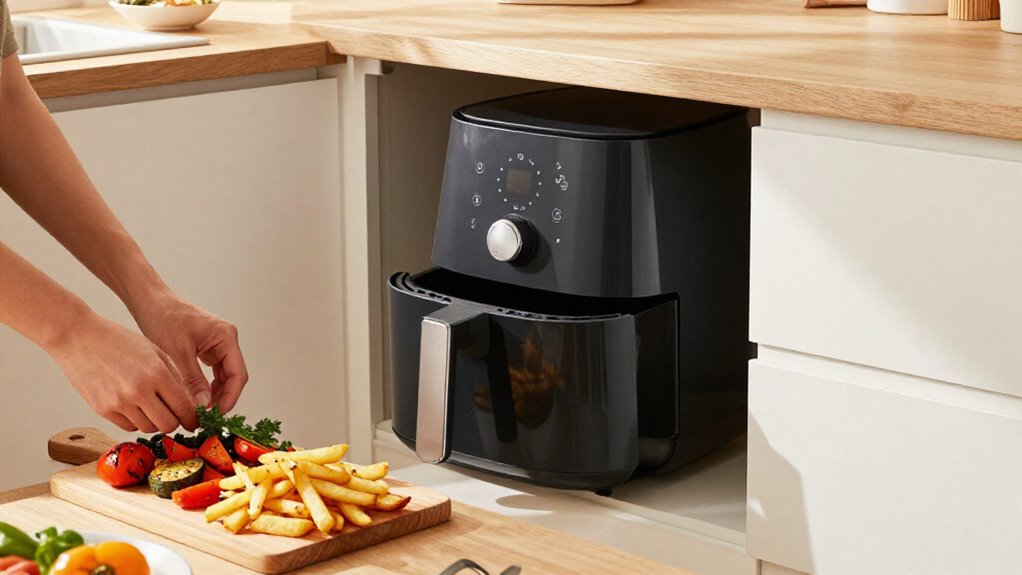
Choose an air fryer by matching capacity to your portions: a two-quart model suits one person, while four-person meals may need six- to eight-quart capacity.
Measure width, depth, and height, leaving two to four inches for ventilation and basket clearance. Favor a shallow, wide basket and clear controls.
Check wattage against your outlet and circuit, plus coating care and dishwasher-safe parts.
A fryer can keep meals crisp without crowding your kitchen. These checks help you choose.
Crispy Fries in Compact Baskets
For crisp fries, choose a compact air fryer with a low, wide, square basket that gives food room to brown. Its cooking surface helps you spread fries out, while a deep, narrow basket can crowd them and restrict airflow. Keep fries in one uncrowded layer whenever possible; don’t fill every inch just to use the basket.
In testing, a 2-quart Instant Pot Vortex Mini cooked half a pound of frozen fries evenly and crisply in 14 minutes. A test used 400°F for 15 minutes, with one shake at the seven-minute mark. If your basket is small, reduce the batch: testers cooked six ounces in the COSORI 2.1-quart and under four ounces in the Nostalgia 1-quart. A smaller load can crisp better than a packed basket.
Plan Weeknight Meal Portions
Plan portions around about 1 quart of air-fryer capacity per serving: a 2-quart model generally suits one person, while a 4-quart basket gives you room for larger portions.
For one or two people, a compact 2–3-quart fryer can cover weeknight meals without asking you to store more capacity than you need. The 2-quart Instant Pot Vortex Mini, for example, cooks about two servings at a time.
If you regularly feed four or more, step up to a 6–8-quart model or consider dual baskets so you can prepare full-meal portions more easily. Match the basket to what you cook: a wide, shallow shape suits fries and wings, while an overcrowded load blocks airflow. Leave space around food for even browning and crisping; cook in batches when necessary rather than filling the basket to its limit. Think about your usual serving count, not occasional guests, and check stated batch sizes before choosing a model carefully.
Basket Footprint and Counter Clearance
On a crowded counter, a basket-style air fryer’s vertical shape can save space: compact models may be just 8 inches wide, while 3.5–5-quart units typically measure about 10–13 inches across. Before you buy, measure the appliance’s width, depth, and height, then add 2–4 inches around it for ventilation. Keep rear exhaust away from walls, and don’t run a tall unit beneath low cabinets. Check the basket’s pull-out path so its handle won’t hit a backsplash or block a drawer.
| Measure | What to check |
|---|---|
| Width and depth | Clear counter area |
| Height and clearance | Cabinet space |
Compare internal basket dimensions and usable capacity with your portions; leave room to shake food. If you’ll stow it, check cabinet fit and let it cool before storage.
Glass-Bowl Versus Basket Air Fryers
Glass-bowl models can double as storage containers, while removable-basket fryers often take up less room and offer more cooking modes. Compare bowl or basket shape, since crowded food may cook less evenly. For a small kitchen, weigh countertop fit and cleanup against capacity, coating preferences, and price.
Design And Footprint
How much counter space can you spare? A compact basket model can make every inch count. Square baskets use space efficiently and offer a broad cooking surface, so you can arrange food without crowding. The 2-quart Instant Pot Vortex Mini measures 11.26 × 9.02 × 11.73 inches; its shallow, wide basket also keeps food close to the heat source.
At 13 × 13 × 8 inches, the 2.6-quart Cuisinart AIR-80 has a square basket and a viewing window, letting you check inside without opening it.
A glass-bowl design may suit you if flexible storage matters more. The Ninja Crispi’s 4-quart and 1.5-quart bowls double as storage containers with leak-proof lids. They’re dishwasher-safe and avoid nonstick coatings, though you must hand-clean the power pod.
Cooking Performance
For crisp, even results, look for a low, wide basket that lets food spread out without crowding. Square baskets make especially good use of the cooking area, helping fries and wings brown evenly. In tests, the 2-quart Instant Pot Vortex Mini cooked fries in 14 minutes and browned wings in 30; its shallow basket kept food close to the heat. The 2.6-quart Cuisinart AIR-80 also made crisp fries and golden wings, though it took a couple of minutes longer.
Glass-bowl models offer a different trade-off. The Ninja Crispi’s 4- and 1.5-quart bowls cooked quickly, and their design avoids a nonstick coating. For more interior room, an air-fryer toaster oven can deliver even browning, but it may cook slower. Choose the format that fits your usual portions and available counter space.
Cleaning And Maintenance
Cleaning is simpler when removable parts go in the dishwasher, but check the manual first, compatibility varies by model. Basket air fryers often let you remove the basket and crisping plate for dishwasher cleaning. To protect nonstick surfaces, hand-wash them with dish soap, warm water, and a gentle sponge instead; skip abrasive scrubbers.
Glass-bowl models offer a different advantage: the bowl avoids Teflon and other nonstick coatings, and on the Ninja Crispi it’s dishwasher-safe. Don’t put its power pod in the dishwasher.
Whichever style you choose, unplug the fryer and let it cool before cleaning. Wipe the exterior and controls with a damp cloth, keeping water away from electrical parts. Dry removable pieces before storing them, so moisture doesn’t linger in a cabinet or drawer.
Best Fit For Small Kitchens
When counter space is tight, a compact basket fryer is often the simplest fit: the 2-quart Instant Pot Vortex Mini measures about 11 × 9 × 12 inches and handles roughly two servings.
Check the basket’s shape, not just its capacity: a short, wide square basket gives food more room than a tall, narrow one, helping you avoid crowding. It’s the lower-cost, easier-to-store choice if air frying is your main goal. A glass-bowl design may suit you better if you value serving and storage in one vessel.
Ninja Crispi comes with 4-quart and 1.5-quart glass bowls and leak-proof snap-on lids; the bowls have no Teflon or other nonstick coating. At about $180, though, it costs far more than the $50 Beautiful 3-quart basket model. Need versatility? The 13-quart Our Place Wonder Oven adds toaster-oven functions in a compact, nearly cube-shaped footprint, but takes more room than a solo basket fryer.
Easy-to-Read Controls
Look for clear button labels and a readable display so you can set the temperature and timer at a glance. Simple presets and intuitive controls make cooking easier, especially if you’ll use only a few functions. In a small kitchen, straightforward controls help you operate the fryer without taking up time or counter space.
Clear Button Labels
Choose an air fryer with clearly labeled digital buttons and a display so you can set the time and temperature without guesswork. Look for separate, readable labels for air fry, roast, bake, and reheat, rather than tiny icons you must memorize. A straightforward panel helps you operate the appliance in a dorm or crowded kitchen, where you may have room to pause and decipher controls.
Check that the display is easy to read and that buttons are spaced well enough to press accurately. A flip reminder can prompt you to turn or shake food mid-cook, so you don’t need to keep checking the clock. Clear markings reduce errors and make use less frustrating; they matter more than a panel packed with unfamiliar symbols.
Simple Preset Options
Simple presets keep everyday cooking straightforward without adding menu clutter. In a compact kitchen, you may want an air fryer to handle familiar tasks without taking up room with extra functions you rarely use. Look for dedicated air fry, roast, reheat, and bake settings; these cover common meals and make it easier to choose a suitable starting point. Clearly labeled digital controls can also feel more intuitive than fully analog controls, according to testers.
A flip reminder is a useful practical extra. It prompts you to shake the basket or turn food partway through cooking, helping you stay on track when counter space is tight and you’re juggling other tasks. For example, the 2-quart Instant Pot Vortex Mini offers four cooking settings, an adjustment knob, and a digital panel. Before buying, check that its buttons are easy to operate.
Readable Display
Readable Display
A clear digital display makes an air fryer easier to use, especially when counter space is tight. Choose a panel with readable labels and temperature and timer settings, so you can check at a glance. Test whether the screen stays visible from your prep spot; a fryer tucked beneath a cabinet or beside other appliances shouldn’t force you to lean around it.
Clear labeling helps you identify functions such as air fry, roast, bake, and reheat without reaching for the manual. Look for a flip reminder or cooking alert, which can keep you on schedule without requiring screen-watching. The Cuisinart AIR-80 displays temperatures up to 400°F and supports a timer of up to 60 minutes. In a compact kitchen, visibility matters as much as the fryer’s footprint.
Intuitive Controls
Easy-to-read controls make an air fryer quicker to use when counter space is limited. Choose clearly labeled digital buttons or a simple digital panel with an adjustment knob; tests found these easier to use than analog controls.
On a compact model such as the 2-quart Instant Pot Vortex Mini, a straightforward layout helps you set time and temperature without occupying workspace or adding a learning curve. Check that cooking modes—air fry, roast, bake, and reheat—are clearly marked, so you can select the right function at a glance. A display window and interior light, found on the Cuisinart AIR-80, let you monitor food without pulling out the basket and releasing heat. Flip reminders and audible alerts tell you when to shake or turn food, so you don’t need to hover.
Verify Outlet and Circuit
Before choosing a compact air fryer, check its wattage against your outlet and circuit capacity.
A 1,550-watt model such as the Ninja AF101 draws about 13 amps at 120 volts; the 1,300-watt Instant Pot Vortex Mini draws less. Check the breaker rating and manual’s electrical requirements before you buy. A shared kitchen circuit may trip if you’re also running other high-power appliances. Don’t assume a compact footprint means a light electrical load.
Plug the fryer directly into a properly grounded wall outlet, not an extension cord or power strip unless the manufacturer explicitly permits it. In a tight kitchen, check that the cord reaches without stretching, crossing a walkway, or getting pinched behind the unit. Choose a counter spot near a suitable outlet nearby.
Warranty and Replacement Parts
Once you’ve checked the outlet, compare warranty coverage and parts availability.
A warranty can protect your budget if a compact fryer needs repair, but terms differ by model. The Cuisinart AIR-80 lists a three-year warranty; the supplied details don’t state coverage for other models, so check the manufacturer’s current terms before buying. Note what the warranty covers, how long it lasts, and whether you must pay shipping or service costs.
Also confirm you can buy replacement baskets, crisping plates, and other removable parts for your exact model. These components aren’t universal: match the model number and verify each part fits securely before ordering. Keep your receipt and model information together so you can confirm eligibility and find the right replacement without storing unnecessary spares. Review care instructions, too; improper cleaning or use may affect coverage.
Check for Fragile Basket Coatings
If your air fryer has a nonstick basket, gentle care can help prevent scratches and wear. Before you buy, check the manufacturer’s care instructions and consider how easily the coating could be damaged during everyday use.
- Wash the basket by hand with dish soap and a soft sponge; skip abrasive pads that can wear the finish.
- Reach for silicone tongs or spatulas, not metal utensils, to avoid scratching the surface while cooking.
- A silicone liner or parchment sheet can shield the basket and simplify cleanup, especially in a compact kitchen.
- Handle the basket gently when loading and removing food; chips or scratches may shorten the coating’s useful life.
If damage appears, consult the maker’s guidance before continuing to use the basket. Keep tools gentle.
Dishwasher-Safe Removable Components
Gentle handling protects a coated basket, and dishwasher-safe removable parts can make cleanup easier in a small kitchen. Before you buy, check which components can go in the dishwasher; rules vary by model and part. A compact fryer’s easy-clean pieces also spare you from keeping extra brushes or soaking tubs nearby.
- Read the manual or product label before loading any part.
- The Beautiful by Drew Barrymore’s basket and tray are dishwasher-safe.
- Ninja Crispi’s glass bowls are dishwasher-safe, but its power pod isn’t.
- If parts aren’t dishwasher-safe, unplug the fryer, let it cool, then wash them with dish soap and a sponge.
Wipe the exterior and controls with a damp cloth, keeping water away from heating elements and electrical parts. Let every component dry fully before storing it to avoid trapped moisture in a cabinet. Choose nesting parts to save valuable cabinet space.
Conclusion
Before you buy, measure your counter space, overhead clearance, and the room you’ll need to open the fryer’s basket safely. Choose capacity around the portions you actually cook, then compare basket and glass-bowl designs for footprint and cleanup.
Make sure the controls are easy to read, your outlet and circuit can handle the appliance, and replacement parts are available. Check warranty terms and coating durability, too. A compact fryer should fit your kitchen and work.