Air Fryer Size Chart: Matching Quart Capacity to Your Household Size
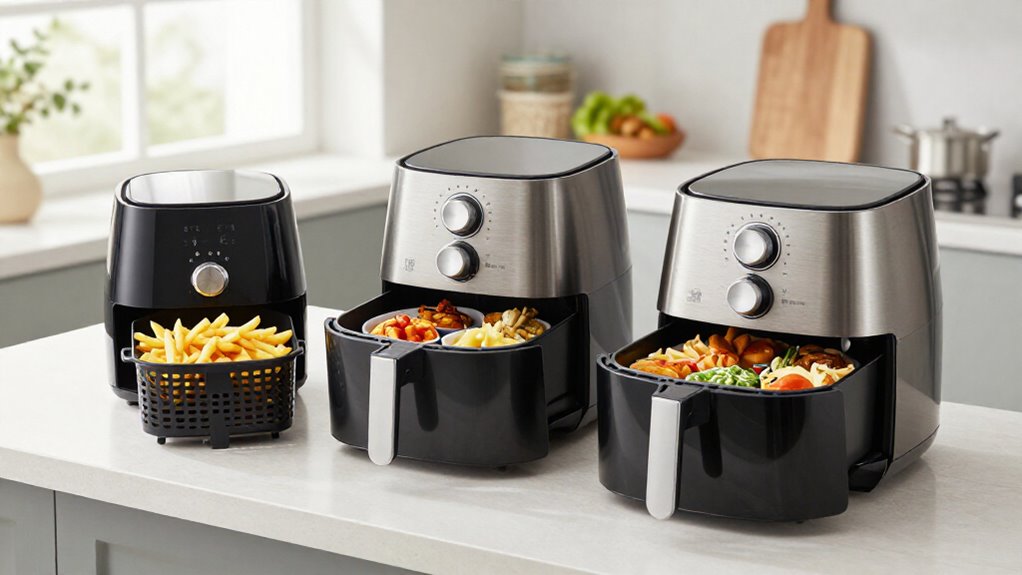
For one person, choose 2–3 qt; for two, start with 3–4 qt. Households of three to four need 5–6 qt, while 6–8 qt gives you room for meal prep and fewer batches.
For five to six, consider 6–10 qt; for seven or more, choose 8–10+ qt or multiple fryers. Capacity is only a guide: check basket floor area, leave space around food, and match the size to your habits. More fit and cooking tips follow.
Quick Household Size Lookup
Use household size as a starting point: choose 2–3 qt for one person, 3–4 qt for two, and 5–6 qt for three or four. For five or six people, consider a 6–8 qt model; for seven or more, choose 8–10+ qt or run multiple fryers.
These ranges help narrow your search, but they can’t guarantee every meal will fit. If you often cook larger portions or want fewer batches, lean toward the upper end. If you mainly make snacks, single servings, or reheated food, a smaller option may suit you.
Check usable basket or tray dimensions before buying; quoted capacity doesn’t show how food will sit. Make sure the unit fits your counter and storage space. Choose one that handles portions, with room for extras.
Capacity-by-Household Chart
The chart below matches air-fryer capacity to typical household needs and practical food loads. Use it as a starting point, then adjust for your cooking habits and available counter space.
| Capacity | Household and practical load |
|---|---|
| 1-2 qt | One person; snacks or 1-2 tenders. Meals need batches. |
| 2-4 qt | One person, occasionally two; small sides or two small breasts in one layer. |
| 4-6 qt | Two to four people; mains for two, sides for three to four. A 6-quart basket may fit a 4-pound chicken. |
| 6-8 qt | Three to five people; mains for three to four with less crowding. |
| 8-10 qt | Four to six people; larger batches. Dual baskets cook two dishes independently. |
Check usable basket or tray area, not just stated volume: crowded food browns less evenly. If you cook for guests or meal-prep often, consider more room; larger models take more counter space.
Quarts Versus Litres
Air-fryer capacity is usually listed in quarts in the US and litres elsewhere. One US quart equals about 0.946 litres, so you can treat the units as nearly interchangeable for a quick comparison. For example, a 6-quart model holds approximately 5.68 litres.
UK and European ratings generally correspond almost one-to-one with US quart figures, but don’t assume matching labels guarantee identical capacity: manufacturers often round their numbers, and measurement methods may differ. When comparing models, check the stated capacity and the manufacturer’s product details rather than relying on a unit conversion alone. Capacity refers to the basket’s volume, including space above the food, not just the volume occupied by ingredients. Use the rating as a guide, not a measure of usable cooking capacity.
Basket Floor Area and Food Spacing
When you compare air fryers, check usable basket floor area, not just quart capacity, since a larger volume doesn’t always mean more cooking space. Match the surface area and basket shape to your portions, and arrange delicate foods in a single layer with gaps for airflow. You can layer fries, wings, or vegetables partway up, but shake them every 4–5 minutes.
Usable Basket Floor Area
How much food fits in one layer often matters more than an air fryer’s advertised quart capacity, so check the basket’s floor area as well as its volume.
Then compare usable dimensions, not just the product label: a 3.5–4.5-quart basket typically offers about 60–75 square inches, while a 5.5–6.5-quart basket offers roughly 85–100. A square basket may give you 20%–25% more floor area than a round basket with equal volume.
Leave about ½ inch between meat pieces and don’t crowd the basket; gaps let hot air circulate and help food crisp evenly. For delicate proteins, arrange pieces in one layer. You can layer fries, wings, or vegetables partway up, but shake them every 4–5 minutes to expose more surfaces to the circulating hot air.
Quart Capacity Versus Surface Area
Quart capacity tells you a basket’s volume, including the space above the food, but not how much can spread across its floor. Compare basket floor dimensions before you choose: a 5.5-quart round basket with an 8-inch diameter offers about 50 square inches, while a 9.25-by-9.25-inch square basket provides about 85. At equal volume, square baskets can offer roughly 20%-25% more floor area than round ones, so shape may matter as much as the quart label.
As a rough guide, 5.5-6.5-quart baskets typically provide 85-100 square inches; 7-8.5-quart models offer about 110-130. That extra area gives you more room to arrange portions without stacking them, supporting airflow and crisping. Check actual dimensions because quoted capacity alone can’t predict the usable cooking surface in your model.
Single-Layer Food Spacing
For single-layer cooking, basket floor area matters more than total capacity because it determines how much food you can spread out for airflow. A 3.5–4.5-quart basket usually offers 60–75 square inches, while a 5.5–6.5-quart model provides about 85–100.
Before buying, compare the basket’s usable floor area with the portions you cook; quart ratings also count empty space above the food. When cooking, arrange pieces in one layer and leave about half an inch between meat portions. This gap helps hot air circulate, so food browns more evenly; overcrowding can slow cooking and soften crisp edges.
Delicate proteins need that single layer. Fries, wings, and vegetables can sit partly layered, but shake them every four to five minutes to expose surfaces for browning.
Basket Shape and Layout
Beyond basket capacity, shape and floor area determine how much food you can spread out for even airflow. A quart rating measures internal volume, including space above the food, so it won’t tell you how much cooking surface you have. Compare the basket’s dimensions, not just its capacity.
At equal capacity, a square basket can provide about 20% to 25% more usable floor area than a round one. As a rough guide, 5.5–6.5-quart baskets offer about 85–100 square inches of floor area; 7–8.5-quart baskets offer roughly 110–130. Spread food in one layer when possible, with gaps between pieces for circulating air. For meat cuts, leave about ½ inch between pieces, and don’t fill the basket beyond roughly 70% of its depth. Check dimensions before you buy.
Matching Area to Portions
Basket floor area often tells you more than quart capacity, which includes the empty space above the food.
For a useful comparison, check the basket’s flat cooking surface, not just its listed volume. A 5.5–6.5-quart basket typically offers 85–100 square inches, enough for about four chicken breasts or 2.5 pounds of wings. Square baskets may give you 20%–25% more usable area than round baskets with equal capacity.
Arrange food in a single layer when you can, leaving gaps so hot air circulates and browns each piece evenly. Delicate proteins need this spacing; crowding can soften their surfaces.
You can layer fries, wings, or vegetables partway up, but shake the basket every 4–5 minutes to expose pieces to moving air. Check dimensions before buying.
Meal-Prep Capacity Adjustments
Regular meal prep calls for more capacity than the usual household-size guide suggests: a family of three or four may prefer a 6–8-quart fryer instead of a 5–6-quart model to cut down on batches. A 6–8-quart basket can hold about 4–5 pounds of fries or 30–40 wings, giving you room to prepare several portions at once. For a complete meal for four in one cycle, target roughly 5.5–6 quarts and 85–100 square inches of basket floor area.
Don’t fill that surface edge to edge: leave space around food so hot air can circulate; crowded ingredients may cook unevenly and force another batch. Compare basket dimensions, not just stated quart capacity, because usable layouts differ. Plan portions around the basket’s usable floor, and reserve larger loads for foods that fit without stacking or overlap when you prep ahead.
Two-Basket Timing Differences
Meal prep isn’t the only way a dual-basket fryer can save time: you can cook foods at different temperatures and durations in separate zones. Each basket can match its food: set one for vegetables and another for a protein that needs time. If your model has a sync-finish function, start the longer-cooking item first; the fryer will coordinate the cycles so both baskets finish together.
Without that feature, track each timer. Remove the earlier-cooked food or keep it warm while the other basket continues. Don’t assume two zones cook like one large basket: in an eight-quart model, each four-quart zone is narrower. Avoid overcrowding, arrange food in a single layer where possible, and shake or turn pieces to help both baskets crisp evenly.
Cooking Whole Chickens
A 6-quart air fryer or larger is usually the best choice for roasting a whole chicken, since it leaves room for hot air to circulate. Still, you may fit a small bird in a smaller basket: many 5.8-quart models hold a 3- to 3.5-pound chicken when you position it carefully. A 5.5- to 6.5-quart basket may suit a 4.5- to 5.5-pound bird, but the chicken’s shape and the basket’s floor area affect the fit.
Check the manufacturer’s capacity guidance, then measure the bird if you’re unsure. During cooking, use a meat thermometer to confirm that the thickest part reaches 165°F. Choose an 8-quart model if you want more room for a larger chicken or plan to cook vegetables alongside it. This size also works well when you’re preparing meals for several people.
Avoiding Overfilled Baskets
For even cooking, arrange delicate proteins in a single layer with space between pieces, and leave about ½ inch between meat cuts. Keep the basket below about 70% of its depth; crowding blocks airflow, leaving food limp instead of crisp. For fries, wings, and vegetables, you can layer food halfway up, but shake the basket vigorously every 4–5 minutes.
- Cook in batches rather than forcing in a larger portion; you’ll protect airflow and get reliably crisp results.
- Leave perforations uncovered; foil mustn’t block hot air from moving through holes.
- Give each piece room, so dinner feels worth the wait, not soggy or uneven.
When your portion won’t fit with gaps, a larger-quart model or another batch is a better choice than packing food tightly.
Dishwasher-Fit Basket Dimensions
Before choosing a large air fryer, check whether its basket will fit your dishwasher: an 8-quart model can take up much of the lower rack.
Basket dimensions matter more than capacity alone. Measure its length, width, and height, then compare them with your dishwasher rack’s usable space. A square basket may give you more cooking floor than a round basket of equal capacity, but its wider footprint can make loading awkward.
Before buying, check:
- Whether the basket is dishwasher-safe; the label doesn’t mean it’ll fit.
- Whether the crisper plate is also dishwasher-safe and fits beside the basket.
- Whether you’re willing to hand-wash parts if they don’t fit.
You can clean removable parts with warm, soapy water and a nonabrasive sponge before you buy.
Conclusion
Choose an air fryer by matching its quart capacity to the portions you cook, then check basket floor area and dimensions. A larger household or meal-prep routine may need extra capacity, while two-basket models can help you cook foods on different schedules. Don’t rely on quarts alone: leave room for food to crisp, and confirm the basket fits your dishwasher if that matters to you. With these checks, you can pick a size that suits your kitchen and everyday meals.