Small vs Large Air Fryer: A Side-by-Side Capacity Comparison for Real Kitchens
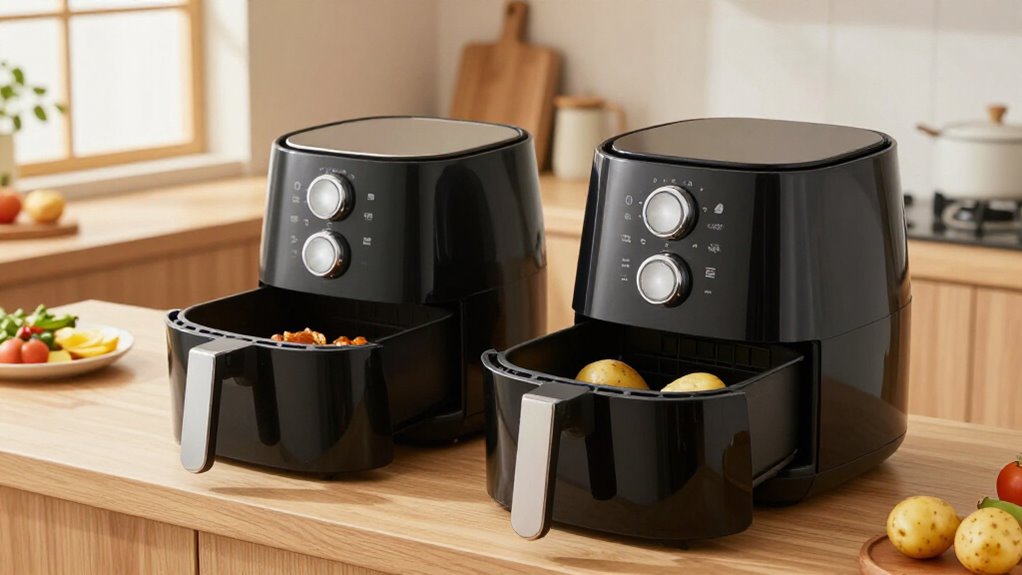
A small air fryer saves counter space and suits snacks, sides, and single portions, but you may need several batches.
A large fryer gives you more flat cooking area for family portions, leftovers, and fewer rounds, though it takes more room.
Don’t judge by quart rating alone: compare basket width, usable shape, and clearance.
For whole chickens, measure the bird against the interior. Compare habits and kitchen setup to see which size fits your routine.
Basket Footprint and Counter Space
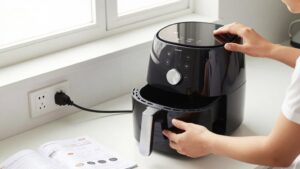
A small basket air fryer, typically 2–4 quarts, uses a narrow, vertical footprint of about 8–10 inches across, making it easier to fit on a cramped counter or store away.
| Size | Typical width | Counter-space trade-off |
|---|---|---|
| Small | 8–10 in | Fits narrow counters |
| Medium | 10–12 in | Needs clear access |
| Large/dual | 14–15+ in | Uses more counter width |
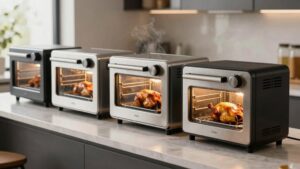
| Oven-style | About 21 in | Often replaces toaster ovens |
You’ll need 2–4 inches of clearance behind and above basket models for ventilation; don’t push yours against a wall or cabinet. A large unit may cook more in one cycle, but its wider footprint can crowd your prep area and usually merits a permanent counter spot.
A small model is lighter and easier to move or store, so you can reclaim space after cooking. Measure clearance before placing it near cabinets first.
Basket Shape and Usable Area
Capacity tells you how much an air fryer holds, but basket shape determines how much food you can spread out in one layer.
Quart ratings measure internal volume, not flat cooking area, so two same-capacity baskets may hold different amounts in a single layer. A wide, square or rectangular basket gives cutlets, fish fillets, burgers, and vegetables more room to lie flat than a deep, narrow one. Extra depth increases volume, but not usable floor space; piling food can restrict airflow and reduce even cooking. Round baskets may leave unused space around rectangular foods. Compare usable diameter, basket dimensions, and crisper-plate shape rather than trusting product photos or quart ratings alone when comparing basket designs. Fries, wings, and small vegetables tolerate some overlap when you shake or turn them. For foods that need to stay flat, choose more width, even if that means cooking in fewer layers.
Batch Size and Leftovers
Basket shape affects how food fits in one layer; batch size determines how many rounds you’ll need. For a solo meal, a 2–4-quart model handles snacks, sides, and reheating, but you may cook a full dinner in several rounds. At 5–6.5 quarts, you can prepare a substantial component for four, though a complete meal may still need separate batches.
- A 7–9-quart single basket gives you room for larger batches and meal prep.
- Its open space can keep foods in one layer.
- An 8-quart dual basket cooks two foods at once, often in separate 4-quart zones.
- You can’t combine those zones into one large 8-quart batch.
- Set your acceptable weeknight batch count first; choose extra capacity if you often host or want leftovers.
Plan accordingly.
Preheating and Cleanup
Although a small air fryer may preheat quickly, wattage affects how well it recovers heat once you add food. A 2-quart Dash Compact, for example, reached temperature in 2.5 minutes, but its 1,000-watt heater recovered slowly after food went in. Increasing the heater to 1,300 watts shortened preheating by only 13 seconds yet cut recovery by 50 seconds.
A test prototype shows why airflow and power matter: at 3,300 RPM and 1,000 watts, it took over five minutes to preheat and failed to return to 400°F within ten minutes after loading. For cleanup, don’t assume size determines effort: removable nonstick baskets simplify washing, while silicone liners or parchment can protect the coating and reduce mess. Check care instructions for your specific model before choosing.
Accessory Fit and Clearance
Before choosing a larger model, measure its body and handle, check how far the basket or drawer extends, and confirm it fits your storage space. A compact fryer usually needs less clearance, while a large or oven-style unit may demand more counter space and careful placement.
- Check cabinet height and leave the manufacturer’s required side and rear ventilation space; some models need five inches on all sides.
- Match racks and trays to the actual basket or cavity, not its advertised capacity.
- Make sure layered racks leave room for food and airflow; extra height doesn’t guarantee more usable area.
- For modular glass models, confirm each accessory fits and works with your chosen mode.
- Before using a rotisserie, check the food’s weight and balance, plus clearance inside the bowl.
These checks help you compare usable capacity, not just dimensions.
Energy Use and Cooking Time
Capacity affects more than how much food fits; it can also change cooking time and energy use. For a typical small batch, you’ll often use less total energy with a compact fryer than with a large model. But wattage and airflow matter as much as capacity: a tested 1,000-watt, 2-quart Dash took 28:53 to cook fries, while a 1,300-watt version took 23:52. Adding higher airflow cut that time to 22:14.
Across tested fryers, times ranged from under 16 minutes to 29. You’ll get faster cooking from a larger fan, but it works best when the heater supplies enough power; airflow alone may not restore heat quickly. For family-size meals, a large fryer may save energy by cooking everything in one cycle instead of several small batches.
Power Outlet Compatibility
Check an air fryer’s voltage, frequency, and wattage against your outlet and the appliance label before buying. A compact unit may draw less, but size doesn’t predict demand: the 8-quart Ninja Foodi DZ201 is rated at 1,690 watts, while the Breville Smart Oven Air uses 1,800 watts.
- A 2-quart Dash Compact is rated at 1,000 watts; the 7.3-quart Philips Premium XXL reaches 2,225 watts.
- At the same voltage, higher wattage means greater current draw, so check your circuit’s available capacity.
- Consider what else shares the circuit, particularly other high-power appliances running at the same time.
- Plug the fryer into a properly grounded outlet and follow its manual’s electrical instructions.
- Don’t use an extension cord or power strip unless the manufacturer explicitly permits it for safety.
Cost and Replacement Parts
Small air fryers usually cost less upfront, while larger models may offer more capacity but require a higher initial investment. Compare that price with the cost of extra batches or a second appliance, and check replacement-part prices and availability for the exact model. Before buying, confirm whether baskets, crisper plates, racks, and trays are sold separately and covered by the warranty.
Upfront Price Difference
What you pay upfront depends on more than capacity: small air fryers generally cost less, while larger models tend to have higher purchase prices. Compare similarly equipped models to distinguish capacity premiums from feature or build-quality differences. A compact unit may suit occasional solo cooking; a larger one may be worth its higher price if you often prepare family meals or need multiple functions.
Check whether the added capacity serves your routine, rather than paying for space you rarely use.
- Compare similarly equipped models, including controls and accessories.
- Check the complete appliance price, not capacity alone.
- Account for delivery charges and required add-ons.
- Review warranty coverage and return terms before buying.
- Pay more only for features you’ll regularly use in your kitchen.
Replacement Part Costs
Replacement-part costs vary by model, and capacity alone won’t tell you whether a basket, crisper plate, tray, or rack will be affordable or easy to find. Before choosing a small or large fryer, check the manufacturer’s parts list for your model number. Confirm each item is sold separately and matches your appliance’s basket size; parts from another capacity may not fit, even within one product line.
Compare prices for the parts you need, then add shipping and return fees. A low-cost small fryer may be less practical if its basket is unavailable, while a larger model’s tray or rack could cost more or be harder to source. Check warranty coverage and availability before buying. You’ll compare ownership costs more fairly than purchase price alone.
Best Size for Whole Chickens
For a whole chicken, you’ll generally need at least a 5–7-quart air fryer, while a 3–4-quart model usually suits pieces instead. Before buying, measure your chicken and compare its length, width, and height with the basket’s usable space. A 7–9-quart single basket offers more room than divided dual baskets, but check rotisserie limits and clearance if you want the bird to rotate.
Minimum Capacity Needed
If you want to cook a whole chicken, start with a large single-basket air fryer, typically 5–7 quarts. This is a starting point, not a guarantee: usable capacity varies by design, and a large label alone won’t confirm a bird fits. Small 3–4-quart models suit compact portions, but generally lack room for whole poultry. Compare options this way:
- Choose 5–7 quarts as your practical minimum starting range.
- Prefer a single basket over divided drawers for one whole bird.
- Treat stated capacity as nominal, not usable cooking space.
- Check the maker’s food and weight limits before buying.
- Consider rotisserie models only if your chicken meets their limits.
A larger oven-style unit may offer more room, but it costs counter space and may take longer to heat.
Measure Chicken Dimensions
A whole chicken’s fit depends on its dimensions, not just the fryer’s quart rating. Measure the bird’s length, width, and height, including its legs and wings, then compare each measurement with the basket’s usable interior space. Leave clearance around the chicken so air can circulate; a snug fit can block airflow or put the bird against the sides.
A 2–4-quart fryer generally suits small portions, while a 5–7-quart model may hold a whole chicken, depending on its shape and basket layout. For rotisserie cooking, check the stated food-weight limit, balance requirements, and clearance from the bowl and heating element. If your chicken touches the sides or obstructs airflow, choose a larger usable cooking area, not simply a deeper basket before you buy.
Small vs Large Models
Choosing between small and large air fryers depends on whether you need room for a whole chicken. A 3–4-quart model works well for meals for one or two, but its limited usable space generally rules out a whole bird. A 5–7-quart model may fit one, particularly with rotisserie, though capacity alone doesn’t guarantee a suitable shape.
- Check the chicken’s length, width, and height against the basket or chamber.
- Confirm clearance around the bird so air can circulate.
- Review the appliance’s stated food-weight limit before buying.
- Treat a 6-quart rating as a guide, not proof of fit.
- Consider 8–26-quart oven-style models, but verify rack or rotisserie dimensions and usable clearance.
If you’ll cook whole chickens often, compare interior measurements first; otherwise, a compact unit may better suit your counter and portions.
Best for Frozen Snacks
For individual portions of frozen fries or nuggets, a 2–4-quart air fryer is compact and practical; a 5–6.5-quart basket gives larger batches more room to crisp with less overlap. If you’ve got limited counter space and usually cook snacks for one, choose the smaller model. For family portions, the larger basket lets you spread food across more of its base, supporting more even crisping without splitting the batch.
Capacity alone doesn’t tell you how much usable cooking area you’ll get. Compare basket width and flat surface, especially for snacks that crisp best in a single layer. Fries can tolerate some overlap, but a deep pile may cook unevenly; shake or turn them during cooking. In RTINGS.com testing, fries reached a 45% moisture-loss target in under 16 minutes in the fastest fryer, versus 29 minutes in the slowest.
Conclusion
Choose your air fryer by measuring the space you have and the food you cook most. A small model frees counter space, heats, and handles snacks or portions, but you’ll need extra batches. A large model fits whole chickens and loads, yet takes more room and can cost more to replace or accessorize. Check basket shape, outlet needs, and accessory clearance before buying. If you cook for a crowd, capacity can justify the trade-off.