Quarts vs Liters: Air Fryer Capacity Terms Decoded in Plain English
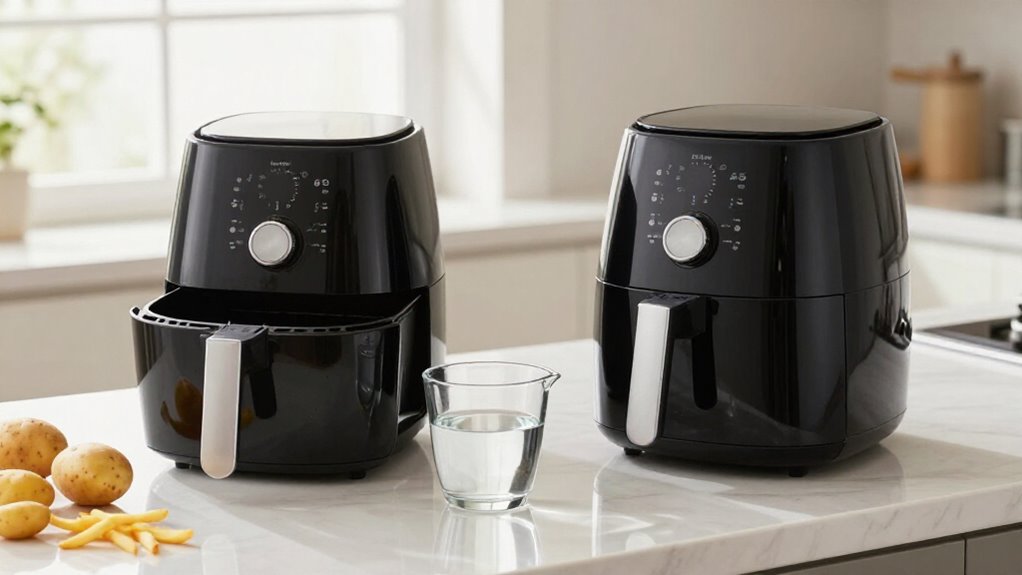
Most air-fryer “qt” labels mean US liquid quarts: multiply by 0.946 for liters, or by 1.057 to convert back. A 5-quart basket holds about 4.7 liters, but dry and imperial quarts differ.
Capacity describes volume, not usable cooking space; basket shape affects how much fits in one layer, while exterior dimensions show whether it fits your counter.
Don’t crowd food; leave room for hot air to circulate. You’ll find more useful comparison tips ahead.
Quart-to-Liter Conversions
To compare air fryer sizes, convert both labels to the same unit: multiply US quarts by 0.946 to get liters, or liters by 1.057 to get US quarts. For example, a 4-quart label converts to about 3.8 liters (4 × 0.946), while a 4-liter label converts to about 4.2 US quarts (4 × 1.057). Therefore, the two products aren’t identical in stated volume: the 4-liter model holds slightly more than the 4-quart model.
Use one unit when you compare listings, since US retailers commonly use quarts and many other markets use liters. If a manufacturer lists both units, treat the figures as rounded equivalents rather than exact measurements. These factors work for US liquid quarts; don’t assume another kind of quart uses the same conversion.
Basket Capacity vs. Exterior Size
Although they’re both called “size,” basket capacity and exterior dimensions tell you different things: capacity indicates how much food the fryer can hold, while its footprint shows how much counter and storage space it needs.
| Spec | What it tells you |
|---|---|
| Basket capacity | Batch size; check basket shape and room to spread food for airflow. |
| Exterior dimensions | Width, depth, and height; measure your counter, storage spot, and cabinet clearance. |
Don’t assume a larger quart or liter figure means a better fit or a larger useful batch. Some makers quote total chamber volume, not space food can occupy while airflow remains clear. Check basket shape and how food spreads; oven-style models depend on rack levels.
Measure width, depth, and height at your counter and storage spot, including cabinet clearance. A 4–5-quart basket may suit three or four people, but exterior dimensions decide whether it fits.
Fluid vs. Dry Quarts
A US fluid quart measures liquid volume, while a dry quart traditionally measures dry goods and holds more. Air fryer labels usually give approximate capacity, so check whether the maker specifies fluid quarts, dry quarts, or liters. For comparison, 4 US fluid quarts is about 3.8 liters; don’t apply that conversion to dry quarts.
Fluid Quart Definition
A US fluid quart equals one-quarter of a US gallon, or two US pints, and holds about 0.946 liters (roughly 0.95 L). When you compare air fryer capacities, treat “qt” as US fluid quarts unless the manufacturer specifies otherwise. This gives you a consistent basis for comparing models listed in quarts with those listed in liters.
To convert liters to US quarts, multiply the liter figure by about 1.0567; to convert quarts to liters, multiply by 0.946. For example, a 4-quart air fryer has a stated volume of about 3.8 liters. Fluid quarts measure liquid volume, while dry quarts traditionally measure dry goods such as grain. Because these are different units, check the product specifications if a listing doesn’t clarify which quart it uses.
Dry Quart Definition
When comparing air fryer capacities, distinguish a dry quart from the US liquid quart used on most US product labels. A US dry quart measures volume and equals one-quarter of a US dry gallon, or two dry pints. It holds about 1.101 liters, roughly 16% more than a US liquid quart.
By contrast, the US liquid quart equals exactly 0.946 liters. So if a product listing says only “quarts,” don’t assume it means dry quarts; in the United States, air-fryer capacity labels usually refer to liquid quarts.
You may also encounter the imperial quart in older British measurements. At about 1.137 liters, it differs from both US quart units. Check the product’s stated measurement system before relying on a quart figure, especially when a listing doesn’t specify “dry.”
Capacity Measurement Differences
US liquid and dry quarts measure different volumes: a liquid quart equals about 0.946 liters, while a dry quart holds about 1.101 liters, roughly 16% more.
That gap matters when you compare capacity figures: four liquid quarts equal about 3.79 liters, whereas four dry quarts equal about 4.40 liters. Don’t treat those numbers as interchangeable.
Air-fryer capacities stated in “qt” generally refer to US liquid quarts, but you should check the manufacturer’s specifications if the measurement type isn’t clear. For a comparison, use the model details and keep the units consistent. Listings may round conversions, so a displayed liter value can differ from a calculation. If you’re comparing appliances, convert each capacity using the correct quart type before deciding which one offers volume.
Air Fryer Labels Explained
What does “qt” mean on an air fryer label? It means quart, a unit of volume. On US models, the label generally refers to US liquid quarts. One US liquid quart equals about 0.946 liters, so a 4-quart air fryer holds roughly 3.8 liters by its stated capacity.
You may wonder whether the label means dry quarts. A dry quart is a separate unit, slightly larger than a US liquid quart, and it measures dry goods. Air fryer makers normally state the appliance’s internal volume, not a weight or measure of dry food, so don’t interpret the capacity as dry quarts.
That stated volume also doesn’t guarantee the same amount of food will fit in a single layer. If the label doesn’t specify units, check the product manual or specifications; rounding and measurement conventions can vary.
Liters Versus Quarts
To compare air fryer capacities accurately, distinguish liters from US liquid and dry quarts.
A US liquid quart holds about 0.946 liters, often rounded to 0.95 liter. A US dry quart is about 1.101 liters, so it holds more than a liquid quart. Air fryer labels generally use “qt” or “L” as capacity ratings; they don’t necessarily identify a dry quart. Check the manufacturer’s specifications before comparing models.
For comparison, four US liquid quarts equal about 3.8 liters, while four liters equal about 4.2 US liquid quarts. Convert both models to the same unit before you judge their capacities. Because manufacturers round figures, small differences between a model’s liter and quart listings may reflect conversion and rounding, not a real capacity difference.
Why Basket Shape Matters
After converting quarts and liters to the same unit, look beyond the number: a wide, shallow basket can offer more usable cooking area than a tall, narrow one with the same stated capacity. Air-fryer labels usually describe the basket’s total volume, not how much food you can spread across its floor in one layer. That difference matters when you cook fries, vegetables, or other foods that need room for hot air to circulate.
A deeper basket may hold plenty by volume, but its smaller footprint can force you to stack pieces. Crowding can block airflow and leave food unevenly cooked, so don’t choose by the quart or liter rating alone. Check the basket’s width, depth, and shape in product dimensions or photos. Also note that a dry quart measures dry ingredients and differs from a US liquid quart; it isn’t a useful substitute for judging an air fryer’s cooking area when comparing basket designs before you buy.
Avoiding Measurement Confusion
When comparing air fryers, don’t confuse US liquid and dry quarts: one liquid quart is about 0.95 liters, while a dry quart is about 1.10 liters. That difference can make two capacity figures look farther apart—or closer together—than they really are.
Most air fryer listings use quarts as a volume label, but they may not say whether they mean liquid or dry quarts. Don’t apply the dry-quart conversion by default. Check the manufacturer’s specifications, and convert using the stated unit when you can. If a listing doesn’t clarify, treat the number cautiously rather than assuming a precise equivalence.
Also remember that manufacturers may round capacity figures. A small difference between a quart label and a liter label may reflect rounding, not a meaningful difference in the stated volume.
Comparing Usable Capacity
A quart label can be misleading unless you know which quart it means: a US liquid quart is about 0.946 liters, so 4 liquid quarts equal roughly 3.8 liters, while a US dry quart is about 1.101 liters. These measures aren’t interchangeable, so check the label before comparing figures.
But conversion alone won’t tell you how much food you’ll cook at once. Air-fryer capacity usually means total internal volume, not usable cooking space. For crisp results, you often need a single layer and room for airflow, which limits the practical load. Compare basket dimensions and shape, not just the rating: two fryers with equal stated capacity can fit different amounts of food. Check photos or specs before you buy carefully.
Liters Versus Imperial Pints
An imperial pint is a UK volume unit equal to about 568 milliliters, so one liter holds roughly 1.76 pints. For example, 4 liters equals about 7 imperial pints, and 6 liters about 10.6. Check the unit system on a listing, since imperial pints differ from smaller US pints.
Imperial Pint Definition
Although air fryer capacities are rarely listed in pints, an imperial pint can help you compare volumes: it equals 20 imperial fluid ounces, or exactly 0.568 liters (about 568 milliliters). That’s a UK unit, and it’s not the same as a US liquid pint, which holds about 0.473 liters. The distinction matters when you read product information from different markets: the word “pint” alone doesn’t tell you which standard a seller means.
Air fryer makers usually state capacity in liters or quarts, so you’re unlikely to see pints on a model label. Still, knowing the imperial pint’s size gives you a familiar reference for volume. Remember, though, that a basket’s stated capacity describes its internal volume, not necessarily the amount of food you can arrange in one layer. Check the basket’s shape and usable cooking area before you choose, rather than treating any volume unit as a direct measure of meal size for meals.
Liters to Pints
When comparing an air fryer’s capacity in liters with a measurement in imperial pints, multiply liters by 1.76: a 4-liter model holds about 7 imperial pints, while 5 liters equals about 8.8 pints.
That factor works because an imperial pint contains 568 milliliters, while a liter contains 1,000. To convert in the other direction, divide imperial pints by 1.76. When you compare product listings, check that “pint” means imperial pint; the U.S. pint is smaller.
A liter equals about 2.11 U.S. pints, not 1.76. Mixing the standards can make an air fryer’s stated capacity seem larger or smaller than it is. If a listing doesn’t identify its pint standard, look for the metric capacity or manufacturer’s specifications before judging basket size. Check dimensions too, since volume alone doesn’t show usable cooking surface.
Capacity Conversion Examples
To compare air fryer capacities, convert each figure to the same unit: 4 liters is about 7 imperial pints, while 5 liters is about 8.8. You can use these figures to compare headline capacities. A 6-quart model holds about 5.7 liters, or roughly 10 imperial pints.
Conversely, one US liquid quart equals 0.946 liters, so a 4-quart fryer holds about 3.8 liters. Convert listed capacities before comparing models, then check basket dimensions and shape to judge whether the size suits your usual portions. The converted figure describes volume, not cooking area.
Always translate both products into imperial pints for direct comparison; rounded label figures won’t match perfectly. Treat each conversion as an estimate, not an exact measurement, when you compare models.
Why Units Differ
Liters are metric, while quarts and pints vary by measurement system, so check which system a product listing uses before comparing capacities. A US liquid quart holds two US pints, or about 0.946 liters, making one liter slightly larger than a US quart. But an imperial pint holds about 0.568 liters, compared with roughly 0.473 liters for a US pint.
That difference matters: a pint-based figure can describe noticeably different capacity depending on the system. When you compare air fryers sold in different countries, look for “US,” “imperial,” or a liters equivalent in the specifications. Retailers also round figures, so a 4-liter model and a 4-quart model are close in size, but they aren’t exact matches. Check basket dimensions too; capacity alone won’t show how much food fits.
Converting a 5-Quart Basket
A 5-US-quart air fryer basket holds about 4.7 liters, so it’s slightly smaller than a 5-liter model. For a quick comparison, remember that one US quart equals about 0.946 liters. The difference between these two advertised capacities is small, so you can treat the models as close in size when shopping.
That number describes basket volume, not exactly how much food you can cook at once. The basket’s shape and cooking space matter, too. If you’re choosing a 5-quart model for a household of three or four, it may suit your needs, depending on portions and the foods you prepare.
For even cooking and crisp results, arrange food in a single layer rather than relying on the full advertised capacity. Compare basket dimensions alongside the converted volume when weighing similar models.
Avoiding Overfilled Baskets
Although the advertised quart or liter capacity tells you the basket’s total volume, it doesn’t show how much food fits in one layer. To get crisp, even results, arrange food in a single layer whenever possible. Leave a little space between pieces so hot air can circulate around them.
If you pack the basket tightly, you can block airflow and end up with soggy spots or uneven cooking. Basket shape matters, too. Two air fryers with the same listed capacity may offer different amounts of usable cooking space; a wide basket may fit more pieces in one layer than a narrow, deep one. If your food won’t fit without piling it up, cook it in batches instead. Shake or turn the food during cooking when your recipe calls for it, helping it brown more evenly.
Check Manufacturer’s Capacity Label
Before comparing models, check whether the manufacturer lists capacity in quarts or liters; U.S. models commonly use quarts, while many other markets use liters. Then compare like with like: one U.S. quart equals about 0.95 liters, so a 4-quart model holds roughly 3.8 liters. Also check what the number describes: the basket, cooking chamber, or total internal volume. That figure may not show how much food you can cook in a single layer. If the unit or measurement isn’t clear, verify it in the manual or on the manufacturer’s official product page, not just a retailer’s shortened listing.
- Match units before comparing models across brands.
- Confirm which volume the label measures, not usable space.
- Check official specs when wording’s unclear for your exact model.
Conclusion
When comparing air fryers, convert quarts to liters with the right standard: one US liquid quart equals about 0.95 liters. Remember, capacity describes the basket, not the appliance’s exterior, and dry quarts measure differently. A 5-quart basket holds roughly 4.7 liters, but usable space is smaller when food needs room to crisp.
Don’t overfill it; cook in batches if needed. Check the manufacturer’s label and manual so you know exactly what the stated capacity means.