Convection Combo vs Toaster Oven Combo: The Air Fryer Hybrid Showdown
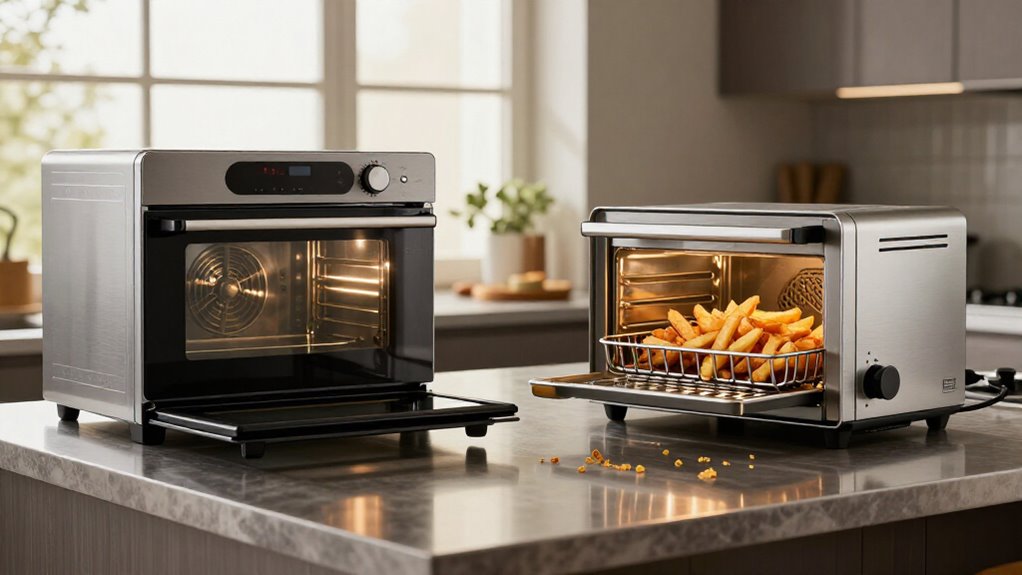
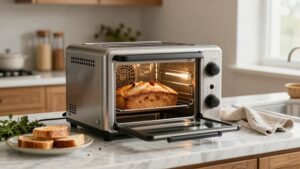
Choose a convection combo if you cook larger dishes or want steadier heat across racks; its rear fan circulates warmth throughout the chamber. A toaster oven combo may save counter space, but its compact airflow can produce less-even browning and smaller crisp batches.
For fries, compare usable basket area, not headline capacity, and spread food in one layer. Both can reheat leftovers and bake, but results vary by model. The details below help you match features to your kitchen.
Airflow Fan Placement
Where the fan sits shapes how each oven moves heat. A larger convection combo usually places its fan at the rear or upper-rear wall; dual fans may smooth circulation across racks. A compact toaster oven often uses a rear or upper-rear fan, sometimes paired with a faster upper blower. Compare the practical effects below.
| Appliance | Fan location | Practical effect |
|---|---|---|
| Convection combo | Rear / upper-rear | Broad circulation |
| Dual-fan model | Rear + top | Fewer hot spots |
| Toaster combo | Rear / upper-rear | Compact airflow |
| Hybrid design | Blower + duct | Guided circulation |
Leave clearance around the fan; tall pans can block its path. Larger cavities fit more racks, while compact ones direct air around smaller portions. Check cleaning access, since tight housings can complicate maintenance. Dual-fan designs may cost more.
Choose by pan size, rack count, and upkeep—not placement alone.
Toast Performance Gap
Although both appliance types can toast, an air-fryer toaster oven often takes longer and browns less evenly than a standalone toaster.
Your results depend on chamber layout and controls: larger gaps between bread and heating elements can leave slices pale or patchy. In testing, Breville’s Smart Oven Air Fryer Pro produced pale toast at medium-dark level five after five minutes. GreenPan’s level five preset ran nine minutes; bringing bread closer to the rods risked uneven browning or burning.
Don’t assume every combo performs alike. DeLonghi’s EO141164M handled a range of toast shades and full batches, while GE’s G9OAAASSPSS browned single slices and full loads evenly, though batches could take time. If your oven shows hot spots, rotate the bread or use convection.
Frozen-Fry Batch Capacity
For frozen fries, usable tray area matters more than an oven’s exterior size.
In testing, frozen fries were prepared in 16-ounce batches at 400°F for 20 minutes, shaken once halfway through unless the oven had a fries preset. Large oven-style chambers let you spread fries in a single layer, helping them cook crispier and more evenly. That’s the advantage of a convection combo: you can finish a broader batch without crowding the food. But don’t assume a larger appliance guarantees more usable space.
Compare the basket or tray dimensions. The Breville Smart Oven Air Fryer Pro’s standalone basket measures 12 × 15 inches. The Compact’s basket measures 11.6 × 16.5 inches, while the Air Fryer Toaster Oven’s measures 11 × 12.75 inches. Check whether your portion fits in one layer; a wide footprint matters more than headline capacity.
Preset Accuracy and Learning Curve
After checking tray space, compare how reliably each oven’s controls deliver the setting you choose.
Presets can save time, but their labels don’t guarantee matching results: GreenPan’s level-five toast cycle ran nine minutes, while Breville’s level-five cycle took about five and still left toast pale. So check food and adjust. Temperature precision varies too: some models move in five-degree increments; others jump by 25, limiting fine tuning.
Manual controls often shorten the learning curve. Breville’s three dials and six buttons make programming clear, and you can change time or temperature mid-cook. By contrast, some Toshiba, Calphalon, and GreenPan ovens require a Start press after preheating; Breville starts automatically. Instant Pot Omni Plus’s touchscreen may feel less intuitive and gets greasy. Choose controls you can operate confidently.
Countertop Clearance Requirements
Before choosing a model, measure both its countertop footprint and the space its chamber actually offers; a larger oven doesn’t always provide proportionally more cooking room.
Compare convection combos with compact toaster-oven hybrids: larger cavities often demand more counter space, but check usable capacity before accepting the trade-off. The Breville Smart Oven Air Fryer Pro measures 21.5 × 17.5 × 12.7 inches, so reserve room for its 21.5-by-17.5-inch base.
Top-fan designs bulk up, while side-fan ovens may pair large chambers with slimmer profiles. Since air frying releases steam, leave space from cabinets; condensation can damage wood over time.
Check door swing and make sure you can remove baskets or trays to shake or flip food. Measure the working area, not only the parked appliance.
Replacement Part Availability
Counter space isn’t the only practical consideration; check how easily you can replace worn or missing parts.
For either a convection combo or a toaster oven air-fryer hybrid, don’t assume accessories remain available after purchase. The tested models’ replacement-part availability isn’t specified, so you can’t compare them on this point.
Breville’s Smart Oven Air Fryer Pro includes a two-year limited warranty, but that doesn’t establish which components the warranty covers or whether you can buy them separately. Before choosing, contact the manufacturer or retailer and ask about replacement racks, air-fry baskets, trays, and crumb trays. Confirm compatibility with the model number and ask about availability. If a design relies on a basket, verify you can replace it; accessible parts can make ownership more practical.
Grease Cleanup and Smoke
When you air-fry wings, rendered fat can splatter across the door, racks, and interior, making cleanup more involved than with a dedicated air fryer. You may also find crumb and drip trays awkward: in tested ovens, they didn’t slide out with the door, so testers balanced baskets on the open door or used a trivet.
Expect to scrub the fry basket, wipe the cavity with a vinegar-based solution, and wash splattered mitts or towels.
Steam adds another cleanup concern. Every tested oven released some during air frying; Cuisinart produced the most, while Cuisinart and Instant Pot models fogged their doors and leaked onto the counter. If you place a combo beneath cabinets, heavy condensation can affect wood over time. Check ventilation and tray access before choosing. Neither design eliminates mess, but easier access can shorten cleanup.
Broiling and Baking Versatility
Compare how each combo broils, since radiant heat can brown food quickly while convection airflow promotes more even results. For baking, convection models circulate heat across racks, while toaster oven combos vary in capacity and temperature control. Check each unit’s settings and performance against the meals you regularly make.
Broiling Performance
For broiling and baking, look beyond the appliance’s air-fry setting: a convection combo’s top and bottom elements, assisted by a rear fan, help maintain even heat for multi-rack baking, roasting, and casseroles, while broiling provides more direct browning. That distinction matters when you finish cheese, skin, or a roast: broil directs radiant heat toward the surface, while air-fry relies on faster fan-driven circulation through a mesh basket. Choose broil for targeted color; use bake for steadier heat through the dish.
The Breville Smart Oven Air Fryer Pro includes both functions, an 80°F-to-480°F range, and three dials plus six buttons, so you can adjust time or temperature mid-cook. Ninja scored 4/5 for baking; GE rated “very good.” Compare broil settings and controls before you choose.
Baking Versatility
A convection combo gives you more control across baking tasks: its top and bottom elements and rear fan maintain even heat for casseroles, roasts, and multi-rack baking, while a separate broil setting adds direct surface browning.
Choose convection when you need consistent results across trays or larger dishes; air-fry mode instead moves hot air through a mesh basket to crisp single-layer food. For broader baking jobs, compare temperature ranges and controls, not just presets.
Breville’s Smart Oven Air Fryer Pro spans 80°F to 480°F and adds pizza, proof, slow-cook, and dehydrate modes. GE’s G9OAAASSPSS covers 85°F to 450°F with bake, broil, convection, and air-fry settings. The Ninja DCT401 earned 4/5 for baking; GE received a very good rating. If you bake often, prioritize capacity and temperature precision. Avoid crowding, which can undermine browning and extend cooking time unnecessarily.
Best for Reheating Leftovers
For even heating without drying, use convection mode for larger portions, but check food as it warms. To restore crispness to fries, choose an air-fry setting, which drives hotter air across the surface. Compare each model’s reheating performance, since strong baking results don’t guarantee evenly reheated leftovers.
Restoring Crispness to Fries
Air-fry mode can revive leftover fries by circulating hot air around them, restoring a crisp exterior with little or no oil. For a small serving, choose the toaster oven combo’s air-fry setting; its faster fan helps crisp fries without a separate appliance. A dedicated air fryer usually reheats more evenly and quickly, thanks to more concentrated heat, but its capacity may limit portions.
With either hybrid, airflow matters more than piling fries high:
- Use a mesh basket so hot air reaches every side.
- If you use a solid tray, expect weaker airflow and less crisping.
- Spread fries in one layer, especially when reheating a larger portion in a toaster oven.
- After greasy batches, clean splatter from the door, racks, and interior.
That cleanup is the trade-off for capacity: choose the toaster oven for more fries at once, or a dedicated fryer for speed and consistency.
Reheating Without Drying
How well a toaster oven combo reheats leftovers depends on the model: the GE G9OAAASSPSS earned a “good” rating, while the Ninja DCT401 scored in the middle.
Consumer Reports assessed evenness by warming lasagna and checking temperatures in several places, so a single score can hide cold spots. For dishes, you’ll want warmth throughout, not just a surface. Arrange portions in one layer and avoid crowding; this helps heat reach each piece more consistently.
A mesh basket circulates hot air around leftovers you want crisp, but that airflow may dry items if you leave them too long. Breville owners praise reheating and crisping, though no test result is available for its Smart Oven Air Fryer Pro. Check food and stop once it feels hot.
Choosing the Right Mode
Choose the mode to match the dish: convection’s rear fan circulates heat from the top and bottom elements, making it a good choice for warming casseroles and other larger portions evenly. Use air-fry mode when you want a crisp exterior: its faster fan pushes hot air around food in a mesh basket. It can revive pizza, though a toaster-oven combo may not crisp as intensely as a dedicated air fryer.
Choose by portion and texture:
- Reheat a large casserole with convection.
- Select air-fry for crisp-edged slices or sides.
- Check food early; airflow can brown surfaces quickly.
- Use the dedicated reheat setting when available.
Breville’s timer pauses when you open its door, so you can check doneness without losing your place.
Smart-App Control Winner
If app control is your priority, the Breville Joule Oven Air Fryer Pro is the clearest connected option, but the available information doesn’t verify its app features or performance, so there’s no confirmed smart-app winner.
At $550 on Amazon and $500 at Williams Sonoma and Sur La Table, you’re paying for a connection, not a proven advantage. By contrast, the Breville Smart Oven Air Fryer Pro relies on three dials and six push-buttons; you can adjust time and temperature while cooking. Its timer pauses when you open the door, and it starts cooking automatically after preheating.
Those conveniences improve control, but they don’t demonstrate remote operation. Check the Joule app’s adjustments, monitoring, and reliability before choosing; without those details, you can’t compare its control with manual controls.
Conclusion
Your best pick depends on what you cook most. A convection combo usually suits you if you prioritize fast airflow, crisp frozen fries, and simple batch cooking. A toaster oven combo makes more sense if you value even toast, broader baking and broiling, or easier control over delicate foods. Before buying, measure your counter clearance, check preset accuracy, and consider grease cleanup and smoke. Choose what you’ll use daily in practice, not what looks clever.