Countertop Appliance Glossary: Air Fry, Convection, and Rotisserie Explained
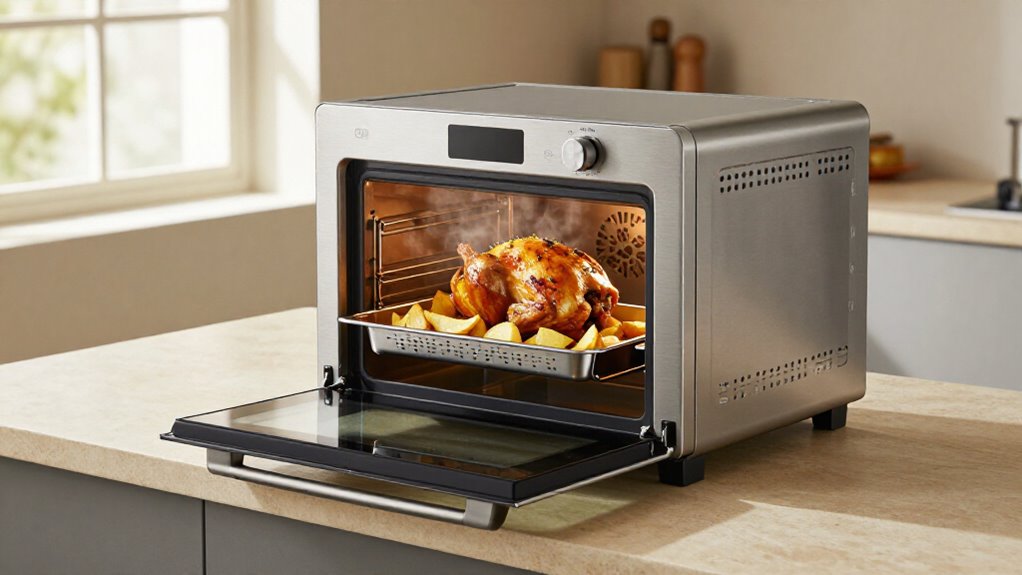
Air fry uses a fan and nearby heat to circulate hot air around food, crisping small portions quickly with little oil.
Convection also circulates hot air, but suits larger batches and more even baking or roasting.
Rotisserie turns food on a horizontal spit for browning without hand-flipping.
You’ll choose modes by food size and texture. Check your manual for setup and maximum rotisserie load.
Keep going for practical tips on settings, preheating, and popular foods.
Spot the Rotisserie Icon
To spot the rotisserie setting, look for an icon showing a chicken or a bird on a horizontal spit, often above a heat symbol.
On a countertop oven, this symbol marks the rotisserie option, so you can identify the control before choosing a cooking mode. Check the oven’s interior for a compatible spit and fork attachments; the picture alone doesn’t confirm that your appliance includes the hardware.
If you don’t find those parts, consult the manual or product listing before selecting the setting. Don’t confuse this icon with air fry: rotisserie uses a spit, while air fry cooks food in a basket or on a tray. The distinction helps you match the control to both the available accessories and the cooking setup you want.
Fan, Heat, and Spit
Although the rotisserie icon points to the spit, the fan and heat source help determine how the food cooks. A motor-driven fan moves heated air around your food, replacing cooler air at its surface and speeding heat transfer.
Heating elements can radiate energy directly, while circulating air carries warmth; a hot rack transfers heat by contact. Together, these parts shape the cooking environment.
| Part | Picture |
|---|---|
| Fan | Blades sweep warm air around food |
| Element | Glows above the turning spit |
| Spit | Holds food as it rotates |
Fan speed and placement affect airflow; a fan may move ingredients. The element’s position influences radiant heat, while air distributes warmth more evenly. These clues explain why rotisserie models cook differently.
Air Fry, Convection, Rotisserie
When you air-fry, a heating element and powerful fan circulate hot air to cook food quickly and crisp its exterior with little or no oil. Convection ovens use a fan to spread heat evenly, while an air fryer’s compact chamber often crisps food faster. Rotisserie cooking turns food on a spit for even browning, making it distinct from both methods.
Air Frying Explained
Air frying uses a heating element and fan to circulate hot air around food, crisping its surface without deep-frying it in oil. Compact models direct intense airflow close to your food, so you can cook quickly and get crisp surfaces with little or no added oil. That makes the method useful for small portions and foods such as fries or tater tots.
In basket-style units, perforations let hot air reach food from above and below. You can shake the basket to redistribute small pieces during cooking, helping them brown more evenly. Unlike deep-frying, air frying doesn’t submerge food in oil; you may need only a light coating, or none at all. Choose this setting when you want a crisp finish without the oil of deep-frying.
Convection Heat Circulation
Convection uses a fan to circulate hot air, distributing heat more evenly than still air. In a countertop oven, this airflow moves heated air around the cooking chamber, helping food cook consistently and often faster than with conventional heating. You can use convection for baking or roasting, especially when you want even results across multiple racks, though delicate foods may dry out under strong airflow.
Air fryers apply the same basic principle in a smaller space. Their nearby heating element and stronger airflow concentrate heat around food, helping surfaces crisp with little or no added oil. A perforated basket lets hot air reach food from above and below, supporting more even browning. You may need to shake or turn food midway for consistent crisping.
Rotisserie Cooking Method
A rotisserie cooks food by slowly turning it on a spit, exposing its surface evenly to the appliance’s heat. Unlike air frying, which uses a powerful fan to circulate hot air around food in a basket, rotisserie cooking relies on the food’s rotation and radiant heat. The turning motion helps cook meat evenly without requiring you to flip it by hand.
Some countertop oven-style air fryers include a rotisserie function, combining a turning spit with heating elements and circulating air. Before cooking, secure poultry or meat firmly on the spit. Leave enough space around it to rotate freely without touching the appliance’s walls or heating elements.
Cooking time varies with the food’s size and your appliance, so don’t rely on time alone. Use a food thermometer to confirm the meat reaches a safe internal temperature.
How Air Fryers Work
Inside a compact chamber, a heating element warms the air while a powerful fan circulates it around the food. That concentrated airflow helps your food cook quickly and develop a crisp exterior with little or no added oil. In many models, the heating element sits close to the cooking area, while the small chamber keeps moving heat near each portion.
A perforated basket lets hot air reach food from above and below; you can shake fries or tater tots partway through cooking to expose them more evenly. Air frying isn’t deep-frying, so wet batter generally won’t become crisp. Dry coatings, such as breadcrumbs, can brown successfully. The method relies on circulating hot air, not on rotating food, as a rotisserie does during cooking.
Convection Oven Basics
Beyond the compact air fryer, countertop convection ovens use a fan to circulate heated air, helping food cook more evenly than in a conventional oven.
In a countertop model, this airflow supports roasting, baking, and cooking across more than one rack. You can use convection when you want consistent heat throughout a batch. Many countertop ovens also include a crisper tray or basket attachment, which lets hot air reach food from multiple directions. That setup can imitate some air-fryer results, but it may not crisp as quickly as a basket-style fryer.
An air fryer has a smaller cooking chamber and more powerful fan, concentrating airflow for fast crisping. If your food sits in a perforated basket, you can shake small pieces during cooking.
Rotisserie Spit and Motor
A rotisserie spit holds food as a small motor turns it steadily, helping radiant heat or circulating hot air brown it evenly.
In a countertop oven, you’ll find a spit-and-fork assembly designed for a whole chicken or roast. Check the appliance’s weight limit and dimensions before you begin; food that exceeds either may not fit or rotate. Balance the load along the rod and tighten the forks against the food so it turns smoothly without wobbling.
Position a drip tray beneath the food to catch rendered fat and simplify cleanup. Secure the assembly as directed, then confirm that the spit can rotate freely before cooking. Keep hands clear of moving parts and hot surfaces when installing or removing it.
Comparing Cooking Functions
Air fry, convection, and rotisserie use different methods to cook food: air fry circulates hot air intensely for fast, crisp results on smaller portions, convection uses gentler airflow in a larger oven chamber for flexible cooking and bigger batches, and rotisserie turns food on a spit for even browning. Basket-style air fryers use perforated baskets to expose food surfaces to hot air. Convection ovens may use a crisper tray or basket attachment for similar airflow.
Both circulate heated air, but air fry’s compact chamber and nearby element create more intense conditions; convection’s larger chamber takes longer to heat. Rotisserie differs: a motor turns food on a spit as it browns and cooks evenly. Air fry and convection circulate air; rotisserie turns food evenly.
Choosing the Right Setting
Match the setting to the result you want: choose Air Fry for quickly crisping fries, wings, or fish fillets; use Convection to roast or bake larger portions evenly; and select Rotisserie when you want meat to turn as it cooks for more uniform browning. Use Air Fry when its compact chamber and powerful fan move hot air close to food for a fast crisp. Choose Convection when you need heat spread through a larger oven space for more even roasting or baking.
Your countertop fryer may preheat in minutes, while a standard oven can take 10–15 minutes. Larger batches may suit an oven better. Before using Rotisserie, consult your appliance’s manual for suitable foods and setup. Match the mode to food size and the texture you prefer.
Broil Versus Roast
Broil uses intense heat from the upper element to brown food quickly, while roast surrounds it with more even, moderate-to-high heat. Choose broil for thin foods or a crisp finish, and roast for larger cuts, vegetables, or whole poultry. Use an oven-safe pan, and watch food closely under the broiler to prevent burning.
Heat Source and Method
Although both settings brown food, broiling uses intense heat from above to quickly char the surface, while roasting surrounds food with more moderate, even heat so it cooks through.
You’ll see the difference in how each setting directs heat: a countertop broil mode emphasizes the top element, placing concentrated energy close to your food. Keep thin cuts or already-cooked dishes near that element for a quick browned finish, and watch them closely; the surface can burn before you notice.
Roasting uses a more oven-like approach, often drawing on heat from above and below to cook larger pieces evenly while browning their exteriors. Choose it for vegetables, chicken, or a cut of meat that needs to cook through, rather than acquire a char. Broiling finishes the surface; roasting develops browning as food cooks throughout. Select the setting based on its size and whether it needs a quick finish or full cooking.
Temperature Differences
Temperature settings reflect each method’s purpose: roasting uses a set temperature to cook food through, while broiling applies intense heat from above, often at a fixed high setting or with high and low options. With broiling, the element directs concentrated heat onto the surface, so you’ll position food close to it and watch carefully; food can brown or char quickly.
Roasting surrounds food with more moderate heat and takes longer, giving warmth time to reach the center while the exterior browns. Check your appliance’s controls, since temperatures vary: a roast setting specifies a temperature, but broil may offer one high setting or high and low choices. The difference isn’t just the number on the dial; it’s how each method delivers heat to your food.
Best Uses for Each
Choose broiling when you want to brown or char the surface quickly, such as on fish, vegetables, or cheese-topped dishes. Broiling directs intense heat from an upper element onto food, creating a fast, crisp finish. Keep items close to the element and watch them closely; their surfaces can burn in moments.
Choose roasting for larger or thicker foods that need to cook through, such as whole chickens and root vegetables. Surrounding oven heat cooks them more evenly while browning the exterior. Roasting takes longer, but a convection fan can circulate heat around the food and may shorten cooking time.
In a countertop appliance, check the manual for recommended rack placement and temperature: broil and roast settings can vary by model. Use each method for its strength: rapid surface browning or thorough cooking with an browned exterior.
Choosing the Right Setting
Which setting fits your goal: cooking food through or browning its surface? Choose roast when you need steady oven heat to reach the center of foods such as chicken, vegetables, or potatoes. Roast gives the interior time to cook without relying on a surface sear.
Choose broil when you want intense heat from above to brown or crisp the outside quickly. Since broiling can darken food fast, keep it close by and check it often to prevent burning.
For a browned exterior and fully cooked center, roast the food first, then switch to broil briefly at the end. Air-fry settings circulate hot air with a fan, whereas broil relies on direct overhead heat. Settings can vary by appliance, so consult your manual.
Pizza, Vegetables, and Chicken
An air fryer can crisp frozen pizza, roast vegetables, and cook chicken quickly by circulating hot air.
Basket-style models may fit only smaller pizzas, while toaster-oven air fryers give you more room. For vegetables, cut potatoes, sweet potatoes, and Brussels sprouts into even pieces to encourage browning. Toss Brussels sprouts with a little oil for crisp, browned edges.
You can cook zucchini and eggplant until their exteriors turn crisp and their centers become soft and jammy. Air fryers cook chicken quickly, and breadcrumb-coated cutlets can develop a crisp coating. Wet batter won’t turn crunchy as it does in a deep fryer. When you prepare chicken and vegetables for two, arrange them with space around pieces so hot air can circulate and brown the surfaces.
Check Maximum Rotisserie Weight
Check your appliance’s manual for its maximum rotisserie load, and include the spit, forks, and other attachments in the total—not just the food. Capacity varies by model, so don’t assume a larger-looking oven can support a heavier roast.
Stay below the stated limit; excess weight can strain the motor and prevent smooth, even rotation. Before cooking, secure the food centrally on the spit and balance it so the assembly turns freely. Check that the loaded spit also clears the appliance’s interior without touching walls or elements.
If your food exceeds the limit or won’t fit with safe clearance, choose another cooking method rather than forcing it onto the rotisserie. When in doubt, weigh the complete assembly, including accessories, and compare it with the manual’s maximum before you start. Use the stated limit as your ceiling for safety.
Decode the Preheat Indicator
When does an air fryer’s preheat indicator signal you’re ready to cook? It usually lights up or changes when the heating element brings the compact chamber to your selected temperature. Its small chamber often heats in minutes, versus roughly 10–15 for a standard oven.
Check your manual: indicators differ by model. Starting food after the signal helps you begin at the intended temperature for more predictable cooking and browning.
- Watch a light glow steadily beside the controls.
- Notice a display switch from “preheat” to “ready.”
- Hear a brief beep announcing the target temperature.
- Picture the heating element warming the small chamber.
- Give the unit a few minutes if there’s no indicator.
Without an indicator, preheat or wait a few minutes before adding food first.
Conclusion
Use the control icons and cooking modes to match each appliance setting to your meal. Air fry and convection circulate hot air, while rotisserie turns food on a spit for even browning. Choose broil for direct, intense heat and roast for slower cooking. Before you start, check your chicken’s weight against the rotisserie limit and wait for the preheat indicator. These quick checks help you cook safely and get the results you expect.