Deep Fryer Oil Capacity Chart: Matching Oil Volume to Quart Size
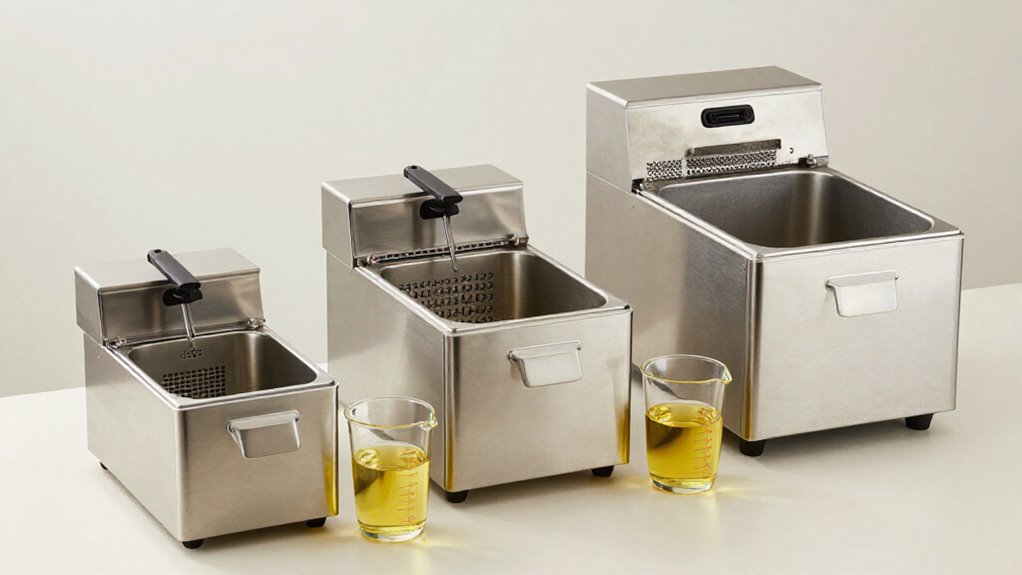
Use your fryer’s quart capacity to estimate oil volume: multiply quarts by 32 to get US fluid ounces.
A 10-quart fryer holds 320 fluid ounces; 30-quart and 42-quart models hold 960 and 1,344 ounces.
Capacity isn’t a fill target. Check the manufacturer’s minimum and maximum lines, leave headroom for food displacement and expansion, and keep food submerged without crowding.
For doughnuts, match oil volume to each batch and verify temperature. Continue for practical guidance.
Quart-to-Oil Conversion
Convert fryer quarts to fluid ounces by multiplying by 32: a 10-quart fryer holds 320 fluid ounces by nominal volume, while 30 quarts equals 960 ounces.
You can convert any quart value with the same multiplier: quarts × 32 = US fluid ounces. Therefore, 42 quarts converts to 1,344 fluid ounces, and 44 quarts converts to 1,408. For a metric comparison, 10 liters equals about 10.57 US quarts, or roughly 338 fluid ounces.
Treat these figures as volume, not weight: oil weighs approximately 0.85–0.92 pounds per liter, depending on its type. Your fryer’s stated quart capacity describes nominal vessel volume; it doesn’t specify how much oil you should pour in during use. Leave space for food displacement and follow the appliance’s marked minimum and maximum fill lines.
Oil Capacity by Size
Fryer oil capacity depends on size and design: countertop models typically hold 1–6 quarts, while commercial floor fryers are often rated by oil weight, from about 30 pounds upward.
Use the ranges below to compare labeled oil capacity; confirm exact specifications for your model.
| Size | Typical oil volume | Fryer category |
|---|---|---|
| 1–2 qt | 0.95–1.9 L | Compact home |
| 3–6 qt | 2.8–5.7 L | Family |
| 8+ qt | 7.6+ L | Extra-large or catering |
Commercial ratings use weight: 30 pounds equals about 16 quarts; 40 pounds equals about 21 quarts. These conversions are estimates; check manufacturer’s specification. Larger oil pools take longer to preheat but recover heat more between batches. Follow your model’s stated capacity and marked limits.
Minimum Oil Submersion Depth
How deep should the oil be? Set the level so it fully covers the food during frying, which supports even cooking. There’s no universal minimum depth: fryer baskets, pot shapes, and food dimensions vary. Check your fryer’s marked minimum and maximum lines, and consult the manual if you can’t read or identify them. Measure the oil level while it’s cool, before heating.
Keep the oil above the minimum line. If it falls below, food may cook unevenly, and the heating element may become exposed to air. Also account for food displacement, especially with frozen or breaded items, because adding food raises the oil level. Don’t exceed the maximum mark: hot oil can overflow during submersion, causing burns, fire, or slippery spills. Add oil only within the marked safe range.
Oil Displacement by Food
Food displaces oil as it enters the fryer, raising the level according to the food’s volume. Estimate capacity with the food loaded, but treat the measurement as approximate and keep oil below the marked maximum line. Frozen or breaded foods and large batches increase overflow risk, so don’t fill the fryer to the brim.
Food Displacement Basics
When you add food, it displaces oil and raises the level, so leave room below the maximum fill line. Frozen, breaded, and large portions generally displace more oil than small, plain pieces. Before heating, use the fryer’s marked minimum and maximum lines as your limits; don’t fill to the brim, even if a capacity calculation suggests you need more oil.
Add food in batches that fit the basket without crowding it. An overloaded basket can push oil over the rim and sharply lower its temperature, producing uneven or undercooked food. For a whole turkey, estimate displacement from its size or the fryer’s interior dimensions, but treat the result as approximate. Keep enough headroom to prevent spills, and follow the appliance’s fill marks as directed.
Why Oil Rises
As you lower food into a fryer, it displaces oil and makes the level rise; frozen items, breaded pieces, and large batches typically displace more than small portions. As food enters, it occupies space, forcing oil upward around it. Before heating or loading the fryer, check its marked minimum and maximum lines while the oil is cool.
Keep the starting level below the maximum so displaced oil stays inside the pot during each load. If you overfill it, hot oil can spill over the sides, creating burn, slip, and fire hazards. Don’t crowd the basket; crowded food displaces more oil and can cause overflow, uneven cooking, and sudden temperature drops. For turkey frying, estimate oil with the bird in the fryer, not to the brim.
Account for Food Volume
Because food takes up space in the fryer, adding it pushes the oil level higher. Account for that displacement when choosing an oil volume; don’t fill the pot to the brim. Frozen foods, breaded items, and large portions displace more oil than small servings, so they increase overflow risk. Keep the oil below the fryer’s maximum line, and follow its marked minimum and maximum levels.
Before filling, check the oil level while it’s cool. For a turkey fryer, allow for the bird’s volume rather than filling the vessel completely. Use your manual or an estimate based on the fryer’s interior dimensions to determine a starting amount. Add food cautiously, keeping the oil under the maximum mark. Don’t overcrowd the basket: dense loads can displace more oil, cook unevenly, and cause sharp temperature drops or overflow.
Measure After Loading
To measure food displacement safely, keep the fryer off and cool, place the food in the empty pot, and add water to your intended level. Remove the food, then measure the water remaining; that volume estimates how much oil the load will displace. Use the fryer’s fill lines and manufacturer instructions to choose a level that covers the food without reaching the rim.
For a turkey fryer, set the bird in the pot before calculating oil needs; its displaced volume matters more than the empty pot’s stated capacity. Treat measurements based on food dimensions as estimates, since shape and packing affect displacement. Never perform this test with hot oil, and don’t add food to an overfilled fryer. Check the manufacturer’s fill lines before heating.
Prevent Overflow Risks
When food enters the fryer, it displaces oil, so filling the pot to the brim can cause a hot overflow. Check oil levels only while cool, and follow the fryer’s marked minimum and maximum lines or its manual. Leave space below the maximum fill line so incoming food can raise the oil without spilling.
Frozen foods, breaded items, and large batches displace more oil, raising overfill risk. If you load too much food, the basket can crowd the oil, causing spills, uneven cooking, and temperature drops. Cook smaller batches when food nearly reaches the oil surface, and avoid packing the basket tightly.
Fill to the maximum line before cooking only if your fryer’s design allows room for food displacement. Never exceed the marked limit.
Reading Manufacturer Fill Lines
Before adding oil, check the fryer’s minimum and maximum fill lines while the oil is cool, and consult the manual if the markings or specifications aren’t clear. Use these marks—not the fryer’s stated quart capacity—to determine how much oil to add. Capacity describes the vessel or model; the fill lines define the safe operating range. Keep the oil at or above the minimum line.
Too little oil can impair cooking and leave heating elements exposed to air, risking equipment damage. Stop at the maximum line, even if the pot’s nominal capacity suggests room for more. Food and the basket displace oil, so excess can spill when you lower the basket. During service, check the level between rushes and top up with fresh oil as needed before you start the next batch. Add only enough to restore the level within the marked limits; don’t treat a quart-size chart as permission to exceed them.
Cold-Oil Expansion and Overflow
As oil heats, it expands, so leave headroom rather than filling the fryer to the brim. Check the oil while it’s cool and follow the marked maximum fill line; it defines the safe operating capacity. Don’t estimate this limit from the pot’s volume alone.
Leave additional space when you’re frying frozen, breaded, or large batches. These foods displace more oil as you’re adding them and can raise the level. If you’ve filled too high, hot oil may spill over the rim when food enters. Overflow can cause burns, start a fire, or create a slippery floor.
For a turkey fryer, treat oil-volume calculations as estimates, not exact fill instructions. Add less oil than the amount calculated to reach the brim, leaving room for operation.
Oil Needs for Doughnuts
For doughnuts, choose a fryer that holds enough oil for your usual batch and can reach the recipe’s target temperature, which is typically lower than the temperature used for chips.
A 2-litre unit can suit small batches and use less oil, but you’ll need to fry in rounds. For more doughnuts per batch, a 3-litre fryer holds about 3.2 quarts; a 4.5-litre model holds about 4.8 quarts.
Larger tanks support bigger batches, yet require more oil.
Match the fryer’s usable oil volume to your doughnut load: a tank that’s oversized for a few pieces wastes oil, while a small fryer can slow service. Before filling, check the minimum and maximum levels, and leave displacement room so doughnuts won’t push hot oil over the rim.
Thermostat Calibration Checks
Oil capacity sets batch size, but accurate temperature control keeps doughnuts frying evenly. Check your fryer’s oil temperature with a reliable thermometer, then compare it with the setting at several points from 325 to 375°F. Let oil stabilize first; readings can fluctuate as the fryer heats and cycles.
- Place the thermometer in oil without touching the basket or heating element.
- Check points across the frying range, not just one setpoint.
- Repeat checks regularly: overheating above 375°F accelerates oil degradation and can cause off-flavors or smoking.
- Compare control performance: PID induction units may hold within ±2°F; gas models can fluctuate ±5 to 8°F, standard electric fryers ±3 to 4°F.
If readings differ consistently, your thermostat or sensor may need attention. Check your manual or ask a qualified technician to adjust it.
Oil Disposal Readiness
Before a fryer needs cleaning, plan how you’ll handle its used oil: a 10-quart unit holds about 320 fluid ounces, while 29-, 30-, 42- and 44-quart models hold about 928, 960, 1,344 and 1,408 fluid ounces, respectively. Treat those figures as planning estimates, not brim-fill targets; leave room for food and safe draining.
- Check the manual and fill lines for specified capacity.
- Let oil cool to 122–140°F before filtration or disposal.
- Use a built-in drain or suitable container; don’t lift a full tank.
- Never pour hot oil down a drain.
A 23 L fryer may need replacement every three to four days with moderate use, or every two to three days in high-volume service; plan collection accordingly in advance.
Conclusion
Use your fryer’s quart size as a starting point, not a promise of usable oil capacity. Check its fill lines, confirm food stays submerged, and allow room for displacement and cold-oil expansion before heating. Verify thermostat accuracy so you can hold the right temperature, especially when frying doughnuts. Once you’ve calculated the volume, note how much oil you’ll need and prepare a safe disposal container. These checks help you fry consistently without overflow or waste.