Air Fryer Sizing 101: How to Pick the Right Capacity for Your Household
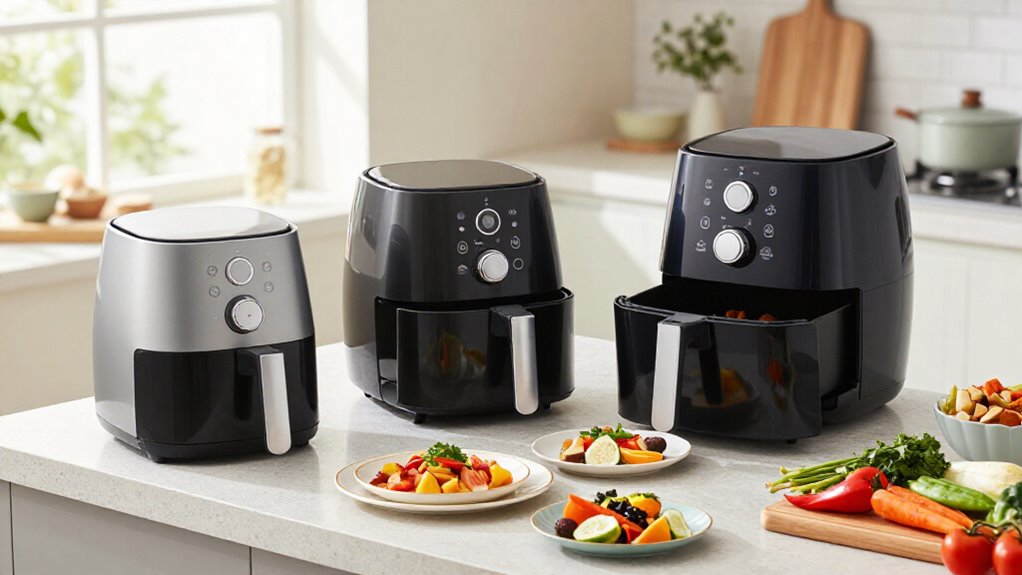
Choose an air fryer by matching capacity to your household, typical portions, and counter space. A 2–4-quart model suits one or two people, while a family of four should consider at least 6 quarts; larger households may need 8–9 quarts or more. Check basket dimensions, since shape affects usable room for food and whole chickens.
Single baskets suit bulky items; dual baskets separate dishes. Measure clearance and compare wattage, too. More sizing guidance follows.
Basket Capacity by Household Size
A simple rule of thumb is to choose a basket that fits your household’s portions without crowding the food. A 2–3-quart air fryer suits one person or a couple, while a 4-quart model is an option for students, singles, or couples. For a household of two to four, consider a 4–5-quart basket; a 6-quart model gives a family of four flexibility.
If you have four or more people, look at 6–8 quarts. A 9-quart unit can help a family of six cook with fewer batches, while 8 quarts works well for entertaining and meal prep. Choose 9 quarts or more if you cook high volumes. Whatever size you select, leave room to spread food in one layer; crowding limits airflow.
Typical Meal Portions
Capacity is easier to judge when you picture the meals you’ll cook: a 4-quart fryer can handle a steak or Brussels sprouts for one or two, while a 6-quart model can fit a whole chicken or a large batch of fries for a family of four.
An 8-quart model gives you room for salmon fillets, a generous portion of wings, or roasted vegetables. If you’re feeding six or often cook large meals, consider 9 quarts; that capacity can reduce batch cooking. For results, arrange food in a single layer when possible, with space between pieces for airflow. Overcrowding restricts circulation and can leave fries soggy.
Choose based on the portions you serve, so your fryer fits everyday meals as well as larger ones.
Room for Frozen Foods
How much room frozen food needs depends on both the batch size and the shape of the basket. Nuggets, fries, vegetables, and pastries crisp best when you leave gaps for airflow. A crowded basket can leave food uneven and extend cooking time; shake or turn pieces halfway through.
| Capacity | Practical batch | Best fit |
|---|---|---|
| 2–4 qt | 1–2 portions | Snacks, small items |
| 4–6 qt | 3–4 servings | Family snacks, 2–3 main items |
For larger frozen meals or batches for four or more, consider a 6-quart-or-larger model. A shallow, wide basket makes single-layer placement easier than a deep, narrow one, where pieces may stack. For trays of fries or mixed frozen foods, an oven-style unit with multiple racks offers more usable space. Allow extra cooking time for frozen items, and preheat when your recipe or appliance recommends it.
Single vs. Dual Baskets
A single basket gives you one continuous space for larger foods, while dual baskets divide capacity but let you cook separate dishes at different temperatures. Sync features can help both baskets finish together, but dual models take up more counter space and add parts to clean.
Choose based on the foods you cook, the space you have, and how much meal separation you need.
Cooking Capacity
When you need to cook a single large item, such as a whole chicken, a single-basket air fryer gives you one open space without a divider. A dual-basket model splits capacity between two compartments, so each may not fit an item that sits comfortably in one large basket. This matters when you cook bulky foods or want to avoid cutting them down.
Compare listed basket sizes, not just advertised total: the 10-quart Philips Dual Basket has 6- and 3-liter baskets, while the 8-quart Ninja Foodi has two 4-quart baskets. These layouts show that total capacity doesn’t tell you the usable space in each compartment.
Choose a dual basket when its divided capacity fits your portions. Choose one large basket when you need room for a single large item.
Meal Separation
Need to cook a protein and side dish at different temperatures? A dual-basket air fryer lets you prepare them separately, with independent settings; some models can sync the finish times so both dishes are ready together.
A single large basket gives you uninterrupted room for bulky items, such as a whole chicken. Dual baskets divide their total capacity into smaller compartments, which may not fit large pieces; check each basket’s dimensions before buying. Two compartments also let you cook separate dishes in parallel, but don’t pack or overlap food deeply, since crowded layers can crisp unevenly.
Choose a single basket if you often cook large, one-piece foods. Choose dual baskets if preparing different dishes at once matters more than fitting one large item.
Counter Space
Cooking two dishes at once can make a dual-basket model appealing, but check its footprint before choosing one. Its two compartments let you cook foods at different temperatures, and sync cooking can help them finish together. However, splitting capacity between baskets may leave too little room for a large item, such as a whole chicken.
A single-basket model gives you one larger cooking space, which may suit bulky foods better. Compare exterior dimensions, not just quart capacity, with your available counter and storage space. Large dual-basket models can take up substantial room: a 9-quart Cosori, for example, measures 17.3 × 15.4 × 11.9 inches and weighs over 19 pounds. Check whether you can leave it on the counter or need to store it between uses. Choose the layout that fits both your meals and your kitchen.
Cleaning And Convenience
For easier cleanup, consider how many parts you’ll need to wash: a single-basket model has one main compartment, while a dual-basket model gives you separate spaces for different foods and temperatures.
A single basket offers larger cooking space, so you can fit bulky foods such as a whole chicken and wash one compartment. Dual baskets let you cook foods at different temperatures; a sync function can help both finish together. But the total capacity is split, and either compartment may be too small for items.
Check whether baskets are removable and dishwasher-safe, since rules vary by model. Consider handling and storage: dual-basket units can be heavy and take counter space. A 9-quart Cosori weighs over 19 pounds. Choose the layout that suits your meals and cleanup routine.
Best for Batch Cooking
For batch cooking, choose at least a 6-quart air fryer; 8 quarts gives you room for multiple servings, while 9 or more can cut repeat rounds for a large family. Plan meals around the basket’s capacity, but leave space between pieces so hot air can circulate and crisp food evenly. A single large basket fits bulky items, while a dual-basket model lets you cook two foods at different temperatures.
Large Basket Capacity
A 6–8-quart basket gives food more room to spread out, helping hot air circulate so batch-cooked fries and wings stay crisp rather than soggy. If you cook for six or often prepare large batches, consider a 9-quart model or larger to cut down on cooking rounds.
A single large basket also suits bulky foods, such as a whole chicken. Dual-basket models split their advertised capacity between two smaller compartments, which can restrict the size of each item. Before buying, check the basket’s usable area, not just its quart rating: a deep or divided design may leave little room for food in a single layer. Measure the fryer’s exterior dimensions, too. Larger models take up more counter space, so make sure you can place and use one comfortably in your kitchen.
Cook Multiple Servings
When batch cooking, a 6-quart air fryer is a versatile starting point for a family of four, while 8 quarts or more gives larger batches and meal prep more room. For a household of six, consider 9 quarts or more; the added space lets you spread ingredients across the basket and prepare substantial quantities together.
A roomy model can hold a large batch of fries or about six chicken thighs, depending on their size and the basket’s shape. Don’t pack food tightly: blocked airflow can leave the exterior soft instead of crisp. If you often cook a main dish and a side, a dual-basket model lets you set different temperatures, though each basket offers less space than one large compartment. Before buying, check exterior measurements, too. A high-capacity fryer may suit your meal-prep routine, but make sure you have enough counter space and a practical place to store it when it’s not in use.
Reduce Cooking Batches
If you want to spend less time cooking in rounds, choose an air fryer with enough room to spread food out. A crowded basket restricts airflow, so you may need extra rounds to cook a household-size amount evenly. For a family of four, six quarts is a minimum, while nine quarts gives you more room for portions at once.
If you cook for six, a nine-quart model can help you avoid batches. An eight-quart fryer can handle bulk quantities, including wings, several salmon fillets, or roasted vegetables. Check the basket area, not just the capacity, and arrange food in a single layer when crisping matters. Dual-basket models cook two dishes at temperatures, but divided compartments may limit the amount of one food per round.
Plan Batch-Friendly Meals
Plan batch-friendly meals around how much food you need to cook at once. If you’re feeding a family of four, treat a 6-quart air fryer as the minimum; for six people or frequent high-volume cooking, consider 9 quarts or larger. Extra capacity lets you spread food out and may reduce the number of rounds needed.
Match the design to your menu. Choose one large basket for bulky items, such as a whole chicken, or dual baskets when you want to cook separate foods at different temperatures. Don’t pack the basket tightly: restricted airflow can leave fries soggy and cause uneven cooking. Check the basket’s dimensions, not just its listed capacity, because usable space varies. Before buying, confirm you have enough counter and storage room for a larger model.
Countertop Clearance and Ventilation
Before choosing a model, measure the countertop space where you’ll use it and check the air fryer’s exterior dimensions. A larger-capacity model may take up more room, so confirm it fits without crowding nearby appliances or walls.
Set it on a stable, open surface and leave clearance around the unit for hot air to circulate. Follow the manufacturer’s spacing instructions; no single distance suits every design. Avoid tight, enclosed spots, where blocked airflow can interfere with ventilation and cooking.
Keep vents uncovered and nearby items clear. If you line the basket with foil, don’t cover its entire bottom; leave room for air to move. Recheck placement after moving the fryer or choosing a wider model, and confirm it won’t crowd appliances or walls.
Energy Use and Running Costs
An air fryer’s wattage tells you how much power it draws while running, but not the full cost of a meal.
To estimate running cost, convert watts to kilowatts, then multiply by cooking hours and your electricity rate. A 1,750-watt model running for 30 minutes uses about 0.875 kWh; multiply that figure by your rate to estimate the session’s cost. Large-capacity models used 1,600-1,750 watts, so compare wattage when choosing capacity.
A bigger fryer may draw more power each hour, yet it can cook a meal in one batch rather than several smaller ones. Air fryers cook faster than ovens, reducing power-on time, but savings depend on your recipe, appliance, and rate. Frequent, long sessions can cost more than occasional short runs.
Ignoring Basket Shape for Whole Foods
When choosing an air fryer for a whole chicken, don’t rely on quart capacity alone: a small bird needs at least 6 quarts, but basket width and depth determine whether it fits without touching the heating element.
Two models with equal capacity can fit very differently, so check interior dimensions and compare them with your bird. Choose one roomy basket; split dual baskets can leave you frustrated when neither compartment fits the chicken.
- Avoid crowding.
- Maintain airflow.
- Even cooking.
Leave clearance around the bird so hot air can circulate and brown it more evenly. Before buying, verify the basket’s usable width and depth, not just its advertised volume. If whole chickens are a meal you often roast, an air-fryer toaster oven with a rotisserie may suit you better.
Doorway and Cabinet Fit
Even if a model’s capacity suits your cooking needs, its exterior dimensions must fit your kitchen.
Measure the fryer’s full width, depth, and height; compare them with both the cabinet opening and countertop space. Similar capacities don’t guarantee similar footprints: a 9-quart Cosori measures 17.3 × 15.4 × 11.9 inches and weighs over 19 pounds, while a 10-quart GreenPan Bistro measures 15 × 12 × 12 inches. Plan for clearance and lifting before you buy. A tight fit can turn everyday cooking into needless hassle.
- Leave room around the unit for airflow, so heat doesn’t crowd your cabinets.
- Check that the basket or door opens fully without striking walls or nearby cupboards.
- If you’ll store it overhead, confirm it fits and feels safe to lift in and out.
Conclusion
Choose an air fryer by how you actually cook, not just by household size. Match the basket to typical portions, frozen foods, and batch cooking; consider whether dual baskets make meal timing easier.
Check the basket shape for whole ingredients, then measure counter space, ventilation clearance, and cabinet access. Compare energy use if you’ll run it often. A capacity that fits your meals and kitchen will help you cook comfortably without taking up more space than you need.