Countertop Cooking Appliance Comparison Chart: 5 Options Side by Side
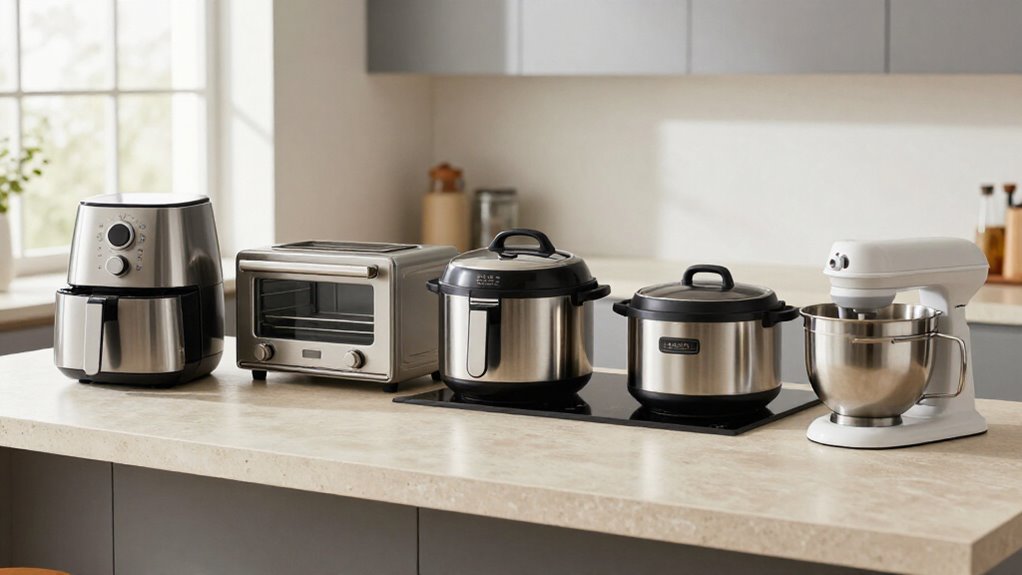
Choose an air fryer for crisping, grilling, baking, and roasting with no oil; Farberware costs $59.88, while NuWave offers six presets and six-quart capacity for $78.92. An eight-in-one multicooker adds slow cooking, sautéing, steaming, and rice cooking for $59. A toaster oven suits small batches, while a food processor preps ingredients but doesn’t cook them. A microwave reheats and defrosts.
Compare capacity, footprint, controls, and cleanup to find your fit; the details below clarify trade-offs.
Air Fryer Versus Multicooker
If you’re choosing between an air fryer and a multicooker, consider which cooking methods you’ll use most. An air fryer suits you if crisping, grilling, baking, or roasting without oil matters most. The Farberware Oilless MultiFunctional Fryer costs $59.88 at Walmart, reduced from $99. The NuWave 6 Qt. Digital Air Fryer costs $78.92 and includes presets plus a dishwasher-safe, nonstick drawer and basket.
A multicooker handles methods including slow cooking, searing, sautéing, rice cooking, steaming, roasting, baking, and warming. Walmart’s 8-in-1 model costs $59, down from $79.
The Breville Multi Function Cooker costs $249 and lets you customize settings on its LCD; its screen indicates when it’s pressurizing, cooking, or releasing steam. Choose an air fryer for crisping, or a multicooker for cooking variety.
Toaster Oven and Processor
A toaster oven cooks and browns food with heating elements, while a food processor uses blades and discs to chop, slice, shred, or puree ingredients. You’ll use a toaster oven for small-batch baking, toasting, reheating, broiling, or roasting; its cavity suits meals for one to four.
| Appliance | Comparison |
|---|---|
| Toaster oven | Cooks food |
| Food processor | Prepares ingredients |
| Oven capacity | 0.3–1.0 cu ft |
A processor handles prep, not cooking, with 3–16-cup bowls, an S-shaped blade, slicing or shredding discs, and sometimes a dough blade. Check its motor rating and run-time guidance, especially for dense dough; you’ll need another appliance to heat food.
Compare countertop space too: processors trade bowl capacity for storage, while toaster ovens need heat clearance around their exterior during operation. Neither replaces the other: one transforms ingredients, and the other applies controlled heat for finished dishes.
Warranty and Included Accessories
Warranty length and included accessories can affect an appliance’s value and day-to-day convenience. When you compare products, check the warranty term and what comes in the box; supplied pieces may reduce purchases or cleanup effort. The Hamilton Beach Professional All-Metal stand mixer offers the longest coverage, with a five-year warranty and a dough hook, flat beater, and wire whisk.
Capacity and Cooking Modes
Compare each appliance’s cooking capacity with its countertop footprint to see how much space it needs and what batch sizes it can handle. Cooking modes also vary: a multicooker may combine pressure cooking, slow cooking, and sautéing, while an air fryer focuses on crisping. Consider whether you’d benefit more from larger batches or greater versatility.
Cooking Capacity
Cooking capacity determines how much food you can prepare at once and which tasks an appliance can handle. The Instant Pot Duo60 holds six quarts, giving you room for larger batches, and combines pressure and slow cooking. The Crock-Pot Cook N Carry and Hamilton Beach Digital slow cookers also hold six quarts, but focus on slow cooking.
Appliance Footprint
Capacity tells you how much an appliance can handle, while its footprint shows how much counter space it takes up. The 6-quart Instant Pot Duo60 measures 13 × 13.5 × 12.25 inches, while its 3-quart version is two inches smaller in every dimension. That trade-off gives you less capacity in a more compact body.
Danby’s microwave measures 10 × 18 × 13 inches, so compare its dimensions with the Instant Pot’s before choosing a spot. The Panasonic FlashXpress toaster oven measures 10 × 13 × 12 inches; the Black & Decker 8-slice model instead accommodates a 9-by-13-inch pan with handles, a useful measure of usable interior space. For prep appliances, the 3-cup Cuisinart Mini Prep Plus is just 9.25 × 5 × 7 inches. Check these measurements against your available counter area.
Available Cooking Modes
A wider range of cooking modes can make one appliance more versatile, but capacity and controls still matter. The 8-in-1 Programmable Multicooker covers slow cooking, searing, sautéing, rice cooking, steaming, roasting, baking, and warming, giving you more ways to prepare foods in one unit. By comparison, the Farberware fries, grills, bakes, and roasts without oil, while the NuWave offers six preset modes and a 6-quart capacity.
The Crock-Pot’s 6-quart removable stoneware supports cooking, warming, and serving; Breville’s display tracks pressurizing, cooking, and steam release rather than listing modes. Check whether you prefer named programs or status updates: presets simplify selection, while a multicooker’s broader functions may suit varied recipes. Compare the modes you’ll use with the appliance’s capacity and interface before making your choice.
Batch Size
Batch size depends on both an appliance’s capacity and the cooking modes you’ll use. A 6-quart cooker, such as the Instant Pot Duo60 or Crock-Pot Cook N Carry, can handle a larger batch than the 3-quart Instant Pot. The smaller model measures 2 inches less in every dimension, which may suit counters but limits volume.
Consider the food and mode when estimating servings: pressure cooking, slow cooking, steaming, or rice cooking may call for fill levels. The 8-in-1 Programmable Multicooker adds searing, sautéing, roasting, baking, and warming, while the Duo60 includes seven functions.
The Breville’s LCD displays its cooking stages as you set it. By contrast, the NuWave air fryer lists six presets; presets don’t indicate its batch capacity, so check its cooking area when choosing.
Capacity Versus Versatility
When you’re comparing countertop appliances, weigh cooking modes against the amount you can prepare at once.
A 6-quart Instant Pot Duo60 offers seven functions, giving you family-size capacity and varied cooking options. An 8-in-1 multicooker adds slow cooking, searing, sautéing, rice cooking, steaming, roasting, baking, and warming. Breville adds customizable settings and a display tracking pressurizing, cooking, and steam release. The multicookers thus suit broader meal preparation, while the blender and chopper focus on specific small-batch tasks.
Counter Space and Footprint
Countertop appliances vary widely in the space they occupy, even within the same category. If you have limited room, compare external dimensions rather than relying on capacity labels alone. The Danby microwave measures 10 × 18 × 13 inches, while the Instant Pot Duo60 is 13 × 13.5 × 12.25 inches. Its untested 3-quart version is 2 inches smaller in every dimension, which may make it easier to place.
Other compact designs suit different layouts: the Panasonic FlashXpress toaster oven measures 10 × 13 × 12 inches and is the smallest toaster oven in Consumer Reports’ tests. The Cuisinart Mini Prep Plus chopper measures 9.25 × 5 × 7 inches, taking about postcard-sized counter space. Among blenders, the Beast B10 measures 15.75 × 5 × 5 inches, compared with the Vitamix 5200 at 20.5 × 7.25 × 8.75 inches. Measure your space before you choose.
Cleaning and Maintenance
Cleaning is easier when food-contact parts detach for washing: the Farberware Oilless MultiFunctional Fryer has dishwasher-safe pieces, as do the NuWave 6 Qt. Digital Air Fryer’s nonstick removable drawer and basket.
You can remove the Crock-Pot Cook N Carry’s stoneware for cooking, warming, and serving, but its dishwasher status isn’t specified. KitchenAid’s Digital Convection Oven has nonstick racks that simplify cleanup; check care instructions before washing. Hamilton Beach’s All-Metal stand mixer tilts at the head, making the mixing area easier to reach.
Check care guidance, since these features don’t confirm dishwasher safety. When you compare models, prioritize removable parts and clear washing instructions; nonstick surfaces may call for gentler tools, while fixed interiors can require wiping rather than sink washing alone.
Weeknight Meals and Snacks
For quick weeknight meals, match the appliance to the task: the compact Danby microwave heats and defrosts evenly, while the Panasonic FlashXpress handles frozen pizza, corn muffins, and full batches of toast. Choose the 6-quart Instant Pot Duo60 when you want one cooker for pressure cooking, slow-cooked dishes, rice, and other meals; its 13 × 13.5 × 12.25-inch body takes more room than either compact appliance.
For small snacks or prep, the Cuisinart Mini Prep Plus chops herbs, nuts, and seeds, or ingredients for sauces, in a 3-cup bowl. The Farberware Oilless MultiFunctional Fryer offers frying, grilling, baking, and roasting in one unit. Its detachable parts are dishwasher-safe, which can simplify cleanup. Choose by task, capacity, and available counter space.
Preheating and Temperature Accuracy
How quickly an appliance preheats—and how accurately it holds a set temperature—can affect cooking results, but the available information doesn’t provide measurements for either.
- Air fryer ovens typically operate from 180–400°F, but that range doesn’t show how closely a unit holds your chosen setting.
- Toaster-convection ovens commonly span 150–450°F; the Panasonic FlashXpress cooks muffins and frozen pizza nicely, without timing or accuracy figures.
- Induction offers precise setpoint control, but the comparison provides no preheat-time or temperature-accuracy measurements.
- Danby’s microwave earns a very-good rating for heating evenness; that doesn’t establish temperature accuracy.
- KitchenAid cites Even Heat technology, while Breville’s LCD tracks pressure, cooking, and steam release, not preheating duration.
Treat these as feature clues, not proof of faster preheating or better accuracy.
Digital Versus Manual Controls
Temperature accuracy tells only part of the story; controls shape how easily you can set and manage a cooking cycle. Digital interfaces offer presets and timed stages, while manual dials can make basic adjustments straightforward.
- NuWave’s six presets simplify air-frying; its removable drawer and basket support cleanup.
- The multicooker’s digital controls cover eight functions, from searing to warming.
- Hamilton Beach switches to warm automatically when cooking ends, reducing monitoring.
- Danby’s digital microwave heats and defrosts evenly, with a quiet highest setting.
- Black & Decker’s digital toaster oven fits a handled 9-by-13-inch pan on its adjustable rack.
Choose digital controls when you value repeatable settings or automatic steps; choose manual controls when you prefer direct, uncomplicated adjustments. Check whether presets match your usual meals consistently.
Conclusion
Choose the countertop appliance that fits your cooking habits, available space, and budget—not simply the model with the most features. An air fryer or multicooker may suit quick meals, while a toaster oven can offer useful versatility. Compare capacity, controls, cleaning needs, included accessories, and warranty before you buy.
Check that the appliance heats accurately and handles the foods you make most. When you match those practical details to your routine, you’ll find a more useful fit.