Do You Really Need Both an Air Fryer and a Countertop Oven?
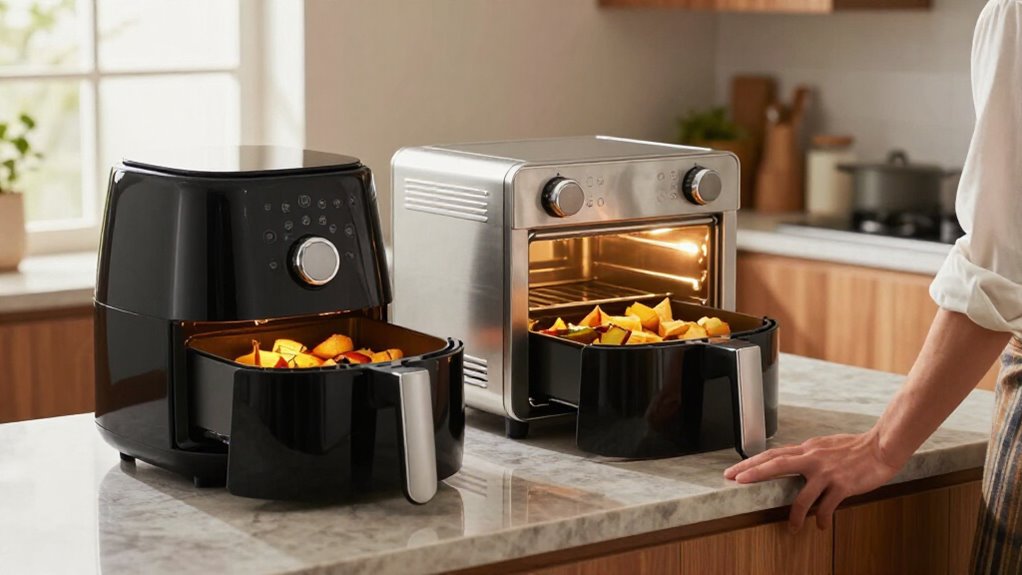
You don’t need both appliances unless you’ll use their distinct strengths. An air fryer’s rapid airflow crisps frozen fries quickly, while a countertop oven gives you room for pizza, baking, and roasting a whole chicken.
If you cook small portions, a compact air fryer may cover everyday needs; if you bake or need greater capacity, choose an oven. Compare dimensions, counter space, and price to find your fit; the points below can help you decide.
Air Fryer’s Crisping Advantage
Because an air fryer’s powerful fan rapidly circulates hot air through its compact chamber, it can crisp food quickly with little added oil. That advantage shows up most clearly with fries and chicken wings, whose surfaces brown before their interiors dry out. In tests, air fryers delivered stronger air-frying results than toaster ovens with an air-fry setting. They also bring leftovers back to crispness in minutes, making them useful for reheating pizza or yesterday’s fries.
A toaster oven can leave fries soggy underneath unless you flip them partway through. Since an air fryer often finishes sooner, check food early and adjust timing rather than relying on a countertop oven’s schedule. For larger portions, you’ll need to work in batches, which can limit convenience. Choose the air fryer when crisp texture matters more than cooking a mixed meal; choose the oven when capacity matters.
Rapid Air Circulation
That crisping advantage comes from rapid air circulation: a fan drives hot air across the food, carrying away surface moisture and encouraging browning. Forced airflow also thins the layer of cooler air that naturally surrounds food, so heat transfers more efficiently than it does in a still oven. In a basket-style fryer, air can move beneath and around pieces, helping small batches brown more evenly.
The compact chamber and nearby heating element further speed preheating and surface drying. You’ll need to watch timing: recipes written for a conventional oven may cook faster in an air fryer, and common conversion guidance suggests lowering the temperature and shortening the cooking time. Countertop ovens with convection use the same basic principle, but their larger cavities can take longer to heat and circulate air as intensely.
Crisping Frozen French Fries
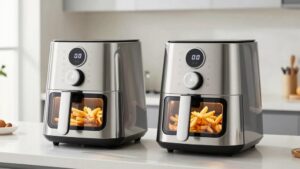
For frozen French fries, an air fryer usually delivers the crispest results: its fast-moving hot air browns the fries with little added oil. A wide, square basket gives fries room for air to circulate; avoid crowding them, which can hinder browning and leave some fries less crisp. Check them early, since air fryers often finish faster than toaster ovens, and use the package directions as your timing and temperature guide.
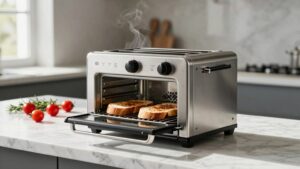
A toaster oven can still cook frozen fries, but less-circulating heat may leave their undersides soggy. Spread them in a single layer and turn them during cooking to improve browning. That extra step matters if you want an even result; an air fryer’s circulation can crisp fries with less intervention. Choose based on how often you make them and whether you value faster crisping or an appliance that can handle other cooking tasks, too, for small batches.
Countertop Oven Interior Capacity
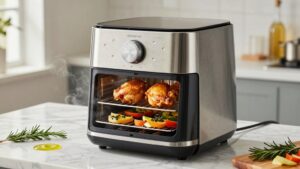
A countertop oven’s interior dimensions determine how much usable cooking space you get and which pans or foods will fit. Its larger chamber can handle items such as frozen pizza or pot pies, and let you cook several portions at once. Check the model’s stated capacity and clearances, since crowded food can restrict airflow and a roomier oven takes more counter space.
Interior Dimensions
Interior Dimensions
Interior capacity determines what your countertop oven can handle and how much space it claims on your counter. A larger chamber gives hot air room to circulate and lets you cook several portions, but it usually takes up more counter space than a standard toaster oven.
| Model | Capacity or size | Example fit |
|---|---|---|
| Instant Omni Plus | 19 quarts | 4-pound chicken |
| Breville Compact | 16.5 × 15.5 × 10.2 inches | Four bread slices |
| Breville Smart Oven Pro | Larger model | Whole turkey |
The Omni Plus also fits six bread slices or nine cookies. These examples show why you should compare dimensions as well as capacity: volume alone doesn’t tell you how much counter space an appliance needs. Toaster ovens hold less than full-size ovens overall, although some larger countertop models can roast a whole turkey.
If you cook larger meals, a bigger chamber may justify its footprint; if space is limited, choose a compact model. Check the manufacturer’s dimensions before buying.
Usable Cooking Space
Beyond its exterior dimensions, a countertop oven’s usable cooking space determines how much you can prepare at once. A larger chamber gives you room to cook several portions together, while a typical air fryer’s smaller basket may force you to work in batches. That difference matters when you’re feeding more than one or trying to finish a meal.
Capacity varies, so check the usable interior rather than relying on the appliance label. The 19-quart Instant Omni Plus, for example, can handle multiple servings in one run. If you plan to air-fry often, leave enough room around food for air to circulate; a larger chamber can help maintain that clearance. A compact toaster oven saves counter space but limits how much you cook at once for your household.
Capacity and Food Size
How much can you cook at once? Your countertop oven’s interior capacity determines whether dinner fits in one round or demands a second. A 19-quart Instant Omni Plus, for example, fits a 4-pound chicken, six bread slices, nine cookies, or a bag of fries.
A toaster oven also handles frozen pizza and pot pies; choose a full-size oven for a whole chicken.
| Food need | Practical fit |
|---|---|
| Fries or wings | Small basket; avoid crowding |
| Several portions | Larger air-fryer oven |
If you air-fry, prioritize a roomier model: food needs space for airflow, though the footprint takes more counter space. A wide, square basket can reduce crowding, while a larger-capacity air-fryer toaster oven may spare you batches. Match interior dimensions to your dishes, not quart rating.
Kitchen Space and Budget
Your available counter space may favor a compact air fryer or toaster oven over a larger air-fryer oven. Upfront prices range from about $60 for a mini air fryer to $270 for a countertop oven and $400 for a premium air-fryer oven. Buying both can be worthwhile if you’ve got storage space and will use each appliance’s distinct strengths.
Counter Space Tradeoffs
If counter space is tight, a standalone air fryer usually takes up less room than an air-fryer toaster oven, while a countertop oven’s flatter shape may fit better where a bulky appliance won’t. Your choice should reflect both footprint and cooking habits: a compact basket model suits one or two people, but its capacity limits batch cooking. A roomy combination oven handles more jobs, yet its larger chamber needs breathing room; a cramped air-fryer toaster oven may circulate air poorly and compromise crisping.
| Option | Space tradeoff |
|---|---|
| Standalone fryer | Smaller footprint |
| Combo oven | More functions; more counter space |
If you can store one appliance away, compare usable capacity with the space it occupies. If not, one versatile oven may serve you better than two separate appliances.
Upfront Cost Comparison
Upfront cost depends on whether you need a dedicated appliance or a space-saving combination: the Instant Pot Vortex Plus air fryer costs about $150, while the Breville Smart Oven Pro toaster oven costs about $270. If you buy both, budget roughly $420 before tax, and reserve room for two appliances. A single Breville Smart Oven Air Fryer Pro costs about $400, combining toaster-oven and air-frying functions, but its roomier footprint may be harder to accommodate.
At the lower end, the 2-quart Instant Pot Vortex Mini costs about $60; its capacity suits one or two people, not larger cooking needs. Compare the price with your usual tasks and available counter space: a toaster oven handles toast and baking, while an air fryer suits quick, crisp foods. When funds or counter space are limited, choose the appliance that covers more of your routine rather than paying for features or capacity you won’t use. Check exact measurements before you commit, including handle clearance.
Value of Dual Appliances
Buying both appliances makes sense only if you’ll use their distinct strengths: an air fryer crisps small foods quickly, while a countertop oven handles toast, pizza, pot pies, and broader baking.
Your counter and cooking habits determine whether that extra capacity earns its place. With limited room, a compact fryer can tuck into a corner or cabinet; an oven needs more permanent space.
| Choice | Practical value |
|---|---|
| Small fryer | About $60; suits one or two |
| Combo oven | Air-fry function; costs more, takes more room |
| Two appliances | Separate strengths; highest space and cost |
For occasional crisping alongside everyday oven cooking, choose an air-fry countertop oven for better value, though a dedicated fryer crisps better. Buy both only when you’ll use each and can spare the counter space.
Roasting a Whole Chicken
A countertop oven is usually the better choice for roasting a whole chicken because its larger chamber can fit a bird that won’t fit in a typical air-fryer basket. That extra room lets you use a roasting pan or, on compatible models, a rotisserie, making cleanup and handling more manageable than squeezing a bird into a basket.
The Breville Smart Oven Air Fryer Pro, for example, combines whole-chicken roasting capacity with air-frying functions, so you may not need a separate appliance if you want both. In testing, the 19-quart Instant Omni Plus fit a 4-pound chicken on its rotisserie. Still, check your model’s usable space and the bird’s size before buying; a traditional oven remains better for larger portions and frequent large meals.
Uneven Heating and Hot Spots
Capacity matters for roasting, but heat distribution also affects results. A toaster oven relies on concentrated radiant heat, which can create hot spots and leave parts of a dish unevenly cooked. If you’re making fries, the bottoms may turn soggy unless you flip them midway.
Check and turn food as needed, especially when you notice one area browning faster than another. An air fryer’s powerful fan moves hot air around the food, generally helping it brown faster and more evenly with less intervention. That difference is useful when you want crisp fries without a mid-cook flip.
Both appliances can produce wings with crisp exteriors and moist centers, though an air fryer may finish sooner. If you prefer a countertop oven, choose a model designed to minimize hot spots and stay attentive during cooking; its performance can vary by design and placement.
Air-Fryer Cookie Baking
When you want to bake a small batch of cookies, an air fryer can work, and many models include a cookie setting. A liner can keep dough from sticking, but choose one that fits securely and doesn’t block airflow. Because circulating heat may brown cookies faster or less predictably than a standard oven, start checking early instead of trusting familiar timing.
- Bake small batches; crowded dough can cook unevenly.
- Leave space between portions so hot air can circulate.
- Check centers and edges; pull cookies when set.
- Adjust time after your first batch, not temperature alone.
For frequent cookie baking, a toaster oven’s flat surface makes spacing easier. It also preheats quickly and uses less energy than a full-size oven for small batches.
Test Frozen Pizza Capacity
After a small batch of cookies, frozen pizza puts an appliance’s cooking space to the test.
A toaster oven’s flat surface and larger chamber suit frozen pizza better than an air fryer’s compact basket. You can lay the pizza flat instead of forcing it into a smaller area. Air-fryer toaster ovens offer a middle ground: they provide more room than basket models while circulating hot air.
Before buying or cooking, check the appliance’s interior dimensions against the pizza box. Capacity varies by model, and a small toaster oven may not fit a full-size pizza. That mismatch can mean cutting the pizza or cooking it in batches.
A countertop oven can add backup capacity, but it won’t replace a traditional oven for larger dishes and portions.
Conclusion
You don’t need both appliances. If you want crisp frozen fries, quick snacks, and smaller portions, an air fryer can cover your needs. Choose a countertop oven if you need room for a whole chicken, frozen pizza, or multiple cookies—and value baking and roasting. Before buying both, compare their overlap with your kitchen space and budget. Keep both only if you’ll use each appliance for distinct jobs enough to justify the counter space.