Air Fryer Accessory Terms Decoded: Racks, Skewers, and Liners Explained
Choose racks and liners for your fryer’s exact model and basket shape, not quart capacity alone. Measure usable width and confirm every part fits without touching walls or the heating element.
Perforated liners preserve airflow better than solid sheets; weigh parchment down with food.
Space skewers and keep portions modest. Basket and tray models need different accessories.
Check clearance, materials, warranty, and cleaning guidance before buying. The details ahead can help you choose confidently and well.
Rack and Skewer Fit
Before buying racks or skewers, check your air fryer’s exact model and basket dimensions; “universal fit” claims can be unreliable.
Measure basket interior and compare every accessory part, not just the largest rack. It should sit securely without touching basket walls or heating element. For a 5.8-quart basket, keep at least 1 inch of clearance from the heating element; oversized two-tier racks failed this check in 6 of 10 test cycles.
Choose skewers shorter than 4 inches where possible; longer ones violated recommended clearance in 8 of 10 cycles. A three-piece set lists parts at 7.67, 7.16, and 5.78 inches and claims fit for most 5.8-quart-or-larger fryers. Verify each piece against your model, and load food only when everything stays clear before you begin.
Liner Perforation and Airflow
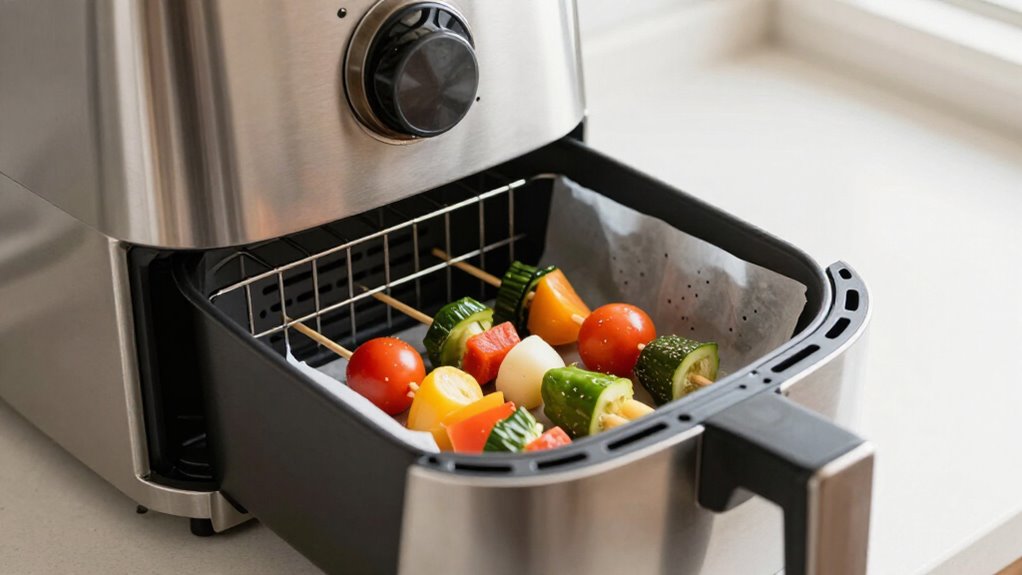
Perforated liners let hot air pass through their holes while catching grease and helping prevent food from sticking. They preserve convection better than solid sheets, supporting more even browning while simplifying cleanup. Place the liner beneath food so it stays weighted, and never let loose paper touch the heating element.
| Choice | Practical effect |
|---|---|
| Perforated parchment | Passes air; catches grease. |
| Solid paper | Can restrict airflow and crisping. |
| Larger holes | Increase airflow; reduce coverage. |
| Smaller holes | Retain coverage; may limit flow. |
| Perforated silicone | Reusable, with airflow openings. |
Check your fryer’s instructions and the liner’s temperature rating. Choose a perforated design sized for your basket, and use enough food to hold it down. Holes help airflow, but no liner matches the circulation you get without one during active cooking.
Skewer Spacing and Capacity
Check your rack’s capacity, basket width, and food size before loading skewers. Leave space between each skewer and around the food so hot air can circulate. Keep skewers short enough to fit with safe clearance from the heating element.
Skewer Rack Capacity
Skewer rack capacity depends on spacing, basket size, and food clearance. You can’t judge capacity by the rack’s tier count alone. Check how many skewers the holder accepts, since product listings may omit that figure. The TQEONKL set, for example, includes a 7.16-inch double-layer rack with skewers, but its supplied details don’t specify the skewer count.
Before you buy, compare rack dimensions with your basket. This set suits most air fryers of 5.8 quarts or larger, yet you should verify the fit for your model. Its multiple levels can expand cooking room, though crowded food may restrict airflow or clearance.
Shorter skewers often suit smaller households and compact baskets. Keep skewers from the heating element: lengths over four inches may exceed recommended clearance in some basket-style fryers. Confirm dimensions, count, and safe placement before cooking.
Spacing Between Skewers
Because the TQEONKL product details don’t specify skewer spacing or capacity, don’t assume how many skewers will fit.
The three-piece set includes a 7.16-inch double-layer rack, but that measurement doesn’t tell you the gap between skewers or the number the rack holds. Use its two levels to separate foods, not to pack in extra kabobs. Thread ingredients with small gaps between pieces so hot air can circulate and brown them more evenly.
Leave space between loaded skewers as well; overcrowding may cause uneven cooking. Load fewer skewers if your food pieces touch or obstruct airflow, then cook another batch. Check dimensions and element clearance; the set suits air fryers of 5.8 quarts or larger, and skewers over four inches may exceed clearance in models.
Basket Width Limits
Basket width, not quart capacity alone, determines whether a rack set will fit. Before you buy, measure your basket’s usable width; quart capacity doesn’t reveal dimensions. The listed TQEONKL set is about 7.8 inches wide and suits fryers of 5.8 quarts or larger. Its holder measures 7.67 inches, double-layer rack 7.16 inches, and toast rack 5.78 inches.
Compare each piece with your basket. Leave one inch from the heating element when your model requires it; oversized or stacked racks can crowd the basket and disrupt cooking.
Keep skewers within width and clearance limits: in eight of ten supplied test cycles, those longer than four inches violated clearance. Racks add usable space, not guaranteed capacity. If a rack crowds the basket, cook in separate batches instead.
Food Size Considerations
Choose racks, liners, and skewers by your fryer’s exact model and basket dimensions—not quart capacity alone. A 7.8-inch rack set suits many fryers of 5.8 quarts or larger, but you still need to measure your basket. Check every piece: the three-piece set includes a double-layer rack with skewers, a 7.67-inch metal holder, and a 5.78-inch toast rack.
Keep each rack at least one inch below the heating element. In tests, oversized two-tier racks let food touch the element in six of ten cycles. Choose skewers shorter than four inches where possible; longer ones exceeded recommended clearance in eight of ten cycles. Match skewer length and food portions to the available space. Fit liners to the basket’s shape: a 5.8-quart liner may gap in a 4-quart fryer or crumple in a 6-quart model.
Airflow Around Skewers
After checking that your skewers fit the basket, leave at least 1 inch between them or any rack and the heating element. That gap lets hot air circulate and keeps food from touching the element. Choose skewers 4 inches or shorter; longer ones violated the clearance rule in 8 of 10 test cycles.
Short skewers usually suit compact baskets and smaller households, while longer models may not sit safely. Check the basket’s usable space and the rack’s dimensions before loading. Avoid oversized two-tier racks: food touched the element in 6 of 10 test cycles, and restricted room can contribute to uneven cooking. If you use multiple rack levels, leave room around each skewer and below the top tier. Cook a second batch instead when your setup can’t maintain clearance for safe everyday use.
Loading Without Crowding
To keep hot air moving around each kabob, leave at least 1 inch between accessories and the heating element, and use skewers no longer than 4 inches. That gap helps prevent food from touching the element and reduces uneven cooking. Short skewers also fit compact baskets better; longer ones breached the clearance in eight of ten test cycles.
Before you add a rack, check its dimensions against your exact basket and model. Although the three-piece rack set is advertised for air fryers of 5.8 qt or larger, verify fit rather than relying on capacity claims.
Don’t pack double-layer racks tightly; leave airflow paths and keep food clear. If needed, cook another batch; oversized racks often caused element contact in six of ten tests.
Rotating Skewer Designs
When comparing rotating skewer designs, check spacing and capacity rather than assuming a rack will fit more food safely.
A three-piece set may include a double-layer rack and skewers, but its listing doesn’t state spacing or skewer count. The 7.16-inch rack suits air fryers of 5.8 quarts or larger, but verify your model’s interior dimensions. Keep skewers short enough for clearance: in tests, skewers longer than four inches breached clearance in eight of ten cycles.
Don’t treat two tiers as extra safe capacity. Oversized racks brought food into contact with the heating element in six of ten test cycles. Check skewer count and spacing against your food’s size and quantity. Short skewers may suit smaller households better than a family of four.
Batch Cooking Tips
Batch cooking works best when you balance capacity with airflow and clearance. A stackable rack lets you cook several small portions at once, but more space doesn’t always mean better results. Check that food and rack tiers won’t touch the heating element or chamber walls. Leave at least 1 inch of clearance above food; if an oversized rack crowds the heater, cook in separate batches.
For kebabs, keep skewers shorter than 4 inches. Longer skewers exceeded recommended clearance in 8 of 10 test cycles, so measure your basket before loading them. Arrange pieces with gaps between them to let hot air circulate and brown food evenly. Use a rack to hold light items, such as pita or tortilla chips, in place.
Don’t overcrowd the basket. Before buying, compare rack dimensions with your exact air fryer basket; “universal fit” may not account for its shape or size.
Basket Versus Tray Terms
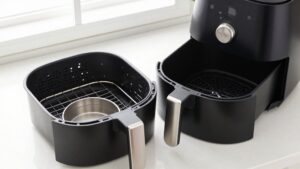
If your air fryer has a pull-out basket, choose accessories shaped for that exact model; tray-style ovens instead fit flat, oven-style pans and racks. Check dimensions rather than trusting “universal fit” claims, since basket shapes vary. Leave the specified clearance around accessories so they don’t block airflow or touch the heating element.
Basket-Style Air Fryers
Basket-style air fryers cook in a removable drawer, while tray-style models use oven-like shelves or pans, so their accessories aren’t interchangeable.
For a basket model, the drawer is your cooking space. Check its exact shape and interior dimensions before buying a rack, liner, or pan. Basket designs vary even within one brand: two 5.8-quart Cosori models may need different liners. Match accessories to your model number, rather than trusting “universal fit” claims.
Leave about one inch between food or accessories and the heating element. An oversized two-tier rack can bring food too close, risking contact and uneven cooking. Pre-perforated parchment and silicone liners can fit baskets. Avoid solid parchment: it can restrict airflow or lift toward the element. Check temperature ratings and secure liners.
Tray-Style Air Fryers
Tray-style air fryers use oven-like shelves or pans rather than a pull-out basket, so they can accommodate accessories such as sheet pans, pizza stones, and rotisserie cradles. That design changes what “basket” and “tray” mean when you shop: a basket model’s removable drawer holds food, while a tray-style model cooks on oven-style levels. Models such as Cuisinart TOA-60, Breville Smart Oven Air, Ninja DT201, and Instant Omni use oven-style accessories, not necessarily inserts sold for baskets.
Don’t assume a liner, ramekin, or cake pan advertised for a basket will work in your oven. Check your manual’s approved accessories and leave the required space around cooking surfaces; a rack or pan mustn’t touch the heating element or chamber walls. “Universal fit” isn’t a guarantee alone.
Accessory Fit And Shape
The right accessory shape depends on how your air fryer holds food. Basket-style air fryers use drawers that are often round or square, so measure the interior before you buy a liner, rack, or pan. Check your model number rather than relying on quart capacity alone. A liner sized for a 5.8-quart basket may leave gaps in a 4-quart model or buckle in a 6-quart one.
“Universal fit” isn’t always universal: even one brand may sell round and square baskets at the same capacity. Match the accessory carefully to the basket’s shape and specific model.
Oven-style air fryers with flat trays generally call for oven-style pieces, such as sheet pans, pizza stones, or rotisserie cradles, not basket-shaped liners.
Airflow And Clearance
For basket-style fryers, leave at least 1 inch between accessories and the heating element, as Cosori’s guidance recommends. Choose racks and liners shaped for your exact basket; a 5.8-quart liner may gap in a 4-quart fryer or buckle in a 6-quart model. Skewers longer than 4 inches breached recommended clearance in 8 of 10 test cycles, so use shorter ones.
Pre-perforated parchment lets air circulate. Solid parchment can block airflow and lift toward the element unless food holds it down.
For flat-tray oven-style fryers, choose oven-style accessories, such as larger sheet pans, pizza stones, or rotisserie cradles. Don’t assume basket racks or liners will fit a tray model. Match each accessory to your appliance’s design and keep air paths open for even cooking.
A Frozen-Fries Example
When cooking frozen fries, a rack can increase capacity, but don’t stack them high or use an oversized two-tier rack: in testing, fries touched the heating element in 6 of 10 cycles. Leave at least one inch of clearance, and cook a second batch if needed instead of piling fries too high.
For a single layer, check that your rack matches your basket’s shape and size. A silicone liner works for dry cooking, but fries took 60–90 seconds longer to reach the same crispness in testing. If you use perforated parchment, place the fries on it before cooking; their weight helps keep the paper from lifting toward the heating element. Check the food as it cooks, and adjust time to get the browning you want. Don’t assume added rack space means faster cooking or even crisping.
Warranty-Safe Accessory Materials
After checking rack clearance, choose materials that can handle your air fryer’s heat and follow its warranty terms. Choose food-grade silicone liners with a disclosed FDA rating under 21 CFR 177.2600; use them up to 425°F continuously or 450°F intermittently. Pre-perforated parchment rated to 425°F can catch spills, but weigh it down with food so it can’t lift toward the heating element.
Choose stainless-steel racks and pans to avoid plastic’s deformation risk. Check your model’s fit and keep accessories at least one inch from the heating element.
Don’t assume an accessory preserves coverage: Cosori may exclude damage from unauthorized accessories, while Ninja’s terms may exclude non-Ninja accessories. Instant Vortex and Omni accept aftermarket silicone liners, but incompatible racks or pans that violate clearance rules may not be covered.
Cleaning Brush Care
A soft-bristle brush lifts grease and food from hard-to-reach basket and tray areas without scratching the nonstick coating. Use it only after the basket has cooled, and choose a brush with bristles gentle enough for coated surfaces. Skip steel wool: a 50-cycle test found it reduced coating uniformity by 30%, while brush-cleaned baskets showed no coating loss.
- For stubborn grease, soak the basket with dish spray before brushing; Dawn dish spray can speed cleanup.
- Keep a plastic-handled brush outside the hot cooking chamber; heat can deform its handle.
- Wash your brush after each use, then let it dry fully before storing.
These simple habits help you clean effectively while protecting the basket’s coating and keeping your brush ready for your next cleanup routine, too.
Conclusion
Before you buy an air fryer accessory, check its dimensions against your model’s basket or tray and confirm that it leaves room for hot air to circulate. Choose perforated liners and evenly spaced skewers when airflow matters; reserve solid liners for foods that won’t block vents. For frozen fries, avoid crowding and shake them midway. Use only materials your manual permits, and clean racks, skewers, and brushes as directed to protect performance and warranty coverage.