Toaster Oven Bake Vs Broil Vs Toast Settings Explained
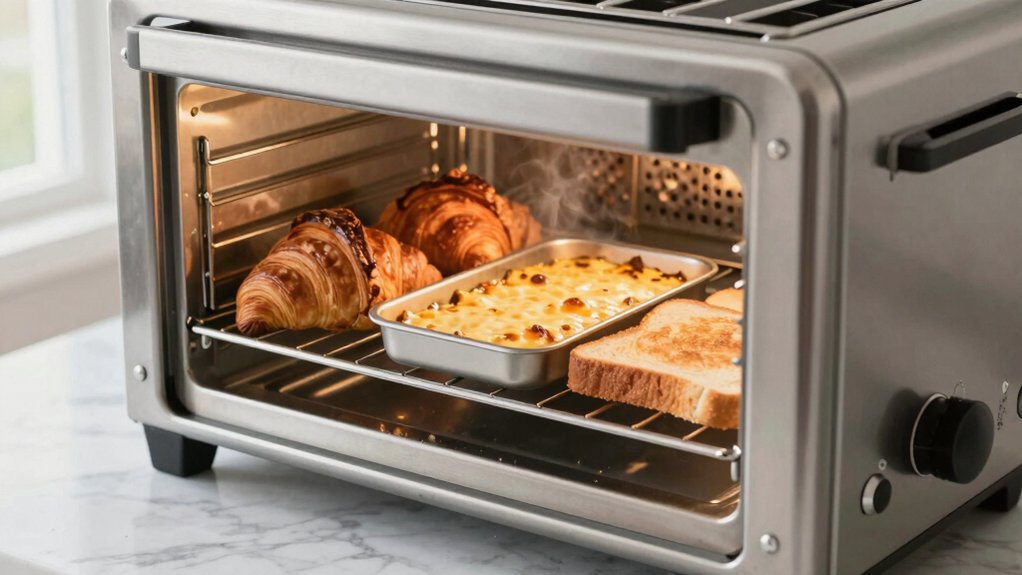
Use bake when you want even, steady heat from calrod or ceramic elements for full cooking and gentle browning. Lower the temp if you’re on the top rack to avoid over-browning.
Use broil (quartz/IR or halogen) for intense, fast top-side searing and crisping. Use toast for concentrated surface browning with balanced top-and-bottom output.
Check voltage/wattage and circuit capacity so the oven runs safely and performs well. Keep going to get practical setup and safety tips.
Quick Overview
- Bake uses lower, steady heat (usually calrod/ceramic) for even cooking throughout; it is ideal for cakes, casseroles, and cookies.
- Broil uses quartz/IR top heat for intense, direct radiant browning and searing. Use it for melting, finishing, or quick crisping.
- Toast uses balanced top-and-bottom wattage for even surface browning. It employs shorter cycles for bread and small items.
- Top-rack positions concentrate radiant heat and brown faster; reduce temperature or raise rack for delicate items.
- Check voltage, wattage, and circuit rating (amps = watts ÷ volts) to avoid overloading. This ensures safe, full-power operation.
Element: Heating Element Comparison
Wondering why some toaster ovens brown faster or heat more evenly? You’ll notice element type drives that. Quartz and infrared deliver strong radiant heat for fast surface browning. Calrod/sheath offers combined convection and gentler radiation for even bake results. Ceramic gives uniform, low-hotspot heating ideal for moist, delicate items.
Don’t treat element choice as an irrelevant topic; it’s core to performance, not stray physics.
| Element | Best Use |
|---|---|
| Quartz/IR | Fast broil/toast, quick browning |
| Calrod (sheath) | Versatile bake, steady convection |
| Ceramic | Even baking, minimal hotspots |
| Halogen | Instant high heat, surface sear |
Match element to setting: quartz or IR for broil/toast; calrod or ceramic for consistent bake.
Top Rack Baking Temps
After comparing element types and how they shape heat, you’ll want to think about where to place your pan. The top rack concentrates direct radiant heat and will brown tops faster than lower positions. You’ll use slightly lower baking temps on that rack for delicate items to avoid over-browning; think 325–350°F instead of higher bake settings. Shift trays down for slower, even cooking when the recipe calls for standard 350–375°F.
- A shallow tart on the top rack, 325°F for even custard set and golden top.
- Cookies slightly nearer the middle; top rack at 350°F for quicker color.
- A casserole browning fast? Lower rack and keep baking temps steady.
- Thin fish at 325°F on top for a crisped surface without drying.
Voltage and Wattage Specs
Check your toaster oven’s voltage and wattage before you plug it in so you know how much power it draws and whether your circuit can handle it. You’ll want to compare listed amperage and plug type to your kitchen outlets. Higher-watt models heat faster; they may need a dedicated circuit.
Also, weigh energy efficiency: a lower-watt unit or one with better insulation can save power during bake, broil, and toast cycles.
Voltage Requirements Explained
How much power does your toaster oven actually need, and why does that matter for bake, broil, and toast performance? Check the appliance label for required voltage; most home models use 120V in the US or 220–240V elsewhere.
Observing voltage safety prevents overheating, tripped breakers, or damaged controls when you run high-heat broil or extended bake cycles. Match the oven to your outlet and ensure plug compatibility: don’t force adapters or run heavy loads through extension cords.
If you move the oven between regions, confirm the rating or use a proper transformer. Proper voltage ensures consistent element performance for even baking, rapid broiling, and reliable toasting without stressing wiring or risking electrical faults.
Wattage And Heating Power
Why does wattage matter for your toaster oven’s bake, broil, and toast performance? Wattage determines how quickly elements reach and sustain temperatures. Higher-watt models preheat faster and recover heat better during baking. For broil, you want concentrated, high-watt output from the top element to seize surfaces. For toast, balanced top-and-bottom wattage gives even browning without burning.
Expect wattage variation between compact and full-size units; check specs to match your cooking habits. Also, consider power efficiency: a well-insulated, properly rated oven uses less wattage to hold temperature, saving time and energy. You’ll get steadier bake results, sharper broil sears, and more consistent toast when wattage and power efficiency are balanced for the tasks you use most.
Circuit And Amperage Limits
Wondering whether your kitchen circuit can handle a high-wattage toaster oven? Check the label for voltage and wattage specs. Then calculate expected amperage draw by dividing watts by voltage (amps = watts ÷ volts).
Typical toaster ovens run 120V and 1200–1800W; so they pull about 10–15A. High-power models can approach or exceed a standard 15A circuit. Respect circuit limitations: don’t run other heavy appliances on the same line, and avoid long-term loads near the breaker rating.
If you see frequent trips or warm outlets, you’re hitting amperage limits and should reduce load or consult an electrician. Knowing these numbers keeps your oven performing safely without overloading household wiring.
Plug Types And Compatibility
Curious about whether that toaster oven will actually work in your kitchen? Check its plug type, voltage and wattage specs against your outlet and circuit. You’ll see either a two- or three-prong plug; grounded three-prong models need a compatible grounded outlet.
Most toaster ovens are rated 120V in the U.S. and draw 800–1800W. High-watt models need more current and might trip a dedicated 15–20A circuit. Match the wattage to your circuit capacity and avoid adapters that defeat grounding. This subtopic relevance helps you prevent overloads and ensure safe operation.
Don’t confuse plug compatibility with unrelated themes like cooking modes: this is strictly electrical matching, not performance or efficiency.
Energy Efficiency Considerations
How much power your toaster oven uses matters more than you might think when it comes to energy efficiency and circuit safety. Check the voltage and wattage on the unit so you can match it to your kitchen circuit and avoid overloads.
Higher-watt models heat faster and cut cooking time; this improves energy efficiency for quick tasks like toasting or broiling, but they draw more current. For baking, moderate wattage helps maintain stable temperatures and preserves baking moisture without cycling elements excessively.
If you use a lower-watt appliance, expect longer cook times and plan accordingly to avoid undercooked centers. Balance wattage with typical use: choose higher watts for frequent fast jobs and moderate watts when you bake often and need consistent moisture retention.
Frequently Asked Questions
Can I Use Broil for Thicker Cuts of Meat Safely?
Yes, but you shouldn’t rely on broiling alone for thick cut meat prep. Broiler safety means using high top heat to sear and finish. Use the broiler to brown a rested, room-temperature roast or steak after searing on the stovetop. Alternatively, start farther from the element and flip often.
Always use a meat thermometer. Aim for safe internal temps and watch closely to avoid burning while ensuring even doneness throughout.
Does Toast Setting Crisp Pizza Crust Well?
Yes, the toast setting can toaster crisp pizza crusts, especially thin or pre-baked crusts. You’ll get quick, even browning from top and bottom elements, producing a crunchy exterior without long baking.
Watch closely to prevent burning, and use a middle rack for balance. For thicker or raw-dough pizzas, bake first; then finish on toast to crisp the crusts without overcooking toppings. Adjust time to your oven and preference.
Will Bake Fog up the Oven Window More Than Broil?
Yes, bake will usually fog the oven window more than broil. You’re using lower, all-around heat for longer; therefore, steam and grease have more time to condense, creating a noticeable fogging effect.
Broil’s high, short top-only heat causes less overall steam and more surface browning. This results in greater temperature variance, but window fogging is reduced. Wiping moisture after baking and venting the oven helps clear the glass.
Can I Broil With the Oven Door Closed?
Yes, you can broil with the oven door closed, but check your manual for model-specific guidance and oven safety tips. Closed-door broiling traps heat, gives more consistent searing, and reduces splatter. However, it can raise internal temperature and stress seals on older ovens.
Stay nearby, use an oven-safe pan, and monitor closely to avoid burning. If your manual recommends a partially open door, follow that for safer, optimum results.
Are Toaster Oven Presets Reliable Across Different Brands?
Yes, but only somewhat. You’ll find toaster oven consistency varies; presets give a helpful baseline. However, brand variability means temperature, element behavior, and timing can differ.
Test each preset with an oven thermometer and adjust times for your recipes. Keep notes for repeatable results, and prefer manual temperature and time control when precision matters. Over time, you’ll learn which presets you can trust and which ones need tweaking.
Conclusion
You now know how bake, broil, and toast use different elements and temps, so pick the setting that matches the food and rack position. Check your oven’s voltage and wattage to avoid overloading circuits; match plugs to outlets or use approved adapters.
Use lower-watt settings for energy savings and reserve broil for quick, high-heat finishing. With these simple checks and choices, you’ll get predictable results and safer, more efficient toaster-oven cooking.