Slow Cooker Low Vs High Temperature Differences
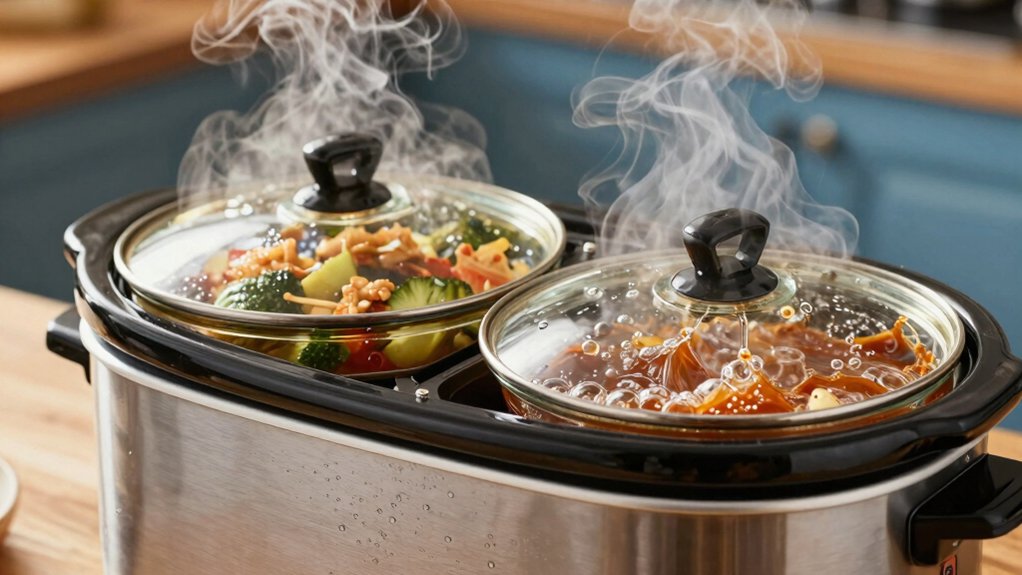
Choose low when you want gentle, collagen-rich breakdown and steady heat (170–200°F).
Choose high when you need faster cook times (270–300°F) and quicker protein denaturation.
Expect low to take roughly 6–8 hours and high about 4–6 hours.
Use the rule: 1 hour high ≈ 2–2.5 hours low.
Always verify doneness with a calibrated probe.
Avoid switching settings mid-run and hold or chill safely afterward.
Keep going to get specific times and temps by protein.
Quick Overview
- Low runs about 170–200°F; high about 270–300°F, so low heats slower and steadier.
- One hour on high roughly equals 2–2.5 hours on low for similar doneness.
- Use internal temperature, not time alone, to confirm safety and doneness.
- Don’t switch settings mid-recipe. Conversions alter texture and collagen breakdown.
- Low is best for tough cuts and long collagen breakdown. High suits shorter cooks and smaller proteins.
Low vs High Temps Chart
How do low and high settings actually differ in practice? You’ll see distinct temperature bands and cooking durations: low runs about 170–200°F; high about 270–300°F. You’ll choose low for prolonged tenderness and high for speed. Use a thermometer to confirm your model’s variance.
| Setting | Temp Range | Typical Time |
|---|---|---|
| Low | 170–200°F | 6–8 hours |
| High | 270–300°F | 4–6 hours |
| Warm | 185–199°F | hold only |
Practical tips: convert cautiously—1 hour high ≈ 2–2.5 hours low. Don’t swap settings mid-recipe. For evidence-based results, test your cooker once with water and a probe. Avoid unrelated topic debates; focus on two word discussion ideas like “time conversion.”
Safe Internal Temps Guide
Why should you check internal temperatures rather than rely on cooking time alone? You can’t assume uniform heat distribution. Slow cookers vary, and time-based estimates risk undercooking. Use a calibrated probe to confirm doneness and prevent pathogens while ensuring safe storage post-cook.
- Measure at the thickest part; avoid bone contact.
- Target published safe internal temps for each food class; verify with thermometer accuracy checks.
- Hold temperature for recommended rest times to allow carryover and microbial reduction.
- Rapid-chill leftovers to safe storage temperatures within two hours; label with date/time.
Regularly test your thermometer against ice-water and boiling points. Document readings and deviations by model to refine timing and maintain evidence-backed safety.
Protein-Specific Cooking Times
When planning protein-specific cooking times, you should match cut type and desired doneness to low/high settings and confirmed internal temperatures. For chicken, beef, pork, fish/seafood, and legumes, the differences in connective tissue, fat content, and cell structure drive time ranges and whether you use low (long) or high (short) cycles.
Use a thermometer and adjust for cooker behavior and volume. Chicken and fish need shorter, precise timing. Tough beef cuts and dried beans need prolonged low heat.
Chicken Time Differences
Curious about how chicken behaves differently between the slow cooker’s high and low settings? You’ll find the distinctions matter: high (≈270–300°F) cuts time to about 3.5–5 hours for bone-in pieces. Low (≈170–200°F) needs 5–8 hours for the same tenderness.
Use a probe thermometer; target 165°F internal for safety and consistency. Models vary, so measure. Prefer thighs or drumsticks on low to preserve juiciness; lean breasts risk drying on high. Avoid switching settings mid-cycle unless a recipe specifies it.
Don’t treat this as an irrelevant topic or an unrelated comparison to beef. Chicken’s muscle structure and fat content dictate these timings. Practical tip: add delicate veggies late on low to prevent mush.
Beef Cut Considerations
Shifting from chicken, beef demands different timing and heat strategies because of its varied cuts and connective tissue composition. You’ll match each beef cut to a temperature pairing: tough, collagen-rich cuts (chuck, brisket, short ribs) need low, sustained heat to convert collagen to gelatin. This typically takes 6 to 10 hours on low.
Leaner cuts (sirloin tip, eye of round) benefit from shorter duration and moderate heat to avoid drying. Use high for 4 to 6 hours only with careful monitoring. Use a probe thermometer to verify internal doneness and texture rather than time alone. Trim excess fat but retain some marbling for moisture.
For shreddable results, confirm fork-tender resistance. For roast-style slices, target medium doneness and remove earlier to rest.
Pork Cooking Variations
How should you adjust time and temperature for pork cuts in a slow cooker? You’ll choose low (170–200°F) for tougher cuts like shoulder or butt to hydrolyze collagen over 6–8+ hours. Evidence shows prolonged gentle heat yields tender, shred-ready texture.
Use high (270–300°F) for smaller roasts or trimmed loin for 4–6 hours; however, monitor to prevent dryness. For lean cuts, prioritize lower temperature and shorter moisture-retaining braises. Measure internal temperature; finish pork to 145°F for medium-rare recommendations or higher for pulled textures.
Control salt additions early to avoid slow cooker saltiness concentration; adjust toward the end. For pork preservation, cool rapidly after cooking and refrigerate within two hours to limit bacterial risk. Label and consume within recommended storage windows.
Fish And Seafood
After covering pork, adjust your expectations for fish and seafood: these proteins require substantially lower temperatures and shorter times in a slow cooker to preserve texture and safety. You should target the low setting but shorten duration. Most fish fillets need 45–90 minutes once the cooker reaches steady temperature; shellfish often finish even sooner.
Use an instant-read thermometer: fish is safe at 145°F (63°C) and opaque throughout. Rely on model-specific testing because actual low-range temps vary; a unit running near 200°F will overcook quickly. For seafood safety, avoid prolonged exposure above the danger zone before reaching final temp.
Add delicate seafood late, keep lid closed, and use gentle liquid conduction to prevent flaking and maintain optimal mouthfeel.
Legume And Bean Timing
Why do legumes demand different timing than meats? You should treat legumes as starch-protein matrices requiring controlled legume hydration and gelatinization rather than connective-tissue breakdown. Dried beans need pre-soak or extended soak-in-pot to equalize moisture. Inconsistent legume hydration yields split skins and uneven doneness.
Use low (170–200°F) for 6–8+ hours to allow uniform water penetration and complete starch swelling without surface rupture. High (270–300°F) can shorten to 4–6 hours but risks skin bursting and uneven cores unless you pre-soak and monitor with a fork test. Rinse and discard soak water to reduce oligosaccharides if desired.
Test individual bean varieties—kidney, chickpea, lentil—since historical bean culture and maturity affect rehydration kinetics and final texture.
Frequently Asked Questions
Can I Start on High Then Switch to Low Later?
Yes, you can start on high then switch to low, but avoid topic drift and monitor for unexpected temperatures. Evidence shows high speeds up initial heating. Switching to low preserves tenderness and flavor if total time is appropriate.
Use a food thermometer, keep the lid closed, and stagger delicate vegetables later. Do not switch arbitrarily mid-recipe; follow tested timings to prevent undercooking, drying, or unsafe temperature zones.
Will Soups Evaporate Too Much on High?
Yes, on high you’ll see more soup evaporation; high heat impact accelerates moisture loss. Evidence shows higher settings reach approximately 270–300°F, speeding evaporation and concentrating flavors but risking reduced volume and thicker texture.
To limit loss, keep the lid sealed, cut back on initial liquid by approximately 10–15%, or switch to low once ingredients reach a simmer. Use a thermometer to monitor and stir only when necessary to preserve moisture.
How Do Leftovers Reheat Safely From a Slow Cooker?
Reheat leftovers safely by cooling them quickly and storing them under 40°F. Follow reheating guidelines: reheat to 165°F throughout within two hours.
Use a food thermometer and stir to eliminate cold spots. Cover to retain heat. Reheat only once; discard if held above 40–140°F over two hours.
Label containers with the date and consume within 3–4 days. Reheat in the microwave, stovetop, or oven until steaming hot for leftovers safety.
Can I Use the Warm Setting to Finish Cooking?
You can sometimes use the warm setting to finish cooking, but you shouldn’t rely on it for full doneness. Use the warm setting for gentle finishing when internal temps are already near safe levels. It won’t safely replace low vs high timing for raw-to-done cooking.
Verify temperature accuracy with a thermometer; keep the lid closed; and monitor minutes added. If in doubt, switch to low or high to reach proper internal temperatures.
Does Altitude Affect Slow Cooker Times or Temperatures?
Yes, altitude affects slow cooker cooking; you’ll need altitude cooking temperature adjustments. At higher elevations, water boils at lower temperatures. Therefore, your cooker reaches and maintains lower internal steam temps.
Practically, extend cooking times (often 15–30% longer) and consider slightly higher settings if recipes undercook. Use a probe thermometer to verify internal food temps, keep the lid sealed, and adjust based on measured doneness rather than clock time alone.
Conclusion
You’ll use low for long, gentle breakdown of tough connective tissue and high when you need faster, safe doneness. Low is 170–200°F; high is 280–300°F, so plan accordingly. Trust internal-temp targets: 165°F for poultry, 145°F for whole pork/fish, 195–203°F for tender brisket.
Convert times: low ≈ high ×1.5–2. Check with a probe; avoid opening the lid. Keep legumes soaked or pre-boiled to destroy toxins. Adjust for cut size and liquid.