Slow Cooker Food Safety Temperature Guide
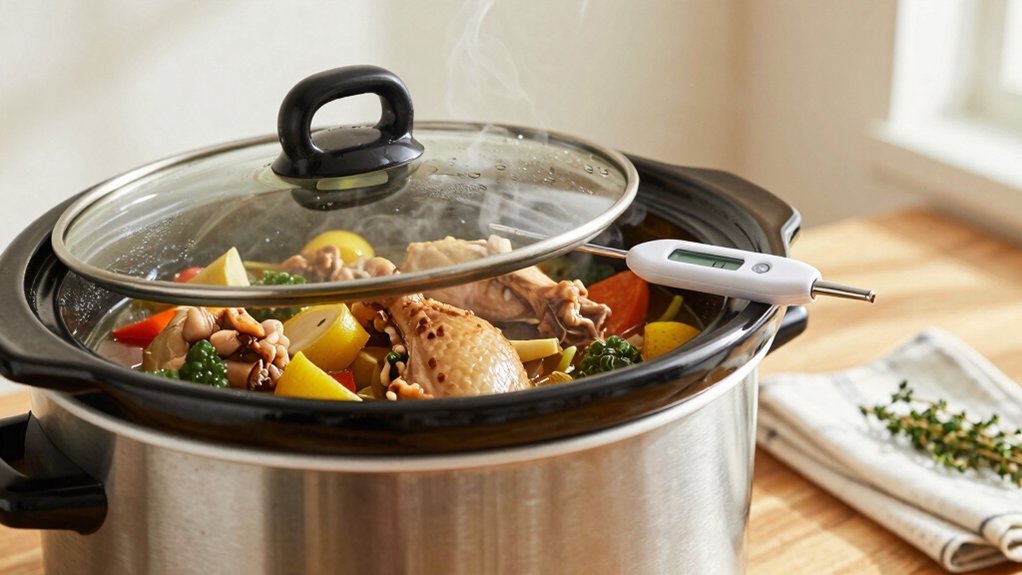
You should cook and hold slow-cooked food to specific temperatures measured with a probe thermometer: whole cuts (beef, pork, roasts) to 145°F with a 3-minute rest; ground meats to 160°F; and all poultry and leftovers to 165°F.
Start with chilled ingredients, keep the cooker half to two-thirds full, and expect typical stews on low to take 6 to 8 hours. Hold hot food at 140°F or above and cool or reheat quickly.
Quick Overview
- Cook whole beef, pork, and roasts to 145°F and rest 3 minutes; verify with a probe thermometer.
- Cook ground meats to 160°F and all poultry to 165°F; check thickest part without touching bone.
- Start with chilled ingredients, fill cooker half to two-thirds, and keep lid closed to raise temperatures safely.
- Typical low setting times: stews/soups 6–8 hours; larger roasts or whole birds require longer and temperature checks.
- Hold hot food at 140°F or above. Discard if held below 140°F or showing spoilage signs.
Internal Temperature Quick Chart
Wondering what internal temperatures you should aim for in your slow cooker? You’ll follow a clear chart: beef/pork/veal/lamb steaks and roasts 145°F with 3-minute rest; ground meats 160°F; poultry 165°F; soups, stews, casseroles and leftovers 165°F. Use an accurate probe thermometer and verify before serving.
| Food Category | Min Temp (°F) | Note |
|---|---|---|
| Beef/Pork/Roast | 145 | 3 min rest |
| Ground Meats | 160 | No rest |
| Poultry | 165 | All poultry |
| Soups/Leftovers | 165 | Reheat to 165°F |
Account for altitude adjustments and lid effects. High altitude may lengthen time to reach temp. Removing the lid drops temp and adds recovery time.
Low-Setting Safe Timeframes
How long can you safely cook on the low setting? You can use low safely when you control factors that prevent low temperature dangers: Start with cold ingredients chilled, cut food small, fill the cooker half to two-thirds, and keep the lid closed so steam raises internal temps quickly.
Preheat or use hot liquid if cook time is short. For most stews or soups, 6 to 8 hours on low reaches safe timeframes. Large roasts or whole birds need shorter high-start then low finish. Use a probe thermometer to confirm internal target temps (165 °F for poultry).
Don’t leave perishables longer than recommended cooling or refrigeration limits.
Follow these steps to stay within evidence-based safe timeframes and avoid microbial risk.
Hot-Holding Temperature Threshold
After cooking, keep food at or above 140 °F to prevent rapid bacterial growth and follow time limits. Discard perishables left above 40 °F for more than two hours.
Use a probe thermometer inserted into the thickest part of the food (not touching the pot) to verify holding and reheating temperatures. Cool leftovers to refrigeration within two hours, and reheat to 165 °F.
Watch for signs of spoilage: off odors, texture changes, or unexpected discoloration. When in doubt, throw it out.
Safe Holding Temperatures
Where should you keep hot slow-cooker food to prevent bacterial growth? Keep it hot: at safe holding temperatures of 140 °F or above to prevent pathogens from multiplying. Use an instant-read thermometer to verify the internal temperature of stews, soups, or meats before serving. The vessel should consistently register at or above 140 °F.
If you’re serving from the cooker, position it on a stable surface, keep the lid closed, and avoid frequent stirring that lowers temperature. For buffet service, use approved hot-holding equipment (chafing dishes, sternos, or electric warmers) that maintain 140 °F+. Label any held food with the verified internal temperature and monitor with periodic checks to ensure continuous safe holding and to meet basic food-safety standards.
Time Limits For Safety
When you hold slow-cooker foods for serving, keep them at 140 °F or above and limit the time they spend in the danger zone (40–140 °F) to prevent rapid bacterial growth. Perishable items exposed to temperatures at or above 40 °F should be discarded after 2 hours. You should plan serving timeframes safely around that two-hour rule: if food cools below 140 °F, move it to refrigeration or reheat to 165 °F within two hours.
If you need extended holding, maintain the cooker on low setting only when it reliably keeps food at or above 140 °F; verify with periodic checks. Avoid leaving prepared perishable dishes at room temperature during transport or buffet service. Discard leftovers not cooled or reheated within recommended limits.
Thermometer Placement Tips
To guarantee hot-holding safety, place your probe so it measures the hottest portion of the food you’re serving: typically the center of thick portions or the middle of a liquid mass. This location best confirms the cooker is maintaining the 140 °F threshold. Insert the probe at least 2 inches into solid foods or fully submerge it without touching the pot sides or bottom.
Check multiple spots (center, edge, and deepest point) for large batches to detect cool pockets. Use a calibrated instant-read or continuous probe thermometer and position it away from bones or dense fat, which read hotter.
Follow hot holding guidelines by verifying temperature after lid removal and periodically during service. Record readings, correct any areas below 140 °F, and retrain staff on proper thermometer placement.
Cooling And Reheating
How quickly you cool and reheat cooked foods determines whether they stay safe to eat. Cool hot foods from above 140 °F to below 40 °F within two hours; ideally, cool them to 70 °F within the first two hours and to 40 °F within four hours total. Then, reheat leftovers to an internal temperature of 165 °F before serving. Use shallow pans, ice baths, or rapid-chill equipment to speed cooling. Divide large batches into smaller portions, label times and temperatures, and never use a slow cooker to reheat or bring foods back into the safe hot-holding range.
Use proven cooling methods: shallow pans, ice-water baths, or commercial chillers. Refrigerate within the safe window. Follow reheating guidelines: reheat to 165 °F throughout, stir to eliminate cold spots, use stove or oven, and discard foods held too long in the danger zone.
Signs Of Spoilage
After cooling and reheating, you should keep hot foods at 140 °F or above to prevent spoilage. Watching for specific changes will tell you when to discard items. Check food spoilage indicators: off-odors (sour, sulfurous), sliminess, discoloration, or gas bubbles in sealed containers.
If texture changes occur—mushy vegetables, grainy sauces, or curdled dairy—treat these as signs of spoilage. Also note unexpected foaming or rapid pH shifts (sour taste) when safe tasting isn’t possible. Use a clean thermometer and discard if the temperature can’t be maintained above 140 °F during holding. When in doubt, throw it out; microbial contamination can be invisible yet dangerous.
Record holding times and temperatures to reduce risk and document safe practices.
Frequently Asked Questions
Can I Brown Meat Before Adding to the Slow Cooker?
Yes, you should brown meat before adding to the slow cooker. Browning meat (meat searing) improves flavor, texture, and surface safety by reducing surface bacteria. You’ll sear pieces in a hot skillet briefly. Then, transfer to the slow cooker with vegetables and liquid.
That step isn’t required for safety if you cook properly; however, it yields better taste and color. It also helps lock in juices during the long cook.
How Often Should I Clean the Removable Crock?
You should clean the removable crock after every use. Regular cleaning frequency prevents residue buildup and bacterial growth. Removable crock care includes washing with hot, soapy water or running it through the dishwasher if the manufacturer allows. For stuck-on food, soak briefly before scrubbing.
Inspect seals and lid; clean those too. Deep-clean monthly by soaking with baking soda or vinegar. Dry completely before storing to avoid odors and mold.
Can I Safely Cook Frozen Meat in a Slow Cooker?
You shouldn’t cook frozen meat in a slow cooker because frozen meat handling raises safety risks. The cooker may stay too long in the 40–140 °F danger zone, allowing bacteria to multiply. That’s a key slow cooker safety misconception.
Thaw meat fully in the fridge first, cut into even pieces, then follow recommended settings so the cooker heats quickly above 140 °F and reaches proper internal temperatures: poultry 165 °F, ground 160 °F.
What Size Slow Cooker for Feeding Six People?
You’ll want a slow cooker with a 6 to 7-quart size capacity for feeding six. That capacity lets you fit a main dish plus vegetables without overcrowding, promoting even heating and safe cooking.
Choose a model that maintains steady temperatures, has a tight-fitting lid, and fills halfway to two-thirds for best results. If you often double recipes, consider an 8-quart for extra room and flexibility.
Is It Safe to Leave a Slow Cooker Unattended Overnight?
Yes, you can safely leave a slow cooker unattended overnight if you follow safe practices. For unattended safety, start with a hot, preheated cooker; keep perishables refrigerated until use; fill it half to two-thirds; and use the low or high setting recommended for the recipe.
Overnight concerns include avoiding large roasts, keeping the lid closed, and ensuring internal temperatures reach safe levels (165°F for mixed dishes) so bacteria won’t multiply.
Conclusion
You’ve got clear targets: use a probe thermometer, hit safe internal temps (165°F for poultry, 145°F for whole meats, 160°F for ground meats), and don’t rely on appearance.
On low, bring food to temperature within 2–4 hours; don’t leave perishable foods in the danger zone (40–140°F) longer than 2 hours total. Cool leftovers quickly; refrigerate within 2 hours, and reheat to 165°F.
When in doubt, toss it. It’s not worth risking foodborne illness.