Ptfe Vs Ceramic Nonstick Coatings Explained
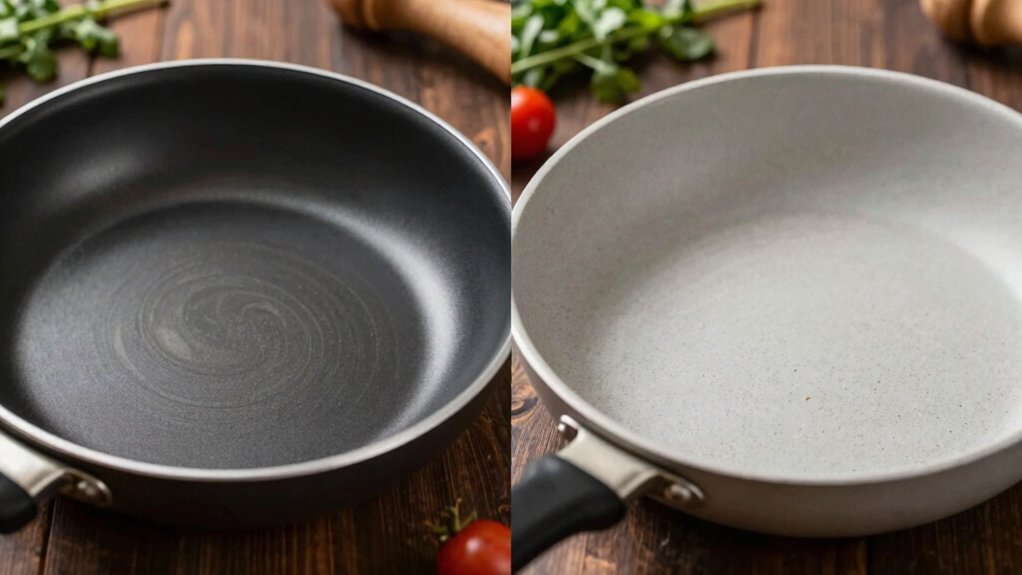
You’ll choose PTFE when you need very low friction, flexible release and resistance to cyclic bending up to about 260°C. It’s softer, tolerates deformation, and sacrifices surface material under abrasion.
You’ll choose ceramic when you need far higher heat and scratch resistance (often >500°C), a harder inorganic barrier, and better static abrasion performance. Though it’s more brittle under impact and thermal shock, if you want practical limits, wear mechanisms, and test methods, keep going.
Quick Overview
- PTFE coatings are soft, flexible, and excellent for dynamic deformation; however, they have a 260°C maximum safe temperature.
- Ceramic (sol‑gel/tri‑ply) coatings are much harder and resist static abrasion; they also tolerate temperatures well above 500°C when supported.
- PTFE thicker layers improve sacrificial wear but can delaminate under shear. Ceramics gain barrier protection with thickness; however, they increase tensile stress.
- For cleaning and longevity, use mild detergents and nonabrasive tools. Document cycles and replace coatings showing blistering or delamination.
- Choose ceramic for static abrasion resistance and high‑heat uses. Choose PTFE where bending, impact resilience, and low friction at moderate temperatures are required.
Heat Tolerance Comparison Chart
How hot can your coating actually run before performance or safety degrades? You’ll use the chart to compare continuous limits: pure PTFE tops at 260°C (500°F) and degrades above that, releasing fumes. PTFE composites behave similarly with slightly improved wear. Ceramic sol‑gel exceeds 500°C but is brittle under dynamic stress. Tri‑ply ceramic is high‑temp and abrasion‑resistant.
| Coating Type | Continuous Max Temp |
|---|---|
| PTFE (pure) | 260°C (500°F) |
| PTFE (composite) | ~260°C |
| Ceramic (sol‑gel) | >500°C |
| Ceramic (tri‑ply) | Very high, stable |
Don’t treat chemical sensitivity or mechanical brittleness as an irrelevant topic or unrelated factor; both determine safe operating envelopes and maintenance intervals.
Care & Use Temperature Limits
You’ve just seen the continuous temperature limits for PTFE and ceramic coatings. Now apply those limits to daily care and use to prevent coating failure and safety hazards. You should set explicit care limits: avoid PTFE exposures above 260°C and exploit ceramic tolerance beyond 500°C only when the substrate supports it.
Follow controlled heating and cooling rates to reduce thermal shock in ceramic layers and prevent PTFE decomposition products.
Establish cleaning routines that use mild detergents and nonabrasive tools to preserve coating integrity. Use temperature-verified cookware or fixtures; never assume nominal ratings without validation. Document operating cycles and replace items that show delamination, blistering, or discoloration. Avoid aggressive solvents on ceramic surfaces; verify chemical compatibility before cleaning.
These practices minimize degradation and ensure safe, predictable performance.
Scratch Resistance Ratings
You’ll compare hardness and durability metrics (e.g., Mohs, Vickers) to understand how PTFE’s flexible, softer film differs from ceramic’s hard, brittle matrix.
Then you’ll examine coating-layer thickness and standardized abrasion tests (Taber, ASTM G65) to quantify wear rates and translate them into common rating scales.
Finally, you’ll factor in real-world variables: mechanical abrasion, thermal cycling, and chemical exposure that shift laboratory ratings into practical service life.
Hardness And Durability
Because ceramic coatings form a dense, inorganic matrix of silicon compounds, they register much higher hardness ratings and resist abrasive wear better than PTFE, which remains comparatively soft and flexible. You should expect ceramic surfaces to withstand scratching and abrasion in static, high-contact applications. PTFE will endure bending and vibration without cracking; however, it will show surface gouging under hard abrasion.
You’ll encounter a durability paradox: ceramic’s superior scratch resistance increases service life in fixed, high-friction roles but introduces a brittleness factor that reduces tolerance for impact and flex. Quantitatively, ceramic Vickers/Knoop hardness values exceed PTFE by orders of magnitude. Yet ceramic microcracking under cyclic load shortens fatigue life where PTFE maintains integrity.
Choose by load type: static abrasion favors ceramic; dynamic deformation favors PTFE.
Coating Layer Thickness
Having established how hardness and brittleness influence service life, layer thickness becomes a primary variable controlling scratch resistance and failure modes in both PTFE and ceramic systems. You should evaluate coating layer uniformity and nominal thickness because they determine load distribution, penetration depth, and onset of substrate exposure.
Thicker PTFE layers increase sacrificial sliding capacity and reduce pinhole susceptibility; however, excessive thickness can delaminate under shear. For ceramic coatings, increased thickness improves barrier performance and scratch ratings but raises tensile stress and brittle fracture risk. Quantify thickness impact against expected contact stresses, thermal cycles, and substrate adhesion metrics.
Use cross-sectional metrology and layer-specific mechanical models to predict failure thresholds so you can balance scratch resistance with adhesion and residual-stress management.
Abrasion Test Methods
How do you quantify scratch resistance so you can compare PTFE and ceramic systems objectively? You use standardized abrasion testing protocols that impose controlled load, abrasive medium, and stroke cycles while measuring mass loss, depth of cut, or optical surface change. Instruments like Taber, linear reciprocating, and scratch testers provide repeatable metrics. You record force, indenter geometry, and wear track morphology.
Correlate results with coating adhesion measurements: pull-off or cross-hatch tests to separate substrate delamination from surface abrasion. Report specific parameters, such as abrasive type, grit, normal load, and cycles, along with statistical variance so comparisons are reproducible. For decision-making, focus on quantified wear rates, failure modes (adhesive vs cohesive), and post-test microscopy to link microstructure to observed abrasion performance.
Rating Scale Comparisons
Why trust a single number to reflect real-world scratch performance? You shouldn’t. Rating scales compress multi-dimensional scratch data: load, indenter geometry, cycle count, and substrate adhesion, into one index, which masks failure modes relevant to PTFE longevity versus ceramic performance.
When you compare scales, look for standardized inputs: indenter type (Rockwell, Vickers, or stylus), applied force range, and optical/microscopic criteria for failure. PTFE longevity shows progressive coating thinning and transfer rather than sharp fracture; thus, ratings based solely on groove depth understate eventual loss of non-stick function.
Ceramic aesthetics depend on microfracture thresholds and gloss retention. High scratch scores correlate with preserved appearance but not impact resistance. Use matched protocols to make defensible comparisons.
Real-World Wear Factors
Where do real-world wear patterns diverge from laboratory scratch scores, and what does that mean for choosing PTFE or ceramic coatings? You’ll find lab scratch tests quantify surface hardness and abrasive resistance under controlled loads. However, real applications add cyclic flex, thermal shock, and chemical exposure that alter failure modes.
PTFE shows low friction and retains function despite micro-scratches. Yet, PFAS-related manufacturing residues raise PTFE health considerations you must weigh.
Ceramic coatings register higher scratch ratings and maintain structural integrity in static, high-temperature contexts. Additionally, ceramic coatings are PFAS free, reducing chemical risk.
Inspect substrate adhesion, coating thickness, and expected mechanical strain: choose PTFE for dynamic, sliding contacts; choose ceramic where hardness, heat stability, and PFAS-free chemistry dominate performance priorities.
Frequently Asked Questions
Are Either Coating Types Safe for Food Contact Long-Term?
Yes, both can be safe food contact options long term with caveats. You should expect PTFE to be safe under normal cooking temperatures (PFAS residue and contamination history raise long-term questions.
Ceramic coatings are PFAS-free and withstand higher heat; however, they may leach with strong alkalis or degrade mechanically. Verify certified, food-contact formulations and supplier test data for long-term safety.
Do Either Coatings Release Fumes When Overheated?
Yes, PTFE fumes form when you overheat PTFE coatings above about 260°C, releasing toxic decomposition products. Avoid inhalation, ensure ventilation, and limit temperatures.
Ceramic hazards are minimal thermal decomposition fumes because ceramic coatings withstand >500°C. However, they can degrade or emit particulates if binders or contaminants burn during extreme overheating. Control temperature, use proper curing, and monitor air quality to mitigate both risks.
Can PTFE or Ceramic Coatings Be Recoated or Repaired?
Yes, both can be recoated or repaired, but recoating feasibility and repair approaches differ. You’ll find PTFE recoating widely feasible: it can be stripped, cleaned, and primed or applied at low cure temps; it’s suitable for on-site refurbishment.
Ceramic recoating often requires abrasive prep and high-temperature sintering in controlled facilities, making repairs limited and costly. For both, you’ll follow surface-compatibility tests, adhesion checks, and vendor-specific protocols to assure performance and safety.
Which Coating Is More Environmentally Friendly to Manufacture?
Ceramic coatings are more environmentally friendly to manufacture. You’ll see lower chemical persistence because ceramic processes are PFAS-free, reducing long-term contamination risks. However, sintering above 800°C raises energy demand.
PTFE uses PFAS (historically PFOA), creating significant recycling implications and persistent pollutants in water and soil. So you’ll favor ceramic for eco-friendly manufacturing, but you must account for higher energy intensity and end-of-life recycling strategies.
Do Ceramic Coatings Contain Silica or Nanoparticle Hazards?
Yes, ceramic coatings can contain silica and raise nanoparticle concerns. You should expect silicon-based compounds (silica, silicon dioxide, silicon carbide) in sol-gel or ceramic matrices. During manufacturing or abrasion, they can release fine particulates or respirable nanoparticles.
You’ll want material safety data, particle-size analysis, and engineering controls (ventilation, PPE) to manage ceramic hazards. Regulatory exposure limits and validated surface stability tests guide safe use and handling.
Conclusion
You should pick the coating that matches your priorities: PTFE offers superior low-friction performance and higher scratch tolerance in thin-film tests. Ceramic scores higher for sustained high-temperature stability and chemical inertness. Use the Heat Tolerance Comparison Chart and scratch-resistance data to set safe-use limits. Follow abrasion-test guidance to anticipate real-world wear.
For maximum longevity, control cooking temperatures, avoid metal utensils, and prefer thicker, multi-layer coatings backed by quantified hardness and thickness ratings.