Electric Griddle Temperature Zones Explained
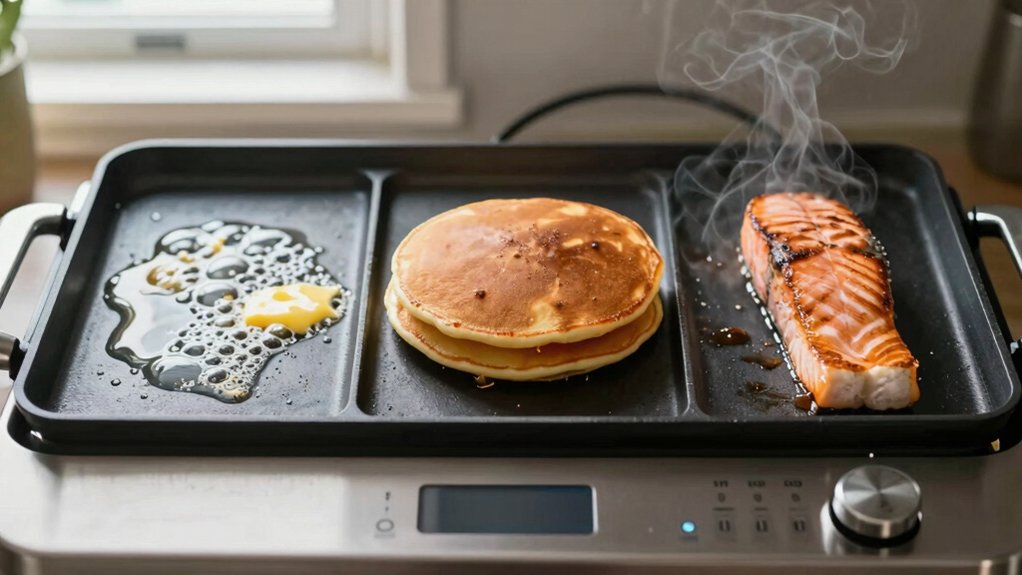
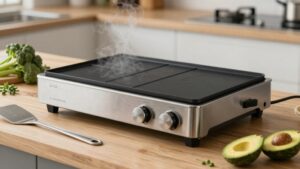
On a dual-zone electric griddle, you’ll set left for low-and-slow holding (200–225°F) and right for high-temp searing (300–400°F).
Then, preheat each zone independently and verify surface temps with an IR probe or water test.
Watts and plate mass dictate time-to-setpoint and recovery under load; so tune power split and keep adjacent burners active for smoother gradients.
Choose cordierite for steadier stability or cast iron for faster recovery and greater sear capacity.
More specifics follow.
Quick Overview
- Most electric griddles have multiple zones so you can sear on high heat and keep food warm on low heat simultaneously.
- Map surface temperatures with an IR probe or water tests to identify actual hot and warm zones before cooking. Use control knobs to allocate watts per zone; higher watts raise surface temps and shorten time-to-setpoint.
- Aim for searing zones around 400°F and holding zones near 200–225°F for optimal cooking and carryover.
- Choose plate material by needs: cast iron for faster recovery and stronger sears; cordierite for steadier stability and gentler handling.
Dual-Zone Temperature Map
Want to cook pancakes and sear steaks at the same time? You’ll use dual zone mapping to create a left/right split with independent control, letting you set a low (250–325°F) side for batter and a high (425–450°F) side for searing.
Preheat each zone fully and verify heat distribution with an IR thermometer or water tests (10s puddle, dancing water ~350°F). Use control knobs to tune flame or wattage per zone; maintain adjacent burners to avoid warping or cold corners. Move finished items to the warm side (200–225°F).
The table below illustrates a typical dual-zone layout and expected function.
| Zone | Function |
|---|---|
| Left | Pancakes/warm |
| Right | Sear steaks |
Surface Temps, Watts, Timings
How hot does the griddle surface actually get, and how do watts and time affect that heat-up and recovery? You’ll measure surface temps with an infrared probe and build a temperature map for any dual zone layout. Wattage determines rate-of-rise: higher watts shorten time-to-setpoint and improve recovery after food load. Thermal mass and plate contact area slow changes; lighter loads recover faster.
- Calculate time-to-temp: watts divided by plate mass gives seconds-to-setpoint under steady loss assumptions.
- Measure recovery: apply known heat sink (e.g., burger), record drop, then seconds to 90% recovery.
- Use temperature map to locate sear vs. hold zones; adjust power split on dual zone controls.
- Target cooking bands (300–400°F) where most reactions occur and validate empirically.
Cordierite vs. Cast‑Iron Plates
When you compare cordierite and cast‑iron plates, focus first on their heat‑retention characteristics and how those affect temperature stability across zones.
Assess surface durability, texture (porosity and seasoning response), and the practical impacts on weight, handling, and rate of thermal cycling.
Factor maintenance requirements: cleaning, seasoning, and chipping resistance; these directly influence long‑term zone consistency and performance.
Heat Retention Comparison
Heat retention differences between cordierite and cast-iron plates come down to thermal conductivity, specific heat capacity, and mass: cordierite, a ceramic composite, heats slower and stores less total heat per volume than dense cast iron. This characteristic buffers temperature swings, but it recovers more slowly after a cold load. On the other hand, cast iron conducts heat more readily, holds higher thermal mass at a given thickness, and returns to setpoint faster. This makes cast iron better for sustained searing and high-throughput cooking, while cordierite offers steadier, gentler temperature stability that can reduce hot-spot drift.
You will notice cordierite’s lower conductivity means slower temperature recovery when you add cold food; cast iron rebounds rapidly. Heat retention correlates with plate mass: thicker cast-iron plates maintain set temperatures during continuous loads.
Also consider surface texture: smoother cast iron transfers heat predictably for contact searing. In contrast, cordierite’s slightly more matte texture moderates direct conduction, affecting initial crust formation and short-term temperature transients.
Surface Durability Differences
Surface durability between cordierite and cast-iron plates differs fundamentally in composition and wear mechanisms; you should choose based on expected abrasion, thermal cycling, and maintenance practices.
Cordierite is a ceramic-oxide composite with low thermal expansion and excellent resistance to thermal shock. Its material composition yields high hardness but brittle fracture susceptibility under point impact. You’ll find cordierite resists corrosive degradation and surface oxidation without seasoning; however, repeated mechanical abrasion or dropping can crack the plate.
Cast iron is a ferrous alloy with ductile toughness and predictable plastic deformation. Its surface durability depends on oxide layer integrity and seasoning maintenance. You’ll need to manage rust by keeping seasoning intact and avoiding rapid cooling to prevent thermal-stress cracking and accelerated wear.
Cooking Surface Texture
How does the texture of cordierite compare to cast-iron plates, and why does it matter for cooking performance? You’ll find cordierite’s smoother, ceramic-like surface offers lower textural grip, so delicate foods release more readily and stick less at medium temperatures.
Cast iron’s micro-roughness increases textural grip; this improves sear contact and crust formation when you use medium-high to high zones. Thermal conductivity differences interact with texture: cast iron stores and transfers heat more uniformly, reducing localized heat loss under heavy contact. Cordierite can show faster cooldown under load, which increases the risk of uneven browning when you crowd the plate.
Choose cordierite for gentle release and easier cleaning. Choose cast iron when you need robust searing and predictable browning across varied zone setups.
Weight And Handling
After comparing texture and searing behavior, you should also consider how plate weight and handling affect setup, maintenance, and heat management. Cordierite plates are significantly lighter than cast-iron, so you’ll lift and index them with less effort; that reduces setup time and makes rapid zone adjustments easier.
Cast-iron’s mass provides superior thermal inertia, stabilizing high-heat zones and smoothing temperature gradients. However, its weight complicates handling and requires robust mounting. For commercial or frequent-use setups, choose cast-iron where thermal stability outweighs ergonomic cost. Select cordierite when modularity and faster replacement matter.
Inspect specifications for mass per unit area and mounting interface. Evaluate surface durability under repeated thermal cycling and abrasion; cast-iron typically rates higher, though coatings and finish treatments can narrow the gap.
Maintenance And Care
Regularly inspect and clean cordierite and cast-iron plates to preserve thermal performance and prevent contamination. Cordierite needs gentler handling and non-abrasive cleaning to avoid microfractures; cast iron tolerates more aggressive scrubbing but requires diligent seasoning to prevent rust. You’ll integrate maintenance care into scheduled cleaning routines: cordierite responds to soft brushes, mild detergents, and low-pressure rinses. Avoid metal scrapers and thermal shock from rapid temperature changes.
For cast iron, you’ll remove carbon build-up with stiff brushes or chainmail. Then re-season with thin oil films at 350°F to 400°F to restore the protective layer. Track wear, hairline cracks, and pitting; replace cordierite plates when porosity increases. Document procedures and intervals to maintain consistent thermal transfer and food safety.
Frequently Asked Questions
How Do I Calibrate My Griddle’s Thermostat for Accuracy?
You calibrate your griddle’s thermostat by comparing it to a verified surface thermometer and adjusting controls until readings match. Use calibration techniques: preheat to set points (e.g., 250°F, 350°F, 450°F). Measure with an infrared or probe thermometer for thermometer accuracy. Record deviations and apply offset adjustments or manufacturer trim procedures.
Repeat tests across zones and temperatures; document results. Recalibrate periodically or after repairs to maintain reliable performance.
Can I Use My Griddle Outdoors in Cold Weather?
Yes, you can use your griddle outdoors in cold weather, but you’ll need to manage thermal stress and griddle durability. Cold air increases heat loss; therefore, preheat longer and monitor surface temperature with an infrared thermometer. You should also expect higher gas or electric draw.
Protect controls from moisture and wind. Avoid rapid temperature changes to prevent warping, and follow manufacturer limits. Consider a wind shield and insulated cover for consistent performance and longevity.
What Maintenance Prevents Hot Spots Over Time?
You prevent hot spots by instituting regular maintenance routines: clean debris and grease after each use. Strip and reseason the cooking surface monthly, and inspect heating elements and thermostats for drift.
Calibrate temperature with an infrared thermometer quarterly and tighten loose fasteners or warped plates to maintain even contact. Replace damaged insulation or warped plates promptly.
These evidence-based steps ensure hotspot prevention and prolong consistent surface temperature and equipment life.
Are Nonstick Coatings Safe at High Griddle Temperatures?
Yes, but you shouldn’t routinely expose nonstick coatings to very high temperatures. Nonstick safety depends on polymer type and temperature limits; most PTFE-based coatings degrade above ~500°F (260°C) and can emit fumes.
Keep temps below manufacturer limits, avoid empty-element preheating, and monitor with infrared thermometers. For consistent safety at searing temps, use stainless steel or ceramic-coated surfaces rated for high-temperature coatings and follow maintenance guidelines.
Can I Convert a Single-Zone Griddle Into Multiple Zones?
Yes, you can create convertible zones on a single-zone griddle, but it’s a workaround. Use physical methods: heat sinks (thick steel plates), aluminum thermal breaks, or added baffles to alter heat flow. You may also add portable electric elements or a split-control thermostat mod if you trust your wiring skills.
Monitor changes with an infrared thermometer to verify thermostat accuracy and map surface gradients. Expect limited range and slower response compared with multi-burner designs.
Conclusion
You’ll choose a griddle by matching zone controls, thermal response, and plate material to your cooking needs. Cordierite offers faster heat-up and lighter weight; cast iron holds heat longer but needs more power and maintenance.
Prioritize surface temperature uniformity, watt density, and abrasion resistance for longevity. Consider plate texture for release and sear, and factor handling and cleaning procedures. These measurable attributes predict real-world performance and maintenance burden.