Dehydrator Temperature Ranges for Drying
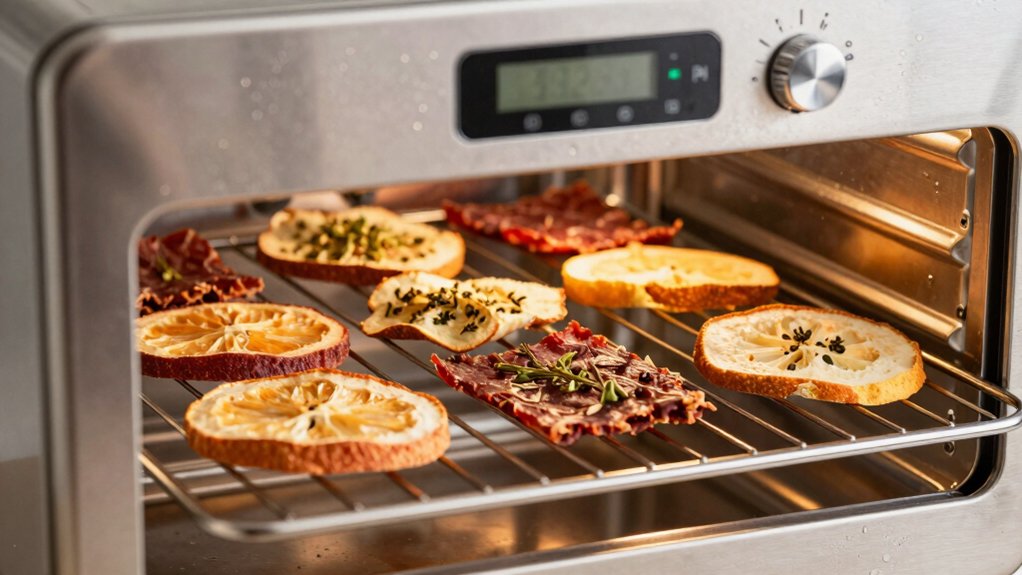
You should set dehydrator temps by product: 95–115°F (35–46°C) for delicate herbs to preserve volatile oils; 125–135°F (52–57°C) for most fruits and mixed loads to balance drying rate and nutrient retention. Avoid sustained temperatures greater than 140°F to prevent case hardening and pigment loss.
Use single-layer uniform thickness and maintain laminar airflow. Log RH and temps, and validate final moisture or water activity for safety. More specifics follow if you want operational details.
Quick Overview
- Fruits generally dry best at 125–135°F (52–57°C) to balance drying speed and nutrient retention.
- Herbs require lower temperatures, about 95–115°F (35–46°C), to preserve volatile oils and color.
- For mixed loads, use ~125°F (52°C) as a compromise between nutrient retention and even drying.
- Avoid sustained temperatures above 140°F (60°C) to prevent case-hardening and pigment degradation.
- Monitor RH; keep
Fruit & Herb Temp Matrix
How should you set your dehydrator for mixed batches of fruit and herbs? You’ll target a compromise: 125–135°F (52–57°C) for most fruits and 95–115°F (35–46°C) for herbs. For mixed loads, prioritize nutrient retention and color preservation by segregating trays or using lower combined setpoints near 125°F. This reduces vitamin A/C loss and prevents herb flavor volatilization.
| Item | Temp (°F/°C) | Rationale |
|---|---|---|
| Fruits | 125–135 / 52–57 | Balances drying speed with minimal nutrient loss |
| Herbs | 95–115 / 35–46 | Preserves volatile oils, pigments |
| Mixed | ~125 / 52 | Compromise: slower fruit drying, better herb preservation |
Use single layers, uniform thickness, and monitor moisture. Avoid >140°F to prevent case hardening and pigment degradation.
Layering & Airflow Tips
Having set your dehydrator temperatures for mixed fruit and herbs, pay careful attention to layering and airflow because they determine drying uniformity and product safety. You’ll arrange trays to maintain consistent layering airflow. Avoid overlapping pieces and keep thickness uniform so the matrix timing established for each food applies.
Position denser items lower if vertical airflow is stronger there. Rotate trays per scheduled matrix timing to equalize exposure.
- Space: Maintain 1–2 cm between items to prevent steam pockets and promote laminar flow.
- Rotation: Swap top-to-bottom at half the predicted matrix timing to reduce variance.
- Loading: Use single layers for thin herbs and staggered for thicker fruit to match dehydration kinetics.
Monitor humidity and visually verify even translucence.
Low-Temp Mold Prevention
When you dry at low temperatures to preserve nutrients, you must control temperature, airflow, and drying time precisely to prevent mold growth. Monitor and log humidity and circulation rates. Stagger trays to maintain even airflow. Extend drying time rather than lowering temperature when relative humidity stays high.
Also, separate and sanitize trays and tools between batches to prevent cross-contamination and microbial transfer.
Ideal Low Temperatures
Why should you avoid dehydrating at temperatures that are too low? Low temperatures slow moisture removal, extending time in the microbial danger zone where molds and yeasts proliferate. You should target temperature/time combinations that reduce water activity quickly: evidence and standards favor 125–140°F for most vegetables and fruits, with 140°F (60°C) as a commonly cited optimum.
Drying at 95–115°F preserves nutrients but only for low-risk items like herbs and some raw-food protocols. It requires controlled initial blanching or acidification to ensure safety. If you use low temperatures, monitor internal product temperature, use validated protocols for product type, and verify final moisture content or water activity. That prevents mold growth while balancing nutrient retention.
Airflow And Circulation
How does airflow speed and uniformity affect mold risk at low drying temperatures? You must control airflow patterns and circulation efficiency because at 95–115°F (35–46°C) moisture removal is slow. Uneven flow creates microclimates where relative humidity stays high, and mold spores activate.
Measure air velocity across trays; aim for consistent laminar flow that prevents stagnation pockets. Increase fan output or redesign baffles to equalize flow without raising temperature beyond nutrient-preserving targets. Monitor outlet humidity and use intermittent higher-velocity pulses to dislodge boundary layers on produce surfaces.
Validate with moisture probes placed in representative locations; acceptable variability is small. Target ±2–3% final moisture relative humidity across trays. Evidence shows improved circulation reduces surface condensation and lowers post-drying mold incidence.
Drying Time Management
Need precise timing? You’ll control drying time to prevent low-temp mold by matching temperature, thickness, and airflow. Use evidence-based benchmarks: fruits at 130–140°F typically finish faster than vegetables at 125°F. Thin slices reduce time nonlinearly. Monitor internal moisture reduction: target 10–20% residual moisture for shelf stability depending on food matrix.
Rotate trays and document elapsed intervals to build reliable two word discussion ideas logs (product × time). At lower temperatures (95–115°F), nutrient retention improves but drying time lengthens; this increases mold risk if air exchange is insufficient. Minimize risk by extending time only with adequate airflow and periodic inspection.
Record final weight and water activity when possible to validate safe completion.
Humidity Monitoring Techniques
Ever wondered which humidity metrics you should monitor to prevent low-temperature mold during dehydration? You should track relative humidity (RH) inside the chamber and dew point continuously. RH above ~60% at low drying temperatures (
Use a calibrated hygrometer with ±2% accuracy and log data at 5–15 minute intervals to detect stalls. Measure surface moisture indirectly via periodic weight-loss rates; a slowing curve at stable RH indicates bound water remaining.
Combine humidity monitoring with airflow tips: ensure uniform air exchange (CFM scaled to tray area) and avoid dead zones. Place sensors at inlet, center, and outlet. If RH spikes or weight loss stalls, raise airflow or temperature slightly until RH returns below target.
Preventing Cross-Contamination
Monitoring chamber humidity and airflow gives you early warning of conditions that favor mold. However, preventing cross-contamination addresses how contaminated materials, surfaces, or handling reintroduce spores into an otherwise controlled environment. You should implement validated cleaning protocols: use food-grade sanitizers on trays and seals, remove debris after each batch, and schedule weekly deep cleans.
Separate raw and dried-product workflows spatially and temporally to limit spore transfer. Use dedicated utensils and label trays to avoid mix-ups. Monitor temp stability during loading and unloading; temperature dips under recommended ranges (e.g., for fruits/vegetables) increase mold risk at low temps. Log cleaning, microbial swabs, and thermal profiles; review trends to confirm controls are effective and adjust procedures when contamination indicators appear.
Frequently Asked Questions
Can I Dry Dairy Products in a Dehydrator?
Yes, you can dry some dairy in a dehydrator, but you must follow dairy dehydration and dehydrator safety guidelines. You’ll use low heat, controlled time, and pre-treatment: acidify or pasteurize to reduce pathogens and avoid spoilage.
Hard cheeses, yogurt leather (strained), and powdered milk work best. Raw milk or creamier products need caution. Always cool quickly, store airtight, and rehydrate or use within recommended shelf-life for safety.
How Does Altitude Affect Drying Times and Temperatures?
Altitude raises reduce air pressure and water’s boiling point. So, you’ll see Altitude impact on drying times: drying takes longer at higher elevations.
You should make temperature adjustments by increasing set temps 5–10°F (3–6°C) or extending time 10–25% depending on elevation and humidity. Monitor moisture and water activity. Use longer runs rather than excessive heat to avoid case hardening. Validate with weigh/feel checks and adjust iteratively for consistent results.
Can I Dehydrate Flowers for Crafts or Tea?
Yes, you can dehydrate flowers for crafts or tea. You’ll use a dehydrator flower drying method at low temperatures (95–115°F) to retain color, aroma, and beneficial compounds. Herbs and delicate petals need cooler settings to avoid browning and volatile loss.
For craft tea dehydration, dry fully until brittle but not scorched. Store in airtight, dark containers, and label with flower type and date to ensure quality and safety.
What Are Signs a Batch Is Over-Dried or Brittle?
You’ll notice over dried indicators like excessive weight loss, hairline cracks, and faded color. The item won’t spring back when pressed. A brittle texture is evident when petals, leaves, or fruit snap immediately instead of bending; powdery residues or dust appear.
Moisture tests (squeeze or knife incision) show no pliability. Hygrometer readings remain very low. These objective signs confirm loss of structural moisture and degraded cell integrity.
Is Seasoning or Marinating Required Before Making Jerky?
No, seasoning before jerky and marinating before jerky aren’t strictly required, but they’re highly recommended for flavor, tenderness, and microbial safety. You should marinate with salt, acid, and antimicrobial ingredients (e.g., soy, vinegar) for at least 4–24 hours to improve taste and penetration.
Seasoning before jerky increases surface flavor. Combine this with correct drying temperatures and internal endpoint (165°F for poultry, 145°F for red meat) for safe, consistent jerky.
Conclusion
You’ve learned precise temperature ranges and airflow strategies to dry fruits, herbs, and delicate botanicals safely. Apply layered trays with 1–2 cm spacing. Maintain recommended low-temp ceilings to limit mold, and keep consistent circulation using fans or periodic tray rotation. Monitor chamber humidity with a calibrated hygrometer and log times to optimize throughput.
Prevent cross-contamination by separating aromatic materials and sanitizing trays. Follow these evidence-based controls to achieve reproducible, safe dehydrations.