
Dehydrator Food Storage and Moisture Testing
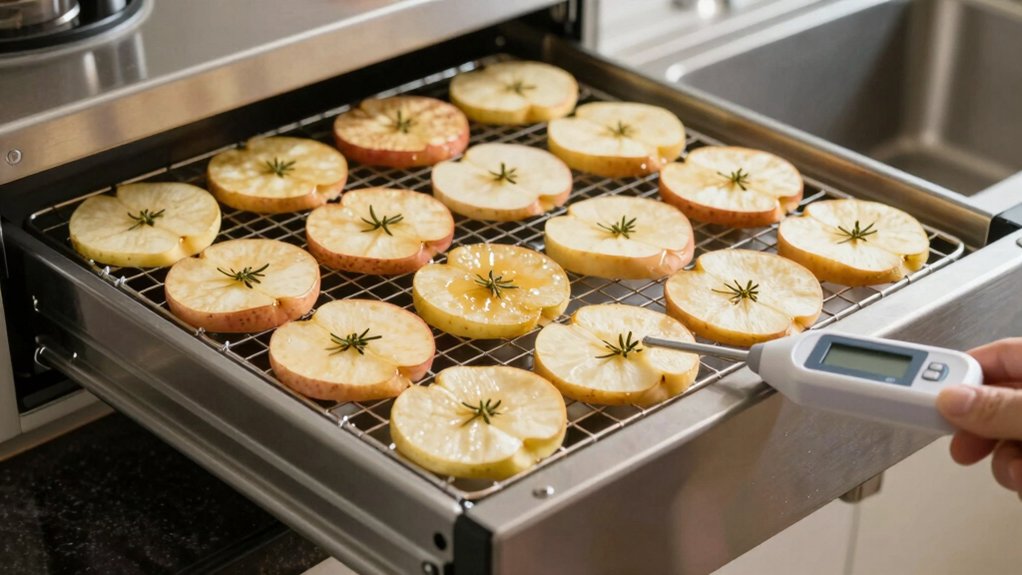
You should target low residual moisture and stable RH to maximize dehydrated food shelf-life. Small moisture differences hugely cut longevity and raise oxidation risk. Measure moisture gravimetrically or by Karl Fischer; validate with sensory checks. Set RH targets and tolerances tied to water activity; monitor with calibrated sensors.
Use desiccants and oxygen absorbers sized for headspace volume plus 10–20% margin. Ensure tight packaging. Continue for specific sizing, placement, and validation steps.
Quick Overview
- Measure residual moisture precisely (gravimetric or Karl Fischer) because small differences drastically change shelf-life.
- Target and control relative humidity/water activity to prevent microbial growth, texture loss, and accelerated oxidation.
- Validate shelf stability with sensory testing and storage trials at intended temperatures (25–35°C) to quantify life reductions.
- Size and place oxygen absorbers based on packaging headspace, residual oxygen, and higher moisture-driven oxidation risk.
- Monitor calibrated RH/O2 sensors and verify with lab tests. Adjust packaging, desiccants, or cold storage if readings drift.
Dehydrated Humidity vs. Shelf-Life
How does residual moisture affect the shelf-life of your dehydrated foods? You’ll find small moisture differences drastically change longevity: at 5 g/100g and 25°C in a 110 µm aluminum pouch, shelf-life reaches ~1,423 days. At 35°C, it drops two to three-fold.
Residual moisture raises water activity, speeds oxidation and browning, and can create localized condensation during temperature swings. Use gravimetric or Karl Fischer methods for precise measurement; then validate with sensory analysis to link chemical stability to consumer perception.
| Parameter | Practical implication |
|---|---|
| Residual moisture | Increases spoilage rate, shortens shelf-life |
| Temperature variability | Causes condensation, accelerates deterioration |
Rh% Targets & Tolerances
Why set precise relative humidity (RH) targets for dehydrated foods? You control microbial risk, texture retention, and shelf stability by specifying rh% targets and acceptable tolerances for each product. Use measured moisture control to match packaging and storage conditions.
Define rh% targets based on water activity equivalents and empirical shelf-life data. Set tolerances (± %) that reflect testing variability and expected environmental swings. Monitor with calibrated sensors and verify with gravimetric or Karl Fischer tests when borderline. Adjust packaging, desiccants, or storage temperature when readings drift outside tolerances.
Be practical: document targets, tolerances, and corrective actions. Consistent moisture control reduces spoilage, maintains quality, and gives you defensible, evidence-based storage criteria.
Oxygen Absorber Sizing Guidelines
When you size oxygen absorbers, start by matching absorber capacity to the packaging volume and the residual oxygen you need to remove.
Account for the moisture content of the food: higher water activity can increase oxidation risk and may require larger or more absorbers and strategic placement within the package.
Use proven practices for placement and distribution; combine absorbers with humidity control and appropriate packaging to reliably extend shelf life.
Determining Absorber Capacity
What volume of oxygen must an absorber remove to keep your packaged food safe for its intended shelf life? You calculate required capacity from headspace oxygen, initial residual oxygen, and the target oxygen level. Use measured package headspace volume and assume air contains 21% O2.
Factor in absorber performance degradation from temperature, humidity, and product respiration; high moisture reduces absorber life and can alter moisture stability of the pack. Select absorber grams based on manufacturer oxygen uptake rates (cc O2 per gram) and add a safety margin (20–50%) for real-world variation.
Verify sizing empirically: measure residual oxygen after sealing and during storage. Re-evaluate if you change product moisture, packaging, or storage conditions to maintain effectiveness.
Packaging Volume Calculation
How much headspace oxygen are you leaving inside each sealed package? Calculate internal volume precisely: measure bag or jar internal dimensions or use displacement with water for irregular containers. Multiply volume (L) by 22.4 to estimate milliliters of gas at STP per mole; use oxygen fraction (≈21%) to get available O2.
Select an oxygen absorber rated to remove that O2 plus a safety margin (10–20%) to account for packaging clearance and minor leaks. Factor dehydrator efficiency: drier foods reduce residual moisture and microbial oxygen demand. Therefore, absorber sizing can be lower when dehydration is optimal.
For mixed or variable fills, size absorbers for worst-case headspace. Record calculations and absorber batch ratings for reproducible, evidence-based packaging.
Food Moisture Considerations
Why does moisture matter so much for sizing oxygen absorbers? You must account for residual water because dehydrated humidity affects both oxygen consumption chemistry and microbial risk. Measure product moisture with a validated method (oven-dry gravimetric or Karl Fischer for accuracy) to determine water activity proxies used in calculations.
Higher residual moisture reduces the protective effect of absorbers and may require additional vacuuming, lower headspace, or alternative packaging to meet shelf life targets. Use absorber capacity ratings against measured moisture and package oxygen volume. An absorbent that’s oversized for oxygen but underspecified for moisture won’t prevent quality loss.
Document moisture data, test batches, and adjust absorber grams per liter empirically to align with your target shelf life and safety margins.
Shelf Life Extension Methods
When sizing oxygen absorbers for shelf-life extension, start by measuring your product’s residual moisture and headspace volume. Then match absorber capacity to both oxygen removal needs and moisture-driven risks. Use validated moisture data (oven-dry or Karl Fischer) and the absorber’s rated oxygen uptake (g O2 per unit) to calculate grams of absorber per liter of headspace. Include safety margins for variability in packing and water activity.
You should convert moisture results to water mass per package and estimate oxygen demand from residual respiration and headspace. Then select absorbers whose cumulative uptake exceeds that demand plus a 20–30% margin. Monitor dehydrated humidity and target water activity below thresholds known to preserve shelf life viability. Record calculations and verify with periodic oxygen measurements.
Placement And Distribution
Where should oxygen absorbers sit in your packaged product to give reliable protection? Place absorbers near the product center and at opposing corners for even scavenging. This placement strategy minimizes oxygen pockets and speeds uptake.
Size absorbers based on headspace volume and expected residual oxygen. Manufacturers provide capacity curves; match capacity to liters of headspace and initial O2 concentration. For multi-item or layered packages, distribute absorbers proportionally across layers to prevent localized spoilage.
Use small, multiple absorbers rather than one large packet when diffusion distances exceed a few centimeters. This improves distribution optimization and redundancy. Validate your design by measuring residual O2 after sealing and during storage. Adjust absorber count, size, or placement to maintain target oxygen levels throughout the planned shelf life.
Frequently Asked Questions
Can Dehydrators Affect Nutrient Retention in Foods?
Yes, dehydrators can cause some nutrient loss, but you can minimize it. You’ll experience Dehydrator nutrient loss mainly from heat-sensitive vitamins (C, some B vitamins) and oxidation.
Follow moisture retention guidelines: dry at lower temps, use even airflow, avoid over-drying, and cool/store promptly in airtight, dark containers. That practical approach preserves most nutrients and extends shelf life while keeping dehydration efficient and evidence-based.
How Do I Test Moisture in Oily Foods?
You’ll use testing methods suited for lipids: Karl Fischer titration for direct water measurement (best for oil compatibility and trace moisture) or oven-dry/gravimetric with solvent extraction for high-oil matrices.
Coulometric Karl Fischer works for very low moisture; volumetric suits higher water. Avoid standard infrared/gravity alone because oils retain bound water and volatiles.
Calibrate with oil-matched standards, run duplicates, and report method, detection limit, and sample prep details.
Can Vacuum Sealing Replace Oxygen Absorbers?
No, vacuum sealing can’t fully replace oxygen absorbers. Vacuum sealing removes most air but leaves residual oxygen and can leak over time. Oxygen absorbers chemically remove remaining oxygen, lowering O2 to near zero and preventing oxidation and aerobic spoilage.
For long-term storage, use both: vacuum seal to reduce bulk air. Then add oxygen absorbers to maintain low oxygen levels. That combo offers the most reliable preservation.
What Packaging Materials Block Moisture Best?
Metallized films and multi-layer laminates block moisture best; you’ll want materials with low moisture transmission and food grade coatings. Use aluminum foil laminates, PET/PE or PET/CPP multi-layers with barrier adhesives, or EVOH/PVDC barrier layers for high protection.
These combine impermeable metal or polymer barriers and compliant food grade coatings to limit moisture transmission. For long-term storage, pair barriers with proper sealing and humidity control for reliable results.
Are Humidity Packs Reusable?
Yes, most single-use humidity packs aren’t meant for reuse, but some reusable packs exist. You’ll avoid food storage myths by checking the manufacturer: reusable moisture packs (often gel-based with resealable pouches or rechargeable silica) can be dried or reconditioned per instructions.
Don’t assume all packs recover full capacity after one cycle. Evidence-based reuse depends on type, regeneration method, and indicator color change. Follow specs to ensure safe moisture pack reuse.
Conclusion
You’ve seen how controlling relative humidity, using correctly sized oxygen absorbers, and choosing proper packaging cuts moisture-driven spoilage and extends shelf life. Aim for target Rh% and measure food moisture before sealing. Calculate absorber capacity from package volume and expected oxygen load. Distribute absorbers near but not touching food for even protection.
With routine RH testing and conservative tolerances, you’ll reliably preserve texture, flavor, and safety. This approach maximizes storage life with predictable, evidence-based steps.