Countertop Oven Wattage and Energy Use
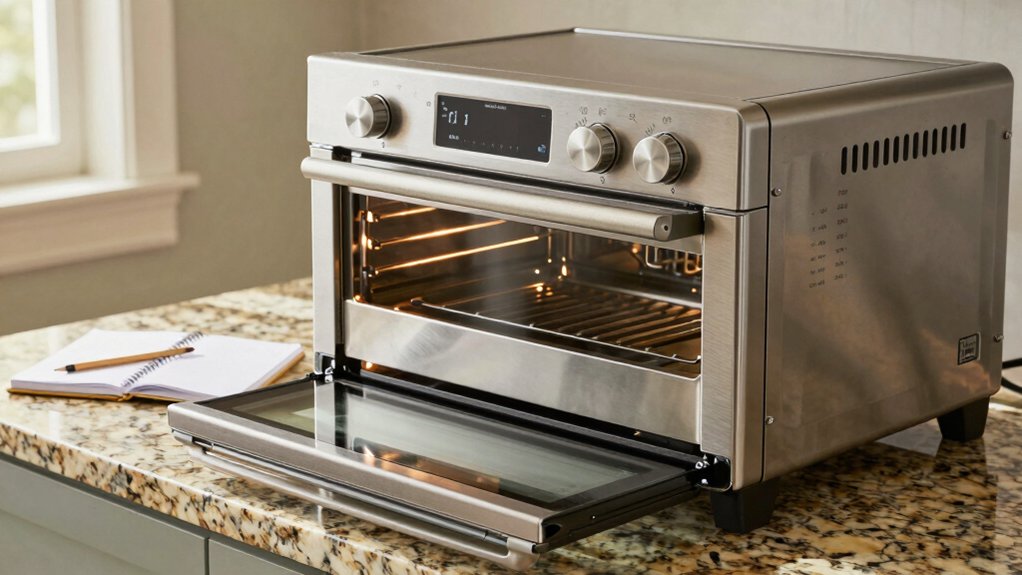
A countertop oven’s power varies: preheat often spikes 2,000–5,000 W; then it cycles to a 750–2,500 W steady state. Higher setpoints and poor insulation increase both peak and integrated energy. Expect preheat of 5–20 minutes.
The steady-state draw is approximately 30–40% below peak; roughly 2,500 W equates to ~41.7 Wh per minute.
Use your model’s measured peak and steady watts to scale cook times and costs. Further sections show specific adjustments and metrics.
Quick Overview
- Countertop oven power typically spikes 2,000–5,000 W during preheat; then it cycles to a lower steady-state draw.
- Convection bake steady-state draw commonly ranges 2,000–4,000 W. Keep-warm modes use about 750–1,500 W.
- Total energy equals integrated power over time: e.g., 3,000 W for 10 minutes ≈ 0.5 kWh.
- Wattage-based time adjustments: lower-watt units (750–1,200 W) need ~15–25% longer than a 1,200–2,000 W baseline.
- Calibrate per model: preheat spikes, duty cycle, steady draw for accurate energy and cooking-time estimates.
Wattage vs. Cooking Time Chart
How should you adjust cooking times for different countertop-oven wattages? You will reduce or extend times based on measured power differences and known inefficiencies. Microwave conversion formulas will not apply because radiant elements and temperature control alter heat transfer. Use wattage efficiency and energy comparison data to scale time: higher-watt units reach setpoints faster and maintain temperature with lower percentage draw.
Create an empirical chart from tests rather than theoretical multipliers.
| Wattage (W) | Relative time adjustment |
|---|---|
| 750–1,200 | +15–25% |
| 1,200–2,000 | 0% (baseline) |
| 2,000–3,000 | −10–20% |
Record preheat spikes and steady-state draw. Calibrate per model for reliable, decision-ready guidance.
Max Watt Recommendations by Function
Why choose a specific maximum wattage for each function? You’ll match peak draw to task, limit unnecessary consumption, and enable precise energy benchmarking for comparisons and two word discussion ideas like “power profiles.” Recommend max watts by function based on typical ranges and operational needs:
- Broil/grill — 3,000–5,000 W max: High instantaneous power short-duration cycles; design for heat flux and safety margins.
- Convection bake — 2,000–4,000 W max: Steady-state operation benefits from lower peaks to optimize kWh per cook.
- Keep-warm/low-temp — 750–1,500 W max: Continuous low draw minimizes standby energy.
You’ll use these caps to size circuits, estimate costs, and create reproducible benchmarks. Record runtime, duty cycle, and temp to validate energy benchmarking.
Power Draw During Preheating
When you preheat a countertop oven, you’ll see preheat time vary widely with size and setpoint, typically from 5 to 20 minutes for compact units. Expect a wattage spike, often 2–5 kW, during the initial ramp as elements run near max output; then it cycles down to a steady-state that can be 30–40% lower. The rate of temperature rise directly controls that spike magnitude.
Compare active preheat energy (Wh per minute) to standby draw to quantify cost impact. Decide whether preheating or using residual heat is more efficient for short tasks.
Preheat Time Variance
Curious about why preheating spikes power draw? You’ll see variance driven by target temperature, oven size, insulation, and element capacity. Data show preheat draws from ~2,000 W to peaks near 5,000 W as elements run continuously to overcome thermal inertia. Compact models cluster lower; larger units higher.
Time-to-temperature scales nonlinearly: doubling setpoint can increase preheat duration and integrated energy by >50% because heat loss rises with temperature differential. You should account for duty cycle: short cycling reduces average draw compared with continuous full-power runs.
Ignore unrelated topic or any tempting marketing angle; focus on measured watt-seconds during ramp-up. For energy budgeting, record seconds at full element output and convert to kWh for precise cost estimates.
Wattage Spike Patterns
How does a countertop oven’s power behave during preheating? You’ll see rapid wattage patterns: initial spikes up to 2,000–5,000 W as elements engage to overcome thermal inertia. That peak typically lasts seconds to a few minutes; then it cycles down as thermostats and relays modulate output. Measurable oscillations follow a decaying envelope before steady-state cooking levels (often 2,000–3,000 W) are reached.
These spikes correlate to Time to heat dynamics. Faster heat-up demands higher instantaneous power and shorter spike duration; slower ramps show lower peaks but longer cumulative draw. In practice, short high-power bursts consume a sizable fraction of preheat energy. Monitoring peak magnitude and duty cycle gives the most accurate estimate of preheat energy use.
Temperature Ramp Rate
Following the spike-and-cycle behavior described earlier, temperature ramp rate quantifies how quickly the oven raises internal air and element temperatures and how that maps to instantaneous and cumulative power draw. You’ll see preheat draw peak, often 2,000–5,000 W depending on model and setpoint; then decline as temperature approach reduces element duty cycle.
Measure ramp as °C/min. Faster ramps (higher °C/min) require sustained high power and increase short-term energy use but can improve overall energy efficiency by shortening high-draw duration. Quantify cumulative energy during preheat by integrating power vs time: a 3 kW peak held for 10 minutes consumes 0.5 kWh.
You should compare ramp profiles when selecting an oven. Steeper ramps save time; flatter ramps lower peak demand but may raise cumulative preheat energy.
Standby Versus Active
Why do we care about standby draw when preheating dominates energy use? You should, because standby energy accumulates over idle periods and can represent 5–15% of total session consumption.
During preheating, active cooking power spikes to 2,000–5,000 W; measured steady-state drops by ~30–40% after ramp. Quantify both: if preheat runs 10 minutes at 4,000 W, it consumes ~0.67 kWh. A 12-hour standby at 2–5 W adds 0.024–0.06 kWh. For typical weekly use, standby can add 0.1–0.4 kWh, small versus active cooking but non-negligible in low-use scenarios.
Reduce standby by switching power strips, disabling clocks, or using models with
Energy Per Minute
Wondering what the oven draws each minute while preheating? You should expect a spike. Typical countertop ovens draw 2,000–5,000 W during preheat; so per-minute energy equals power divided by 60. At 3,000 W that’s 50 Wh per minute (0.05 kWh).
For compact models peaking at 2,500 W, you get ~41.7 Wh/min. A 5,000 W transient yields ~83.3 Wh/min. Track cumulative minutes to estimate kWh consumed before steady state reduces draw by 30–40%.
Include non-thermal effects (fans, controls) which add tens of watts continuously and show up on energy labeling. So, reported wattage may differ from measured transient draw. Use a watt-hour meter to capture minute-resolution preheat profiles for accurate cost calculations.
Frequently Asked Questions
Can a Countertop Oven Run Safely on a Portable Power Station?
Yes, you can run a countertop oven from a portable power station only if the station’s continuous output (and surge capacity) meets the oven’s wattage and the battery energy covers runtime. Check oven draw (typically 750–3,000 W), portable power continuous rating, surge, and available kWh.
Account for inefficiency (approximately 15%), inverter limits, and ventilation. Safety concerns include overheating, overloads, proper grounding, and fire risk; follow manufacturer specs.
How Does Altitude Affect Oven Wattage and Cooking Performance?
Altitude effects reduce air density, so you’ll need longer cook times and higher temperatures to achieve the same results; this increases total energy use. You’ll measure a drop in convective heat transfer and boiling point (≈1°C per 285 meters), which lowers power efficiency during cooking.
Expect 10–30% longer runtimes at high elevations. Adjust setpoints and preheat duration to compensate, and account for increased watt-hour consumption when sizing portable power sources.
Do Glass or Metal Racks Change the Oven’s Energy Consumption?
Yes, glass racks and metal racks slightly affect energy use. Metal racks conduct heat faster; this marginally reduces preheat time and steady-state cycles by approximately 1–3%, lowering energy draw. Glass racks insulate and slow heat transfer; this may increase runtime by approximately 2–5%.
Net wattage differences are small versus total oven power, which is typically hundreds to thousands of watts. Choose metal for efficiency; choose glass for gentler, more uniform heat distribution.
Can Multiple Small Dishes Increase Total Energy Use vs. One Large Dish?
Yes, cooking multiple small dishes can raise total energy use compared with one large dish. Use energy accounting and dish clustering to analyze: more items increase heat loss during loading, interrupt airflow, and lengthen steady-state time. This often yields 10–30% higher kWh for identical mass.
You’ll see marginal increases from uneven heating and added preheat cycles. Consolidating items or using racks to promote uniform convective flow minimizes extra consumption.
Are Wattage Ratings Different Between US and EU Electrical Standards?
Yes, different standards affect wattage interpretation. You’ll see identical labels but different nominal voltages (US 120V vs EU 230V) and certification rules. Therefore, manufacturers rate appliances by input power under local supply.
Wattage (W) itself is universal; however, measured/test conditions and listed continuous vs peak draw vary by region. Check local spec sheets and certification marks to compare real energy use and required plug/circuit capabilities accurately.
Conclusion
You’ve seen how wattage and time drive countertop oven energy use, so use that data to optimize cooking. Choose higher wattage for shorter cycles when ramp rate and preheat spikes still yield lower total kWh.
For low-power tasks, pick lower-watt settings to avoid inefficient standby-heavy runs. Monitor preheat duration and spike behavior for your model and favor recipes that minimize idle heat time: those choices cut energy without sacrificing performance.