Air Fryer Troubleshooting Burning Food
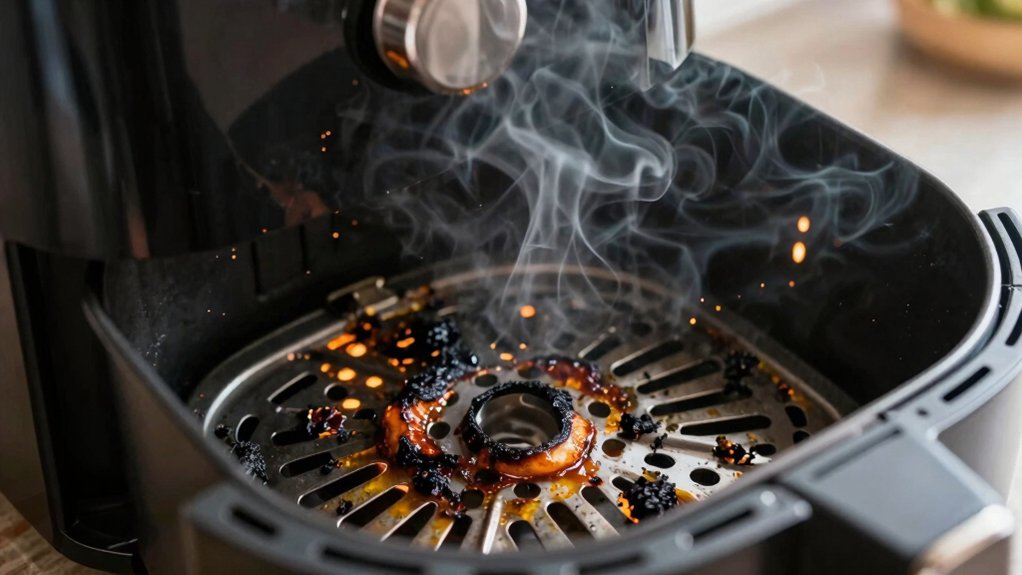
If your air fryer’s burning food, lower the temperature 25–50°F (10–20°C) and cut cook time 20–25%. Then preheat the empty basket 2–5 minutes and arrange food in a single layer so hot air circulates.
Check items 5 minutes early, shake or flip halfway, and reduce heat further for sugary or delicate foods. Confirm your model’s wattage and avoid overloaded circuits; follow manufacturer limits to prevent overheating.
Keep going to learn model-specific tweaks and timing charts.
Quick Overview
- Reduce the oven recipe temperature by 25–50°F (5–10°C) when converting to air fryer cooking.
- Cut the suggested cook time by about 20–25% and check food five minutes early.
- Preheat the empty basket for 2–5 minutes; then arrange food in a single layer for even airflow.
- If your unit runs hot or has high wattage, lower the temperature another 10–20°F and watch closely.
- Ensure the fryer’s circuit and outlet aren’t overloaded. Shared circuits or max-watt limits can cause overheating.
Temperature vs Time Chart
Wondering how to convert oven recipes or set a safe baseline for your air fryer? You’ll start with the general conversion: reduce oven temp by 25–50°F (5–10°C) and cut time by 20–25%.
Account for temperature variability across models; basket-style units run faster. Make time adjustments by checking 5 minutes early and adding small increments. Prevent burning by single-layer placement, flipping or shaking halfway, and lowering temps for delicate or sugary foods. Use internal-temperature targets for proteins and finish at higher heat for crisping if needed.
| Baseline Tip | Action |
|---|---|
| Oven→Air Fryer | –25–50°F, –20–25% time |
| Model check | Test ±5 min early |
| Delicate foods | Lower temp, monitor |
Preheat Basket Guideline
After you adjust oven recipes for air-fryer time and temperature, preheating the basket gives you predictable results: heat the empty basket for 3–5 minutes at the target cooking temperature (or 2–3 minutes for small, compact units) so the food starts cooking immediately and evenly.
You’ll avoid uneven browning and reduce burn spots by following clear preheat timing and consistent basket placement. Use this quick checklist before each batch:
- Confirm target temperature, then run empty basket for recommended preheat timing.
- Place food in a single layer, leaving space between pieces for airflow.
- Re-seat basket securely to ensure even circulation and check mid-cycle for hotspots.
Preheating is a simple, repeatable step that gives you control and predictable results.
Model-Specific Wattage Limits
Check your model’s wattage rating before adjusting cook settings because higher-watt units heat faster and can burn food if you use recipes meant for lower-watt fryers. If your air fryer approaches its max wattage or shares a circuit with other appliances, reduce temperature or cooking time.
Consult the manufacturer’s specifications to confirm safe limits. Refer to the manual for exact wattage, recommended settings, and any circuit or outlet restrictions to prevent overheating.
Check Your Model’s Wattage
How does your air fryer’s wattage affect cooking performance and the risk of burning? Check the spec label or manual to confirm your unit’s wattage; do not assume higher numbers are better. Wattage determines how quickly the appliance reaches and maintains temperature; matching recipes to your model prevents overheating and burnt edges. Treat other devices’ wattage as irrelevant wattage. Comparing unrelated safety specs can mislead adjustments.
If your fryer runs hotter than expected, reduce temperature by 10–20°F and shorten time; then test. Conversely, low-watt units may need slightly longer cooks at the same temperature. Note the manufacturer’s recommended limits and follow them. They are practical guidelines for reliable, even results without risking damage or burned food.
Max Wattage Impact
Wondering how the maximum wattage listed for your model affects cooking? You need to treat that rating as a ceiling; it defines heat delivery capacity and recovery speed. If you use accessories or replace parts with unrelated wattage ratings, you risk faster browning or uneven heating. Check the manual for permitted wattage ranges and don’t force higher-power elements into the unit.
A mismatch, hazard misalignment, can overload circuits, trigger thermal cutouts, or produce hotspots that burn food. When swapping components or using third-party inserts, verify compatibility with model-specific limits. If food burns despite correct settings, confirm the unit actually operates within its rated wattage and that power supply and outlet match specifications. Doing this prevents unexpected overheating and improves predictable results.
Adjust Temperature Settings
After confirming your air fryer’s wattage and ensuring compatible parts, adjust temperature settings to match that power ceiling so the unit doesn’t overwork and burn food. You should lower default or recipe temperatures when your model’s wattage is below typical ranges. Reduce by 10–20°C (about 25–35°F) and test. Treat recipe temperatures as guidelines, not commands: recipes from ovens or different air fryer models are an irrelevant topic when setting your device.
Monitor the first batch closely, and log successful temps for repeats. Don’t blame uneven results on an unrelated factor like finish or color. Focus on measured temperature adjustments, short test runs, and timed checks. This methodical approach prevents overheating, preserves delicate foods, and yields repeatable results.
Circuit And Outlet Limits
Curious about why your air fryer seems to overheat or trip breakers? Check the circuit and outlet limits first. You’re responsible for outlet safety: confirm the outlet isn’t shared with heavy appliances (microwave, toaster oven) that cumulatively exceed the circuit capacity.
Find the air fryer’s wattage on its label. Then add other loads on the same circuit; a typical household circuit handles 15–20 amps (≈1800–2400 watts). If totals approach that, you’ll risk tripping breakers or heat buildup that can affect cooking and cause burning.
Use a dedicated outlet or move other appliances. If unsure, consult a qualified electrician to verify wiring and install a dedicated circuit. That practical step prevents electrical stress and improves cooking consistency.
Manufacturer Specifications
Knowing your circuit capacity is only part of the picture. You also need to check the air fryer’s model-specific wattage limits printed on its label or in the manual. You’ll confirm the maximum draw and match it to your outlet to avoid tripping breakers or overheating wiring.
Note both continuous and peak wattage; some models list higher short-term peaks that can trigger protective circuits. Don’t ignore manufacturer warnings. Running a higher-wattage unit on a lower-capacity circuit causes inconsistent heating and can make food burn. Discard irrelevant discussion and nonessential chatter when consulting specs; focus on exact numbers, recommended extension use (usually none), and any required dedicated circuit.
Follow those limits and you’ll reduce electrical causes of burning.
Frequently Asked Questions
Why Is My Food Smoking Even at Recommended Temperatures?
Because burning oil or drips accumulate, food can smoke even at recommended temperatures. You should clean the basket, tray, and heating element to remove residue and avoid burning oil.
Improper airflow from overcrowding or touching pieces also raises local temperatures and causes smoking. Don’t overfill; use a single layer and shake halfway. For fatty or sugary items, lower the temp, check more often, and use parchment or drip trays to catch grease.
Can Sugar-Based Sauces Cause Sudden Burning?
Yes, sugar-based sauces can cause sudden burning. You’ll find sugars caramelize and then char quickly at high heat; this creates hotspots that burn surfaces while insides finish.
To prevent sudden burning, lower the temperature, apply sauces near the end of cooking, and watch closely during the final minutes. Use light glazes or dilute sauces, and check every few minutes. Thin, high-sugar coatings need the most careful timing and monitoring.
How Do I Prevent Grease Fires in the Air Fryer?
You prevent grease fires by keeping the fryer clean, avoiding excess oil, and monitoring cooking. Empty and wipe the drip tray and basket after each use. Remove accumulated grease from the heating element, and don’t overcrowd so fat can’t pool. Use lower temperatures for fatty foods, and check frequently.
For fire safety, unplug and close the drawer if smoke appears. Let it cool before cleaning, and keep a nearby fire extinguisher.
Will Using Parchment Paper Affect Browning or Burning?
Yes, parchment paper safety is fine if you use it properly. You’ll see some reduced browning effects where paper covers food because it blocks direct hot air. Leave space around edges for airflow and don’t stack paper under empty basket.
Use perforated parchment or cut holes; secure paper under food and avoid high temperatures or greasy drips that can smoke. Check food earlier than usual to prevent unexpected burning or uneven color.
How Often Should I Deep-Clean the Heating Element?
You should deep clean the heating element every 1–2 months, or immediately after heavy greasy or smoking cooks. Check monthly if you use the air fryer often. Reduce to weekly if you cook high-fat or sugary foods that cause residue.
To deep clean, unplug and cool the unit. Gently brush loose debris, then wipe the element with a damp cloth and mild detergent. Rinse, dry thoroughly, and reassemble before next use.
Conclusion
You can stop burning food by matching time and temperature to your model’s wattage, preheating only when the manual says, and not overloading the basket. Check your air fryer’s wattage and the outlet/circuit limits. Lower the temperature when wattage is high or meals are thin.
Follow manufacturer specs and the preheat basket guideline. Adjust times precisely and test in small increments until you get consistent results. Practical tweaks prevent most burning problems.