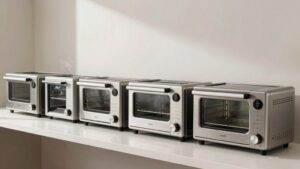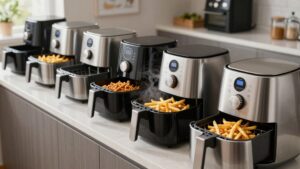
Air Fryer Toaster Oven Vs Convection Toaster Oven Differences
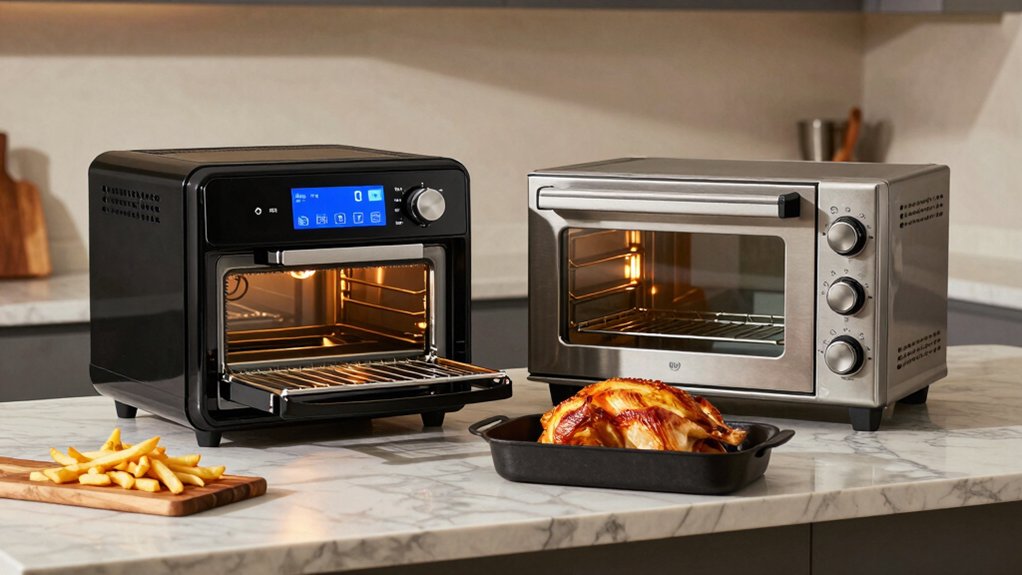
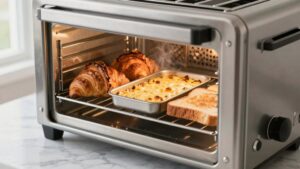
If you want fast, crispy results in a small footprint, an air fryer toaster oven heats and circulates air more quickly; you’ll get browning with little or no preheat.
However, you’re limited to one or two racks or a basket.
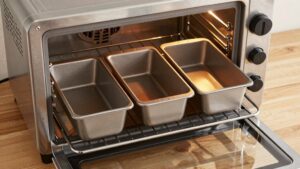
A convection toaster oven handles larger pans and multiple rack positions; it also provides steadier temps for baking or batch cooking.
However, it needs longer warm-up and uses more energy during preheat.
Keep going and you’ll get specifics on timing, capacity, and when to choose each.
Quick Overview
- Air fryer toaster ovens use smaller chambers, powerful fans, and close heating elements for faster browning and crisper results on small batches.
- Convection toaster ovens offer more rack positions and larger capacity. They can fit 9×13 pans and multiple trays for multi-item cooking.
- Air fryers preheat in approximately 0–3 minutes and stabilize quickly. This makes them ideal for fast, single-item meals.
- Convection ovens typically run 5–10 minute preheats with wider temperature swings. They are better suited for longer bakes and roasts.
- Air fryers use less preheat energy and cycle quickly. In contrast, convection ovens consume more energy warming larger air volumes but handle larger loads.
Rack Capacity Comparison
How many racks do you actually get and how does that affect what you can cook? You’ll notice rack comparisons reveal capacity emphasis: Air fryer toaster ovens often include 1–2 racks or basket positions, while convection toaster ovens offer 2–4 positions. That difference dictates whether you can do a 9×13″ pan, multiple trays, or just a single basket batch without crowding.
| Model Type | Rack Positions | Typical Outcome |
|---|---|---|
| Air fryer toaster oven | 1–2 (basket reduces usable area) | Best single-batch fries/wings; risk of overcrowding |
| Convection toaster oven | 2–4 (multi-rack) | Roast/bake multiple items; better airflow and spread |
Choose based on whether you need volume or crisp single-item performance.
Temperature/Timer Quick Specs
After considering rack capacity and how many items you can fit, you’ll want to look at temperature ranges and timer behavior since they directly affect cooking results and scheduling. You’ll notice clear differences: air fryers often run hotter and use shorter cycle timers. Convection toaster ovens have wider temp ranges and longer timers for baking. Avoid treating this as an irrelevant topic or turning it into an off-topic discussion; it is practical for timing and crispiness.
- Air fryer temps: typically 300–400°F, short timers, precise for quick browning.
- Convection oven temps: often 200–450°F, longer timers, better for larger roasts.
- Timer granularity: air fryers use minute-level presets; ovens offer longer intervals.
- Auto-shutoff safety differs by model; check specs before use.
Rapid Preheat Time Differences
You’ll notice big differences in cold start time and overall warm-up cycle length between air fryers and convection toaster ovens. Air fryers heat faster because their smaller chambers and closer heating elements reach set temperatures quickly. This affects temperature stability and energy use during preheat.
Comparing the preheat heat source and how long each unit maintains steady heat will help you choose the faster, more efficient option for your cooking needs.
Cold Start Time
Wondering which heats up faster when cold? You’ll notice air fryers beat convection toaster ovens on cold start time. With smaller chambers, closer heating elements, and higher fan speeds, air fryers achieve rapid cold-to-hot transitions; often needing no preheat or just about three minutes.
Convection toaster ovens, with larger volumes and more air mass, typically require 5 to 10 minutes to reach an equivalent temperature. That means if you’re starting from a cold unit and want speed, an air fryer gives a consistent rapid cold response and faster initial temperature stabilization. For quick single-item tasks or frozen snacks, the air fryer’s cold start advantage saves real time. For larger batches, the oven’s longer warm-up is more tolerable.
Preheat Heat Source
Since air fryers heat their smaller chambers with elements positioned close to the food and use higher-speed fans, they reach cooking temperatures far faster than convection toaster ovens; often needing no preheat or just about three minutes. Larger toaster ovens usually take 5–10 minutes to stabilize. This difference stems from heat-source proximity, chamber volume, and airflow intensity.
When you care about minimizing preheat time, the air fryer’s compact, high-intensity setup gives a clear advantage. You’ll notice shorter ramp-up because less air needs heating and the fan forces rapid convective transfer. Don’t confuse this with an irrelevant topic like total cooking capacity or an unrelated concept such as monitoring visibility; those affect use, not the fundamental heat-source-driven preheat speed.
Warm-Up Cycle Length
How quickly does your oven reach cooking temperature? You’ll notice air fryers often hit target temps in under three minutes because their small chambers, close heating elements, and high-speed fans concentrate heat. Studies and specs commonly cite rapid preheat as a core advantage.
Convection toaster ovens, with larger cavities and more thermal mass, typically need 5–10 minutes to stabilize. That difference matters when you want fast weeknight meals or repeat batches. Don’t treat warm-up length as an irrelevant topic or a stray consideration; preheat time affects total cook time, energy use, and timing for multi-item meals.
Choose an appliance based on how often you value immediate heat versus larger capacity and flexibility.
Temperature Stability
Because air fryers have smaller cavities, closer heating elements, and faster fans, they reach and hold target temperatures far more quickly and consistently than most convection toaster ovens. You’ll notice shorter preheat times; often none or just a few minutes. Therefore, temperature swings are minimal once cooking begins.
Convection toaster ovens, with larger volumes and greater thermal mass, take longer to stabilize and can show wider fluctuations as elements cycle. That affects timing-sensitive recipes: you’ll get more predictable short-cook results in an air fryer, while the toaster oven requires you to account for ramp-up and recovery after opening the door.
Avoid making an irrelevant topic or off topic comparison about features; focus on chamber size, fan speed, and element proximity for accurate expectations.
Energy Use During Preheat
Curious how much energy you use just to get a cooking chamber up to temperature? You’ll notice air fryers reach target heat far faster; often needing no preheat or about three minutes. Their preheat efficiency is higher. Smaller volume and concentrated heating elements reduce runtime and total energy draw compared with larger convection toaster ovens that usually need 5–10 minutes to stabilize.
Faster ramp-up cuts energy consumed during active heating; though frequent short cycles can raise cumulative use. Also consider standby energy: a convection toaster oven left plugged in or preheated longer wastes more standby energy than an air fryer that heats quickly and shuts off. For lowest consumption, match appliance size to task and avoid extended idle preheating.
Frequently Asked Questions
Can Either Appliance Fit a 12-Inch Frozen Pizza Whole?
Yes, a 12-inch frozen pizza usually won’t fit whole in most countertop air fryer baskets, so you’ll need to cut or fold it. A toaster oven, especially a convection toaster oven, commonly accommodates a 12-inch pizza whole thanks to larger interior space.
Check your specific appliance’s cooking capacity and internal dimensions before buying or cooking. Manufacturer specs confirm whether a 12-inch pie fits without trimming.
Which Option Is Easier to Clean After Greasy Cooking?
Air fryers are easier to clean after greasy cooking. You’ll remove the nonstick basket or drawer and wipe away grease quickly, minimizing scrubbing. For maintenance tips, soak greasy parts in warm soapy water; use a soft brush for stuck bits; and dry thoroughly to protect coatings.
Convection toaster ovens need more effort. Racks and trays trap grease, and the interior takes longer to degrease. Regular wiping prevents buildup.
Do Air Fryers Require Shaking or Flipping Food Mid-Cycle?
Yes, you’ll usually need mid cycle shaking or flipping in air fryers to get even browning and prevent steaming from overcrowding. Short, frequent turns (or a shake halfway) expose surfaces to hot air, improving crispiness. This is especially true for fries, wings, and small pieces.
If you space items well or use a convection toaster oven’s larger tray, you can reduce shaking; however, baskets often demand it for best texture and uniform cooking.
Can I Bake Cookies Evenly in an Air Fryer?
Yes, you can bake cookies evenly in an air fryer if you manage spacing and heat. Use a single layer with plenty of room. Lower the rack or use a baking pan to spread dough. Reduce the recommended oven temperature by 25°F.
Rotate the pan halfway through to promote even heating and prevent hot spots. Expect smaller batches than in a convection toaster oven; however, you’ll get crisp edges and tender centers.
Which Produces Crispier Frozen French Fries Consistently?
Air fryers produce crispier fries more consistently. You’ll get crunchier, golden results because the smaller chamber, higher heat, and stronger airflow reduce steaming and speed moisture evaporation.
In a consistency comparison, air fryers outperform convection toaster ovens for packaged frozen fries. Toaster ovens can work; however, they tend to yield floppier fries unless you space items widely and extend cook time. Monitor and shake the basket for best uniformity.
Conclusion
You’ll pick the right oven by matching features to your priorities. If you need extra rack capacity and steady, even heat for batch cooking, a convection toaster oven typically wins.
If you want faster preheats, shorter warm-up cycles and lower cold-start energy use for single meals, an air fryer toaster oven often performs better. Consider temperature stability data and preheat energy use for your typical cooking patterns to make an evidence-based choice.