Air Fryer Oven Vs Basket Air Fryer Differences
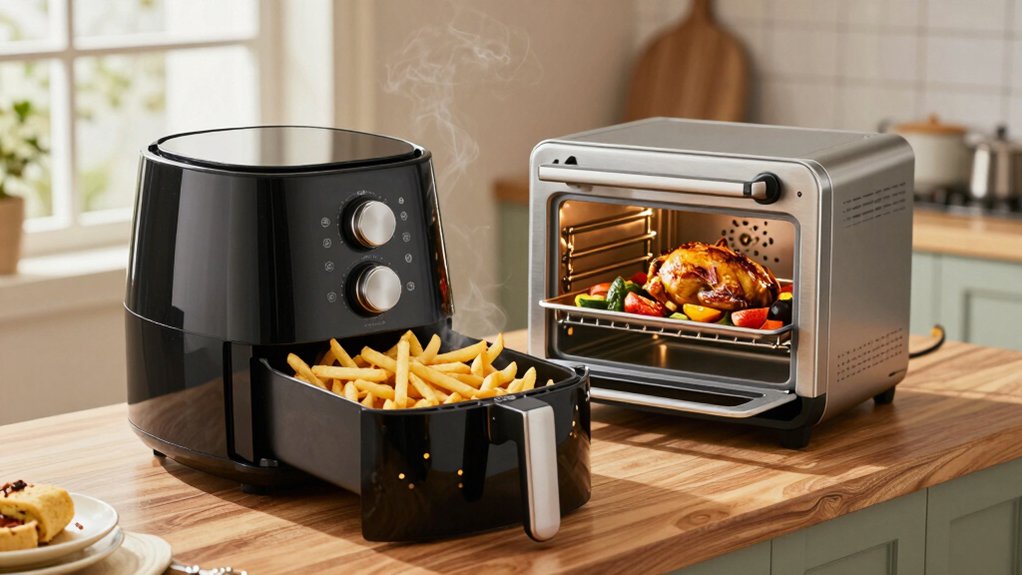
You’ll pick a basket air fryer when you want compact, fast-heating performance for 1–2 people and quick 2–10 L batches. It runs hotter and faster; so drop conventional temps ~25°F and shave about 20% off times.
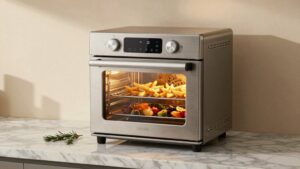
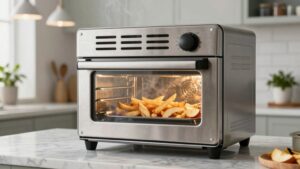
Choose an air fryer oven for larger loads, multi-rack cooking, and staging. Capacities run 12–34 L and support simultaneous dishes at the cost of counter space.
Keep calibrating with tests, and continue on to learn practical tweaks.
Quick Overview
- Ovens have larger capacity (12–34 L) for multi-rack meals; baskets are compact (2–10 L) for 1–4 people.
- Baskets heat hotter and faster; reduce conventional oven recipes by 25°F and ~20% time.
- Oven-style units support multiple dishes/racks simultaneously. Baskets are best for single small batches.
- Basket units have minimal countertop footprint; ovens require more space and ventilation.
- Baskets need frequent deep cleaning every 2–4 weeks. Ovens demand more gasket, glass, and vent maintenance.
Capacity & Footprint Comparison
How much counter space and food volume do you need? You’ll weigh capacity contrasts and footprint tradeoffs: baskets (2–10 L) suit 1–4 people and tight counters. Ovens (12–34 L) handle roasts, pizzas, and multi-rack meals; however, they need more space. Choose based on meal size, batch tolerance, and kitchen real estate.
| Scenario | Basket | Oven |
|---|---|---|
| Small/1–2 people | 2–5 L, fast, compact | Overkill, slower heat-up |
| Family/4+ | 5–10 L, may need batches | 12–34 L, multi-rack, fewer batches |
| Multi-dish simultaneous | Limited single layer | Multiple racks/zones, larger footprint |
| Counter impact | Minimal; fits small kitchens | Significant; needs wider/taller surface |
Match capacity to typical loads. Prioritize oven when multi-dish throughput outweighs space limits.
Temperature & Time Quick-Guide
Having picked the right size and layout, you’ll next match temperatures and cook times to each machine’s behavior. Basket air fryers run hotter and faster; you usually lower conventional oven temperatures by about 25°F and shave overall time by roughly 20%.
Use this quick-guide to convert recipes reliably and avoid treating conversion as an irrelevant topic or an off topic idea.
- Reduce oven temp by 25°F and cut time ~20% for basket units.
- For oven air fryers, keep listed temperature but expect 5–10% longer cook times.
- Check internal temps early: insert probe 5–10 minutes before expected finish.
- For layered cooking in oven models, rotate racks and stagger start times for uniform doneness.
Calibrate with simple tests (fries, chicken) to dial exact adjustments.
Cleaning & Maintenance Tips
You’ll want a routine that separates quick daily wipe downs from periodic deep basket cleaning to keep performance consistent. Compare oven interior care and filter/vent maintenance carefully: ovens need more attention for racks, trays, and vents; baskets are easier to strip and scrub.
Finally, adopt simple anti‑rust steps: dry thoroughly and avoid metal scouring on coatings to protect both types over time.
Daily Wipe Down
When did you last give your air fryer a quick wipe down after use? You should perform a daily wipe on exterior surfaces, control panel, door seals, and visible vents to remove grease and particles that accelerate wear.
For basket units, wipe the drawer rim and basket exterior. For oven models, clean front glass and accessible gasket areas. Use a damp microfiber with mild detergent, avoiding soaking electronics or heating elements. Dry thoroughly to aid rust prevention on mesh trays and exposed metal.
Inspect seals and hinges for residue that impedes closure. Quick daily attention reduces buildup, shortens deep-clean frequency, and preserves airflow efficiency. Don’t scrub perforated trays or immerse electronics; save that for deep cleaning routines.
Deep Basket Cleaning
Daily wipe downs cut surface grease that turns into stubborn residue. Therefore, schedule a periodic deep basket cleaning once deposits build or every 2–4 weeks depending on use. You’ll remove baked-on fat and carbonized crumbs by soaking the basket and drawer in hot, soapy water while you inspect seals and heater clearance.
Use a soft-bristled brush and non-abrasive pad to restore perforations; avoid steel wool that damages nonstick coatings. Rinse thoroughly and dry before reassembly to prevent rust and odor. Compared to oven racks, basket disassembly is simpler; however, you must still monitor airflow holes for clogging.
Don’t treat this as an irrelevant topic or approach it from an unrelated angle. Systematic cleaning preserves performance and prevents smoke.
Oven Interior Care
Because oven air fryers have larger cavities and multiple surfaces, you should follow a methodical cleaning routine that preserves airflow, heating elements, and finish while minimizing downtime.
You’ll remove racks and trays, soak them in warm, soapy water, then scrub perforations with a soft brush to avoid surface damage. Vacuum loose crumbs and dust buildup from corners and seams. Do not use water near the fan or element.
Wipe interior walls with a nonabrasive cleaner and microfiber cloth. For stubborn deposits, apply a baking soda paste, wait, then rinse. Inspect seals and door glass for residue; clean with a glass-safe solution.
Keep the exterior tidy and route the power cord to prevent cord clutter. Store it neatly after cooling to avoid kinks or tangles.
Filter And Vent Maintenance
How often should you check the vents and filters on an oven-style air fryer? Inspect vents and filters every 2–4 weeks with heavier use. Basket units need checks more frequently due to faster cooking and particulate generation. Use a soft brush or compressed air to clear lint and food particles to prevent vent clogging that reduces airflow and raises internal temperature.
For oven models, remove mesh filters and soak in warm soapy water. Then air-dry before reinstalling; basket filters are usually simpler to access. Track filter replacement intervals per manufacturer: typically 6–12 months or sooner if you notice odor or smoke. Document maintenance dates and symptoms. That comparative log helps you apply targeted cleaning schedules between oven and basket designs.
Preventing Rust Build-Up
Want to keep your air fryer components rust-free and functioning? You should inspect and dry removable parts immediately after washing to minimize surface moisture that initiates corrosion.
For basket models, focus on the inner basket and screws. For oven units, target racks and tray edges where food residue traps moisture. Use mild detergent, a soft brush, and a cloth; avoid abrasive pads that compromise coatings and lower corrosion resistance.
After cleaning, apply a light coating of food-grade oil to bare metal contact points to enhance rust prevention. Store parts separately in a dry area if you won’t use the unit for weeks.
If you detect pitting or flaking, replace affected parts. Restoration often fails and risks contaminating food.
Frequently Asked Questions
Can I Fit a Baking Sheet Inside an Air Fryer Oven?
Yes, you can often fit a baking sheet inside an air fryer oven if you check air fryer sizing first. Measure interior width, depth, and rack positions against the baking sheet dimensions. Many ovens accept half-sheet or smaller pans, but not full-size commercial sheets.
Use perforated or low-profile sheets to preserve airflow and crisping. Don’t block vents; allow clearance for circulation and even cooking across racks.
Are Replacement Parts Readily Available for Both Types?
Yes, replacement parts are generally available for both types. You’ll find replacement parts more common and affordable for popular basket models; this offers better availability and straightforward compatibility for baskets, liners, and heating elements.
Oven-style units have parts too, but compatibility varies by brand and model. Racks, trays, fans, and controls can be pricier and harder to source. Always check manufacturer support and part numbers before buying.
Do Air Fryer Ovens Support Rotisserie Accessories?
Yes, many air fryer ovens support an air fryer rotisserie, but compatibility accessories vary by model. You’ll find ovens equipped with rotisserie spindles, forks, and motor mounts. However, others need purchasable adapter kits.
Technically, confirm roast cavity dimensions, motor power, and rack spacing for proper balance and clearance. Practically, check manufacturer specs and part numbers to ensure accessories fit. Basket-style units rarely offer true rotisserie capability.
Which Model Is Quieter During Operation?
Basket models are generally quieter during operation. In a model comparison, basket air fryers use smaller fans and compact chambers, producing less motor and airflow noise than larger oven units.
You’ll notice quieter operation with baskets, especially for short tasks and reheating. Oven air fryers need bigger fans and more powerful circulation for even cooking; this raises noise levels. Choose based on noise tolerance and cooking needs.
Can I Use Silicone Molds in a Basket Air Fryer?
Yes, you can use silicone molds in a basket air fryer if they’re heat‑rated for at least 400°F and fit the basket without obstructing airflow. Silicone tolerates convection heat, won’t stick, and simplifies cleanup. However, it insulates more than metal; therefore, bake times may lengthen slightly.
Compare results with metal pans for crisp edges. Avoid overcrowding and ensure molds sit on a perforated tray or rack to maintain even circulation.
Conclusion
You’ll pick the right unit by matching it to your needs: choose a basket air fryer if you want faster crisping, a smaller footprint, and simpler maintenance for single-portion cooking. Choose an air fryer oven when you need larger capacity, multi-rack flexibility, and stovetop-replacing functionality.
Consider temperature uniformity, preheat time, and cleaning routines: wipe daily, deep-clean baskets, and keep vents clear to maximize performance and prevent rust. Balance footprint, workflow, and maintenance for best results.