Air Fryer Cooking Time Adjustments Vs Oven
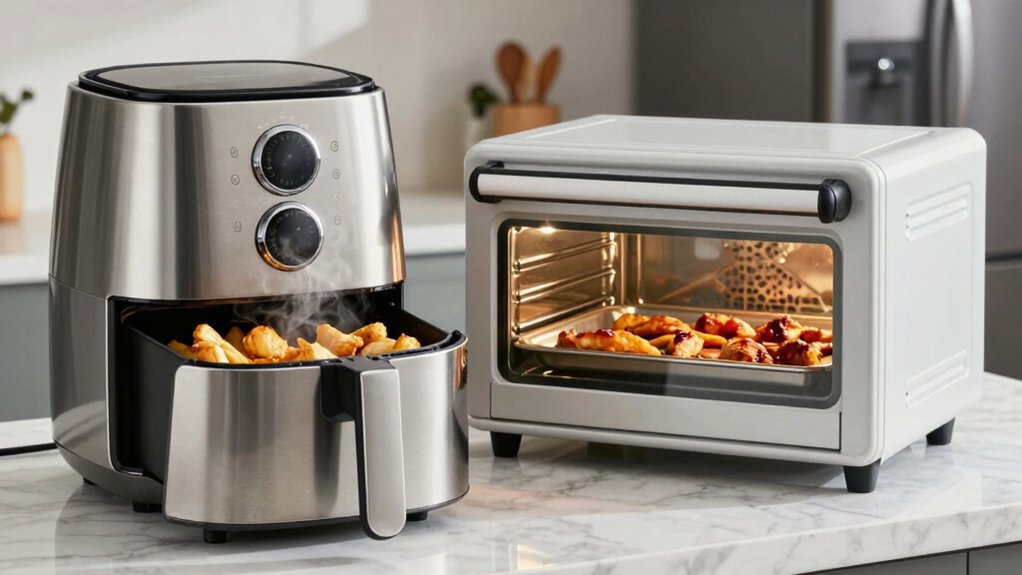
You’ll generally cook oven recipes about 20–25% faster in an air fryer. A 60-minute roast often finishes around 45–48 minutes with a crisper exterior. Reduce the oven temperature by roughly 25°F and preheat the air fryer 3–5 minutes.
Don’t crowd the basket; leave 1–2 cm around pieces and use racks instead of stacking. Start checking doneness early and rely on an internal thermometer. Keep going for tips on spacing, temps, and timing.
Quick Overview
- Air fryer cook times are typically about 20–25% shorter than oven times; reduce time accordingly (e.g., 60→48 minutes).
- Lower target temperature by roughly 25°F when converting oven recipes to air fryer settings.
- Preheat the air fryer 3–5 minutes. Start timing once it signals readiness.
- Avoid crowding. Use a single layer with 1–2 cm clearance or add racks and stagger pieces.
- Check doneness early; start at half the converted time and confirm with an internal thermometer.
Air Fryer Vs Oven Times
Wondering how much time you’ll save by switching from an oven to an air fryer? You’ll generally cut cooking time by about 20–25%. A 30-minute oven recipe becomes approximately 24 minutes in an air fryer. A 60-minute recipe becomes approximately 48 minutes.
Air fryers circulate hot air more intensely, so they crisp faster. Start checking at half the converted time to avoid overcooking. Don’t treat this as an unrelated topic to conversions; time and temperature shifts matter together. Reduce oven temps by approximately 25°F for air fryer use.
Quick reference:
| Oven Time (min) | Air Fryer Time (min) |
|---|---|
| 30 | 24 |
| 60 | 48 |
| 20 | 16 |
These evidence-based rules let you save time and even use budgeting tips for meal planning.
Basket Capacity & Rack Tips
How much you load the basket directly affects cook time and evenness. Do not crowd items; air needs room to circulate for the 20% time savings and 25°F temp reduction to hold true. You should match portion size to basket capacity. Overfilling forces longer cooks and uneven browning.
Use rack tips to layer without stacking. A second rack can increase capacity but needs spacing for airflow. Check food earlier when you add layers, and flip or rotate items halfway through the converted time. Measure outcomes and adjust future conversions based on crispness and doneness.
- Leave 1–2 cm clearance around items for proper circulation.
- Avoid stacking; use a single layer when possible.
- If using racks, stagger pieces vertically.
- Reduce batch size for consistent results.
Preheating Temperature Differences
When you preheat an air fryer versus a conventional oven, expect shorter heat-up times and slightly lower target temperatures: typically about 25°F less for air fryer conversions.
Compare heat-up methods too. Concentrated, fan-driven circulation in an air fryer achieves working temperature faster and can change surface texture by crisping more quickly.
Factor these differences into safety and timing by checking doneness earlier and following manufacturer preheat recommendations.
Preheat Time Differences
Why does preheating matter for air fryers compared with conventional ovens? You should preheat an air fryer for a shorter preheating duration because its smaller cavity and rapid fan-driven circulation reach target temperature faster. Measured tests show many models stabilize within 3–5 minutes; this is versus 10–15 minutes for full-size ovens. That difference changes initial heat transfer to food and affects searing, rise, and browning kinetics.
You’ll notice the airflow impact is immediate in an air fryer: intense convective flow reduces cold-start lag and promotes even crust formation. Practically, shorten your preheat time when converting oven recipes. Begin timing once the unit reports readiness. This prevents overcooking and aligns converted time reductions with actual operating conditions.
Target Temperature Variance
Curious about the exact temperatures you should target when preheating an air fryer versus a conventional oven? You should plan for a consistent target variance: lower setpoints for the air fryer. Evidence-based conversion guidance recommends reducing oven temps by about 25°F when moving to an air fryer to account for faster, more efficient heat transfer. That temp difference rule prevents excessive browning while preserving cook speed.
Practically, if a recipe calls for 400°F in an oven, target 375°F in the air fryer; 375°F becomes 350°F. Monitor internal doneness rather than relying solely on set temperature. Start checking at the converted time and adjust by 25–50°F only when your model runs consistently hot or cool.
Heat-Up Methods Compared
Although air fryers and conventional ovens both reach cooking temperatures, they heat up differently, and you should account for that when preheating. Particularly because air fryers achieve target temps faster due to their compact chambers and powerful fans, you’ll usually preheat an air fryer for 3–5 minutes versus 10–15 minutes for an oven. That faster warm-up means you can start timing sooner and follow the time reduction guidelines.
In non-oven comparisons, factor in that air fryers stabilize temperature quickly but can cool faster when opened; use brief door checks. Adopt simple cooling methods: resting food on a rack away from residual airflow to avoid carryover cooking. These adjustments keep conversions precise and prevent overcooking.
Effect On Texture
Because air fryers reach cooking temperature in 3–5 minutes while ovens take 10–15 minutes, the starting temperature and preheat behavior noticeably shape final texture. You’ll find texture results differ because the air fryer’s rapid heat and active circulation crisp exteriors faster, locking moisture inside.
When you reduce oven temperatures by about 25°F for air frying and shorten time by roughly 20%, you avoid over-browning while maintaining crispness. Browning differences stem from the fan-driven surface dehydration versus the oven’s gentler, more uniform heat; the oven yields softer interiors and milder crusts.
For foods where a crisp exterior with tender interior matters, use the air fryer with adjusted time and temperature. For uniformly soft textures, stick with the conventional oven.
Safety And Timing
How should you adjust preheating when switching between an oven and an air fryer to keep cooking safe and timed correctly? Preheat both appliances, but shorten air fryer preheat time: Most models reach set temperature in 3 to 5 minutes versus 10 to 15 minutes for a conventional oven.
Reduce oven temperatures by about 25°F when converting recipes. Start checking food at the halfway point of the converted time to prevent overcooking. For safety reminders, always confirm internal temperatures with a probe thermometer. Avoid overcrowding the basket, and let air circulate freely.
Rely on accurate timers; timer accuracy matters more in air fryers because faster cooking narrows the margin for error. Adjust times, monitor doneness, and follow manufacturer guidelines.
Frequently Asked Questions
Can I Use Oven Recipes for Delicate Baked Goods in an Air Fryer?
Yes, you can adapt oven recipes for delicate baked goods, but you’ll need care. Reduce temperature by about 25°F and cut time roughly 20%. Start checking halfway. Use lower air-fryer racks, gentle baskets or pans, and avoid overcrowding to prevent over-browning.
Expect crisper crusts and faster set times. Cakes and custards may prefer oven bake modes. Test with small batches and follow manufacturer guidance for best, evidence-based results.
How Do Altitude or Humidity Affect Air Fryer Cooking Times?
You’ll see altitude effects and humidity impact air fryer cooking. At high altitude, lower air pressure speeds evaporation; so foods can dry faster and may need slightly more time or added moisture. Reduce temperature by ~25°F and check earlier.
High humidity slows evaporation; so crisping may take longer and you might increase time a bit. Always monitor doneness early, adjust time in 10–15% increments, and use a thermometer for accuracy.
Are Microwave-Prepared Leftovers Suitable for Air Frying Afterward?
Yes, you can reheat microwave leftovers in an air fryer safely. For air fryer safety, transfer food to an oven-safe container or use the basket; avoid sealed plastic and check for even heating.
Set a moderate temperature (about 350°F) and reduce time compared to oven guidance. Watch closely to prevent drying. Start checking at the halfway point; stir or flip for uniform crisping, and ensure the internal temperature reaches 165°F.
What Safety Precautions Differ Between Air Fryers and Ovens?
You should note safety features differ between air fryers and ovens: air fryers have automatic shutoff, cool-touch exteriors, and shorter cords. Ovens rely more on built-in thermostats, safety locks, and hardwired installation. Because appliance differences affect burn and fire risk, you’ll avoid overcrowding, use oven mitts, keep ventilation clear, and follow manufacturer maintenance.
You’ll also never leave either appliance unattended during high-heat cycles or bypass safety interlocks.
Can I Convert Pressure Cooker or Slow-Cooker Recipes for the Air Fryer?
Yes, you can convert pressure cooker or slow-cooker recipes for the air fryer, but you’ll use different conversion methods and check equipment compatibility.
Pressure-cooked braises need deconstructing into crispable pieces. Slow-cooker stews require drying and higher heat. Reduce time and temperature, preheat, and monitor closely.
Confirm your air fryer’s basket size and manufacturer limits to avoid overcrowding and ensure even browning. Adjust liquid and layering accordingly.
Conclusion
You’ll usually need shorter cook times and lower temperatures in an air fryer than in a conventional oven because concentrated, convective heat and compact baskets speed browning and crisping.
Adjust by reducing oven recipes about 20–25% in time and 15–20°C (25–35°F) in temperature. Monitor internal temps and avoid overfilling baskets or racks.
Preheat briefly, use probes when possible, and prioritize texture and safety: aim for recommended internal temperatures rather than arbitrary times.