Air Fryer Cooking Temperature Range Explained
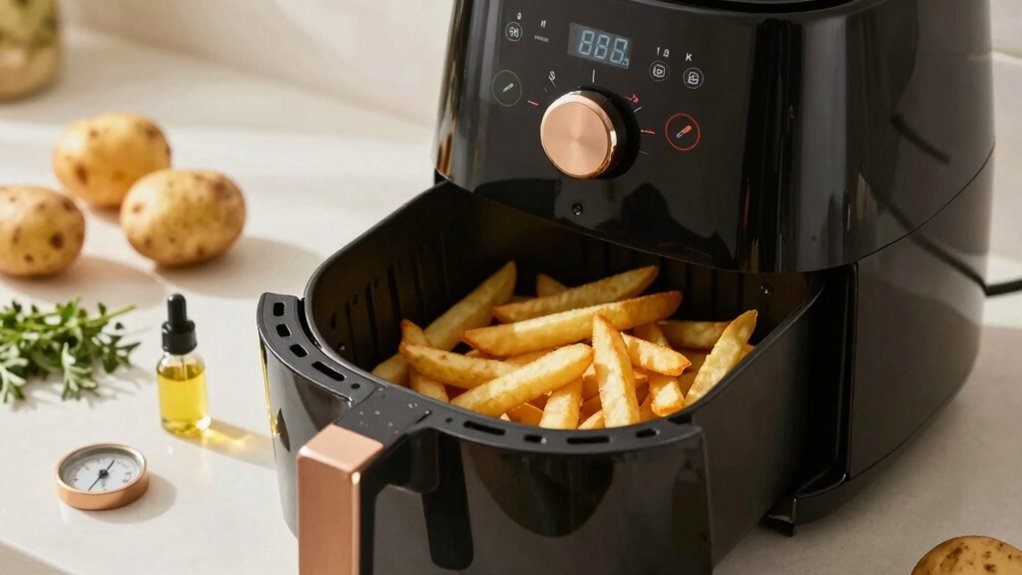
You should set your air fryer between about 360–400°F (180–205°C) and match the temp to food type and thickness: vegetables and delicate seafood do well at 380–400°F for quick crisping.
Dense roots and whole beets need parboil plus longer time.
Chicken cooks safely around 370–380°F.
Steaks benefit from 400°F for searing.
Don’t exceed your model’s max. Preheat briefly, use silicone liners, and clean the ceramic basket to avoid damage; more practical tips follow.
Quick Overview
- Air fryer temperatures typically range 320–400°F (160–205°C), varying by model and recipe density.
- Reduce conventional oven temperatures by ~25–50°F; cut cook times about 20–25% for air fryer conversions.
- Vegetables and delicate seafood use higher short bursts (380–400°F) for crisp edges. Roots need parboil and longer time.
- Meats cook between 360–400°F. Chicken cooks around 370–380°F for juiciness; steak cooks at ~400°F for a good sear.
- Respect your model’s max-temp limits (often 320–392°F). Avoid prolonged top heat and preheat briefly to protect ceramic baskets.
Temp Range by Food Type
How should you pick an air fryer temperature for different foods? You’ll match texture goals and density: vegetables and delicate seafood use higher short bursts (380–400°F / 190–205°C) for crisp edges. Dense roots and whole beets need longer, similar temps with parboil. Meats sit lower or variable; chicken 370–380°F for safe juiciness, steak at 400°F for sear.
Apply evidence-based conversions from oven recipes: reduce temps ~25–50°F, time −20–25%. Use different spice blends but don’t let seasoning obscure target temps. Debunk cooking myths that higher always equals faster. Monitor thickness, shake/flip, and check internal temps.
| Food Group | Temp (°F) | Typical Time |
|---|---|---|
| Veggies | 380–400 | 5–20 |
| Meat | 360–400 | 6–60 |
Max Temp Safety Limits
You’ve just learned how food type and thickness guide temperature choices. Now consider the upper limits air fryers safely handle. You should know each model specifies a max temperature and built-in safety limits: usually 160–200°C (320–392°F). Exceeding manufacturer limits risks thermostat failure, motor strain, degraded nonstick coatings, and fire hazards.
Rely on specs, routine maintenance, and brief preheats rather than prolonged runs at top heat.
- Visualize a thermostat cutoff activating when internal temps exceed design tolerances.
- Imagine weakened coating off-gassing after repeated exposure near maximum heat.
- Picture fan motor overheating under sustained top-temperature cycles.
Follow manufacturer max temperature guidance and allow cooling cycles to preserve safety limits and appliance longevity.
Avoid Overheating Ceramic Baskets
Don’t run ceramic baskets at the highest air fryer settings; use lower maximum temperatures and preheat only briefly to reduce thermal stress. Avoid sudden temperature spikes. Opt for silicone liners when suitable, and clean the basket after each use to prevent residue that concentrates heat.
These steps extend the basket’s lifespan and maintain cooking consistency.
Use Lower Maximum Temperatures
Why lower the max temperature on your air fryer when it has a ceramic basket? Ceramic tolerates heat; however, prolonged exposure to top-end settings accelerates glaze cracking and surface discoloration. You should favor low temperatures where possible to protect the basket and maintain energy efficiency. Cooking at 170–190°C (340–375°F) for many items reduces thermal stress while still delivering crisp results.
Adopt a methodical approach: consult recipe profiles, reduce oven-to-air-fryer conversions by 10–20°C, and stagger high-heat steps. Finish with a short blast if needed. Monitor internal food temperatures with a probe rather than relying on maximum settings. That evidence-based routine extends basket life, preserves non-reactive surfaces, and lowers power draw without compromising cooking performance.
Preheat Briefly Only
How long should you preheat an air fryer with a ceramic basket? Limit preheating to 3–5 minutes at target temperature; ceramic retains heat and prolonged empty heating can degrade the coating.
Use preheating tips: set timer, monitor temperature, and avoid running at the highest setting while empty. Rely on sensory cues: warm basket surface and reduced fan noise to judge readiness rather than long clocked cycles. If a recipe calls for immediate loading, preheat for the lower end of the range.
After repeated use, inspect the ceramic for discoloration or hairline cracks; these are signs you’ve overheated. Methodically document times and outcomes for your model; small adjustments (±1–2 minutes) optimize results without risking basket damage.
Avoid Sudden Temperature Spikes
Having limited preheat times helps protect ceramic baskets; however, you also need to prevent sudden temperature spikes during use. You should avoid sudden increases by selecting settings that allow a gradual heat up rather than abrupt jumps: for example, step from 160°C to 180°C instead of 200°C.
Rapid changes stress ceramic glazes and bonding layers; thus, they increase crack risk. Monitor the display and use incremental adjustments when recipes call for higher final temps. Many models let you raise temp in 5–10°C steps. If you need a quick boost, pause cooking, let the unit stabilize for 1–2 minutes, then resume at the target temperature.
These measured actions reduce thermal shock, extend basket life, and maintain predictable cook times.
Choose Silicone Liners
Silicone liners offer a practical barrier that prevents direct, repeated exposure of ceramic baskets to high heat and food residues, reducing the risk of thermal stress and surface damage. Use food-grade, heat-resistant liners rated for at least 230–260°C (450–500°F) and confirm fit to avoid blocking air flow.
Choose liners specified for air-fryer use, nonstick and BPA-free, to maintain food safety and chemical stability under repeated cycles. Measure internal basket diameter and depth, and test fit before cooking to ensure vents remain unobstructed and circulation patterns aren’t altered.
Replace liners showing warping, discoloration, or residue buildup. Document manufacturer temperature limits and follow them; doing so minimizes ceramic degradation while preserving cooking performance and maintaining established food safety margins.
Clean After Each Use
After you remove liners and confirm the basket sits properly, clean the ceramic basket after each use to prevent residue buildup that can trap heat and raise local temperatures. You should let the basket cool; then wash with warm water, mild detergent, and a nonabrasive sponge to remove oil films and carbonized particles that elevate hotspots.
Regular cleaning addresses cleanup misconceptions: grease films don’t just look messy; they change heat transfer and can unevenly increase surface temperature. That affects cooking accuracy and can prompt you to raise settings unnecessarily, reducing energy efficiency. Inspect vents and seals for deposits, dry thoroughly, and reassemble.
Follow manufacturer guidance for deep-cleaning frequency; methodical maintenance preserves temperature control, performance, and safety.
Frequently Asked Questions
Can I Use Foil or Parchment at High Air Fryer Temperatures?
You can use foil safely at high air fryer temperatures if you secure it so it won’t block airflow. Foil safety demands anchoring and avoiding contact with heating elements.
Parchment limits: Use silicone-coated or parchment rated for high heat (usually up to 220–230°C/428–446°F) and trim to fit. Don’t cover the entire basket; leave gaps for circulation.
Start with manufacturer guidance and check food earlier, since air fryers cook faster.
How Does Altitude Affect Air Fryer Cooking Temperatures?
Altitude impacts air fryer cooking because lower air pressure reduces boiling points and slows heat transfer. You’ll need a temperature adjustment and slightly longer cook times at high elevations (above 1,500–2,000 m).
Increase temperature by 5–10°C (10–20°F) or extend time 10–25%. Check doneness earlier and add time as needed. Test with a thermometer; start modestly and adjust based on moisture loss and browning for reliable results.
Do Different Oil Types Change Recommended Temperatures?
Yes, different oil types can slightly change recommended temperatures because smoke points affect temperature effects and browning. You should choose oils with higher smoke points for high heat; adjust recipe conversions modestly and avoid foods that release excess water or delicate batters.
Foil or paper usage alters airflow and may require lower temps. Altitude minimally impacts this; however, test and monitor doneness, starting with shorter times and adding if needed.
Can I Convert Deep-Fryer Recipes Directly to Air Fryer Settings?
Yes, you can convert deep-fryer recipes to air fryer settings, but you’ll need to make recipe adjustments and follow safety considerations. Reduce temperature by 25–50°F (10–20°C) from deep-fryer temps. Cut time by 20–25%. Spray or toss foods lightly in oil for crisping, and check early.
Use single layers, flip midway, and verify doneness with a thermometer to ensure safe internal temperatures.
Are There Foods That Shouldn’t Be Air Fried Regardless of Temperature?
Yes, there are Foods to avoid; you shouldn’t air fry batter-heavy or wet-battered items, loose spinach or leafy greens, and very large roasts that exceed basket capacity.
You’ll also avoid cheese that melts through and delicate pastries that over-brown. These limits stem from equipment limitations: small baskets, single-direction airflow, and no deep-oil suspension.
Follow manufacturer guidance and use alternate methods (oven, stovetop, deep fryer) for those items.
Conclusion
You now know the safe, effective temperature ranges for different foods and the limits you shouldn’t exceed. Apply lower maximums with ceramic baskets; preheat only briefly; and avoid sudden spikes that stress coatings and foods. Use silicone liners to protect surfaces and reduce cleaning. However, still clean after each use to remove residues that degrade materials and harbor bacteria.
Follow these measured steps and you’ll get consistent, safer results from your air fryer.