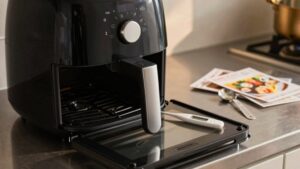
Air Fryer Basket Size Measurements Guide
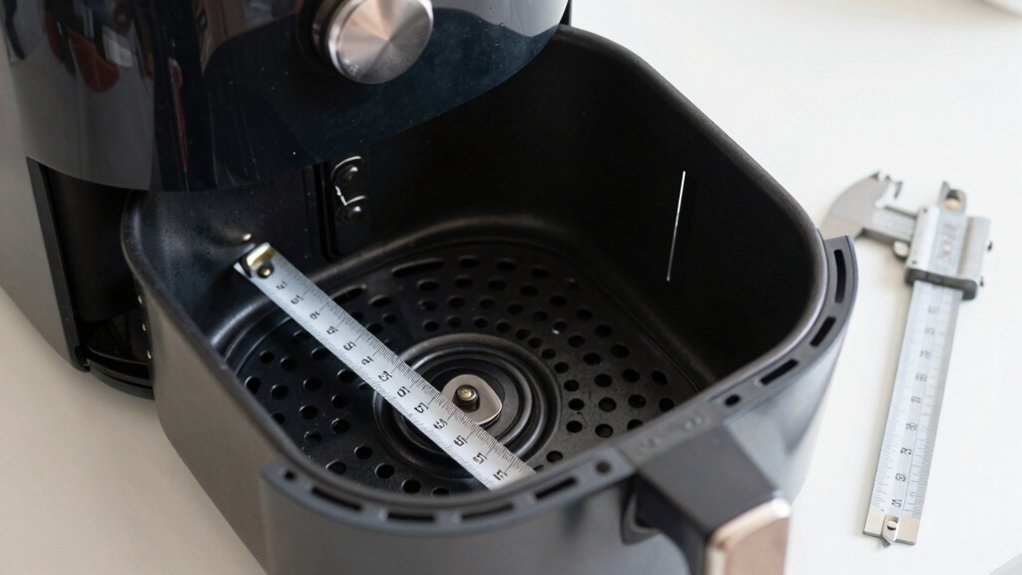
You’ll confirm whether a 6.5-quart fryer fits pans or poultry by measuring internal diameter at the widest point and depth from the lowest point to the rim. Exclude crisper trays. Use calipers or a rigid tape and note tapering walls. Then compute usable volume: π × radius^2 × depth.
Check handle clearance and crisper plate impact on usable height. Care for nonstick with soft sponges, silicone utensils, and moderate temps. Continue for measurement tips and accessory checks.
Quick Overview
- Measure the widest internal diameter (top and bottom) with calipers or a rigid tape to determine true accessory fit.
- Measure basket depth from lowest point to rim. Then subtract crisper tray thickness for usable depth.
- Calculate usable volume with π × (radius)^2 × depth to compare stated quarts to actual capacity.
- Check handle, crisper plate, and tapering walls; these reduce usable space for tins, racks, or whole poultry.
- Protect nonstick coating: hand-wash gently, avoid abrasives, and use silicone/wood utensils to preserve measurements and fit.
.2–6.5 Qt Basket Sizes
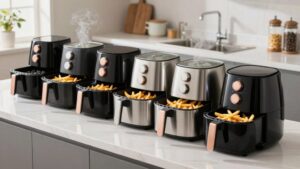
Looking for a reliable mid-to-large air fryer basket, the 6.5-quart class gives you consistent internal volume and depth for full family meals without taking excessive counter space. You’ll get repeatable capacity: Ninja and Cosori variants handle about 5 lbs fries or 9 lbs wings, with typical power at 1725–1750W.
Check basket diameter against accessory fits and confirm depth measurements for whole chickens or 8″ tins. Note handle and crisper plate affect usable space. Maintain performance via proper nonstick coating care: wash gently, avoid metal utensils, and air-dry to preserve release properties.
Compare warranties (1 vs 5 years) and accessory compatibility when you select a 6.5-qt unit.
| Model | Key spec |
|---|---|
| Ninja | 6.5 qt |
| Cosori | 6.5 qt ceramic |
Basket Diameter and Depth
Having reviewed 6.5-quart baskets and their real-world capacity, you should next verify the basket diameter and depth because those two measurements determine what accessories and food sizes will actually fit. Measure internal diameter sizing and basket depth to calculate usable volume and fit tolerances for pans, racks, and whole proteins.
Use calipers or a rigid tape; note tapering walls and removable trays.
Confirm diameter sizing at the widest internal point; record both top and bottom measurements. Measure basket depth from the lowest point to the rim with any crisper tray removed and inserted.
Calculate usable volume (π × radius^2 × depth) to compare stated quarts to actual capacity. These steps let you predict compatibility with 7–8 inch tins and whole poultry precisely.
Nonstick Coating Care Tips
When cleaning your basket, use warm soapy water and a soft sponge to remove oil and food residue without abrading the nonstick surface. Don’t use steel wool or harsh scouring pads. Choose silicone, nylon, or wood utensils to prevent scratching and premature coating failure.
Also, be mindful of manufacturer temperature limits. Consider professional recoating or part replacement if you observe peeling, deep scratches, or loss of release performance.
Proper Cleaning Methods
Protect the nonstick coating by washing the basket by hand after each use: Let it cool, remove loose food with a soft brush or nylon scrubber, and clean with warm water and mild dish soap. Never use metal scouring pads or abrasive cleaners that can scratch the surface.
For persistent residue, soak the basket for 10 to 20 minutes in a warm, soapy bath to loosen oils. Avoid prolonged soaking of removable electronics or seals. Dry immediately with a lint-free cloth to prevent water spots and corrosion at seams. Inspect gasket and handle joints for trapped debris.
Document care tips: frequency, detergent type, and soak time. Note common cleaning pitfalls such as high-temperature dishwasher cycles and harsh chemical degreasers that degrade coatings over repeated exposure.
Avoiding Abrasive Tools
Why would you risk scratching a nonstick basket when simple tools prevent it? You should prioritize avoiding abrasive contact: steel wool, metal brushes, and scouring powders create micro-scratches that degrade coating integrity and heat distribution.
Inspect the basket after each wash for coating lift or pitting. Document damage to decide if replacement is required. Use soft, nonmetallic cleaning implements and controlled abrasive pads rated safe for nonstick surfaces. Rinse thoroughly to remove residues that can abrade during future cycles.
Avoiding abrasive methods preserves thermal uniformity and extends usable volume by preventing flaking into food. Note: subtopic irrelevant items like utensil choice will be addressed separately; focus here is detecting and preventing mechanical abrasion to maintain coating performance and basket longevity.
Using Safe Utensils
You’ve already seen how abrasive contact damages nonstick coatings. Now focus on choosing utensils that prevent mechanical wear. Select silicone, wood, or nylon tools with smooth, rounded edges to minimize friction against the basket surface. Verify utensil compatibility with the manufacturer’s coating specifications and avoid metal tines, scrapers, or sharp-edged implements that concentrate pressure.
Implement safety precautions: inspect utensils for cracks, exposed metal, or hard fillers that can abrade the coating over repeated use. Use appropriately sized tools to avoid levering against basket walls. Match utensil length and head size to basket dimensions for ergonomic reach and reduced force application. Store utensils separately to prevent accidental contact and periodically test for material degradation that could compromise coating integrity.
Temperature Limits Awareness
Curious how heat affects your air fryer’s nonstick coating? You should know the manufacturer-specified temperature limits and never exceed them during use. High temperatures accelerate polymer breakdown, causing surface blistering, discoloration, and loss of release properties.
For coating care, preheat only when required and avoid empty-unit cycles at maximum settings. Use temperature-controlled cycles appropriate for the basket size so hotspots don’t concentrate thermal stress in one area. Cool the basket before aggressive cleaning; thermal shock can microfracture the coating.
Inspect periodically for surface crazing or flaking and adjust operating habits if you detect degradation. Maintain records of peak temperatures used for different recipes to correlate wear patterns and optimize long-term coating care strategies.
Recoating And Repairs
After monitoring heat-related wear, you’ll want to address nonstick coating damage methodically to restore performance and safety. Inspect coating for scratches, delamination, or blistering; document affected area dimensions and substrate material.
Determine repair compatibility with manufacturer specs before proceeding. Some baskets use bonded PTFE; others use ceramic or silicone blends that require distinct solvents and primers. Establish recoating timelines based on service load: light surface abrasion can wait several months; exposed metal or flaking mandates immediate action.
Prep includes abrasive decontamination, degreasing, and micro-etching to promote adhesion. Use industry-grade touch-up kits matched to substrate and follow curing profiles (temperature and time) precisely. Verify restored coating thickness and adhesion with tape and hardness tests before returning the basket to service.
Frequently Asked Questions
Can I Cook a Whole Turkey in a Large Air Fryer Basket?
Yes, you can, but turkey feasibility depends on basket capacity and internal depth. You’ll need a 5-quart or larger unit with at least 8–9 inch width and 4+ inch depth for a small spatchcocked turkey or crown.
Whole, unspatchcocked birds usually exceed typical basket capacity; they won’t fit or cook evenly. Measure internal dimensions, confirm usable volume, and allow airflow clearance to ensure safe, consistent roasting.
How Do Air Fryer Basket Sizes Affect Cooking Time?
Larger baskets usually increase cooking time because air fryer physics spread heat over a bigger volume, reducing convective velocity and raising thermal mass. You’ll need longer cycles or higher temperatures.
Smaller, denser loads cook faster but have capacity trade offs; you’ll sacrifice batch size and may need multiple runs. You should monitor internal temps, stagger air flow (avoid overfilling), and adjust time/temperature by 10–25% when capacity or basket geometry changes.
Are Air Fryer Baskets Oven-Safe or Broiler-Safe?
No, most air fryer baskets aren’t oven-safe or broiler-safe. You’ll check manufacturer guidance for material safety and corroborating heat tolerance; many baskets use nonstick coatings and plastic handles rated below oven/broiler temperatures.
If the basket is stainless steel without coating and explicitly labeled oven-safe, it’s compatible with broilers and ovens. Always verify compatibility with broilers, oven safety ratings, and max temperature limits before using baskets outside the appliance.
Can I Stack Two Baskets for Increased Capacity?
No, you shouldn’t stack baskets. Stacking baskets disrupts airflow and causes uneven cooking. You can physically nest or layer baskets in some oversized units; however, that creates significant capacity tradeoffs: reduced effective volume, cold zones, longer cook times, and inconsistent crisping.
If you need more capacity, choose a larger single basket or use sequential batches. For multi-tier designs, follow manufacturer specs to preserve airflow, temperature uniformity, and safety.
Do Basket Sizes Impact Energy Consumption?
Yes, basket sizes impact energy efficiency and cooking time. Larger baskets let you cook more per cycle, improving overall energy efficiency for batch meals. However, they can need slightly longer preheat and cook times to reach uniform doneness.
Smaller baskets heat faster and may use less energy per cycle; yet, they require multiple batches for larger servings, raising total energy use. You should match basket size to typical load for optimal efficiency.
Conclusion
You’ve now got the key measurements and care steps to choose and maintain an air fryer basket that fits your cooking needs and protects its nonstick finish. Match basket diameter and depth to your batch size. Clean gently with nonabrasive tools, and avoid metal utensils. Keep heat below the coating’s limit and recoat or repair only when wear appears.
Following these technical practices will extend performance, ensure safe use, and maintain consistent cooking results.