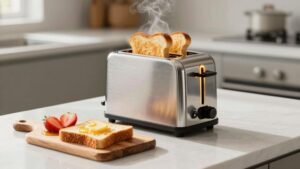
Toaster Browning Levels Explained
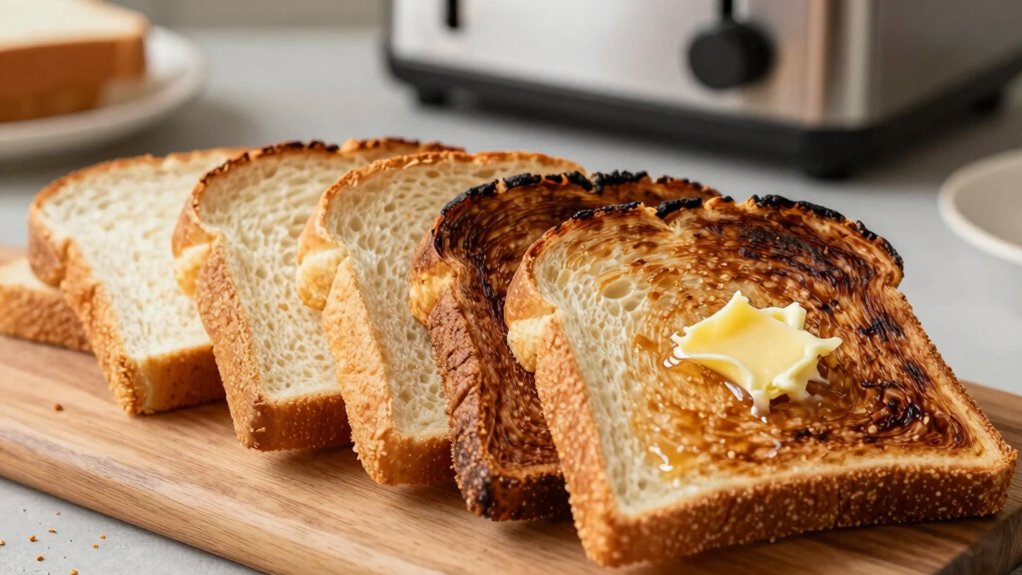
Toaster dials don’t show fixed minutes but shade levels tied to the toaster’s control type (timer, bimetallic, capacitor, or sensor).
You’ll need to match setting, wattage, and slice thickness for consistent browning.
Higher wattage and thinner slices brown faster; thicker or denser slices need more time or a higher shade.
Crumb tray position and heat carryover affect final color.
So, make small adjustments and clean regularly for repeatable results.
Keep going to learn practical tweaks and energy tips.
Quick Overview
- Browning numbers map to the toaster’s control type (timer, bimetallic, capacitor, or sensor), not fixed minutes.
- Higher wattage shortens required toast time; lower wattage needs longer cycles for the same brownness.
- Thicker or denser slices need more time and energy than thin slices to reach identical surface browning.
- Crumb timing and tray position affect carryover browning. Clean trays and small timing tweaks improve consistency.
- Sensor/conductivity toasters target moisture or conductivity for set browning; timer and bimetallic models rely on elapsed heat exposure.
Toasting Time vs Shade
How long does a number on your toaster really mean? You’ll find that dial numbers aren’t universal minutes; they control mechanisms: timer-based toasters set minutes, bimetallic strips set a trigger curvature, and sensor systems target surface change. That means bread moisture and residual heat change outcomes. Wetter slices need longer, and a warm machine shortens effective time. Adjust settings per bread type and recent cycles rather than trusting numbers alone.
| Toaster Type | What Number Means |
|---|---|
| Timer-based | Minutes of heating |
| Bimetallic strip | Trigger curvature (variable time) |
| Capacitor-driven | Circuit timing (shade level) |
| Sensor/conductivity | Target moisture/conductivity |
Test one slice, note adjustments, and compensate for moisture and leftover heat.
Crumb Settings and Timings
Curious about how crumb settings affect your toast? You’ll see crumb timing controls how long heating elements run after the lever lifts. This prevents carryover browning and helps shade precision across slices. Use the tray and setting together to keep cycles consistent and cleanup quick.
- Check tray position: A full tray can insulate heat, lengthening crumb timing slightly.
- Match shade: Reduce timer if you want lighter results without changing dial.
- Clean regularly: Trapped crumbs cause uneven heat and hurt shade precision.
- Adjust incrementally: Small timing changes improve consistency across different breads.
You’ll get predictable browning when you treat crumb settings as a minor timing fine-tune. This is not a major power change.
Wattage and Slice Thickness
Check your toaster’s wattage when you adjust browning, because higher watts shorten toast time while lower watts need longer cycles. Remember that thick slices take more time and energy to reach the same color. Conversely, thin slices brown faster and can burn if you don’t lower the setting.
Comparing energy use, faster high-watt toasting can use similar or slightly more power over a shorter period than low-watt longer toasts. Therefore, match wattage and timing to slice thickness for consistent results.
Wattage Settings Explained
Why does wattage matter when you’re choosing a toaster or adjusting settings for different slices? Wattage determines how quickly heating elements reach the temperature needed to brown bread; higher-watt units deliver faster, more consistent results.
You’ll notice that toaster design influences heat distribution. Compact models may heat unevenly, while wider toasters spread energy across thicker slices. When you pair wattage with slice thickness, thin bread browns rapidly on high wattage and risks burning. In contrast, thick or dense slices need more power or longer cycles.
Choose a wattage that matches your typical bread and kitchen rhythm. Consider features like crumb tray usability for maintenance: clean trays keep elements efficient, preserving the intended watt-to-toast performance over time.
Effect On Toast Time
How long a slice takes to toast depends mainly on two factors: the toaster’s wattage and the bread’s thickness and density. You’ll notice higher-wattage toasters shorten toast duration because they deliver more energy per second; heating elements faster achieve desired Maillard reactions sooner. Lower-watt units need longer cycles to reach the same color, which increases browning variance between batches if you don’t adjust settings.
Thickness and density change heat penetration. Thin, airy slices toast quickly. Dense or compact slices slow internal heating, requiring extra time for even browning. To control results, you’ll match wattage to slice characteristics and use incremental shade settings. Monitor one test slice to establish the correct duration for consistent, repeatable browning.
Thick Slice Considerations
If you’ve matched wattage and shade settings for typical slices, thicker or denser pieces change the equation: They need more energy and longer exposure to reach the same internal temperature and surface brownness without burning the exterior.
When you load a thick slice, the toaster’s fixed element spacing and preset timing under-deliver heat to the center. To compensate, raise the shade setting or choose a higher-wattage model so the increased time lets heat conduct inward while the surface browns more slowly.
Monitor one test slice, noting how much extra time yields uniform color. Aim for browning consistency across slices by adjusting incrementally. Avoid maxing settings immediately, since uneven hotspots can still char edges before centers finish.
Thin Slice Behavior
Wondering what changes when you pop a thin slice in the toaster? You’ll notice faster heat penetration: less mass means the nichrome elements and infrared energy brown the surface quickly. You should lower the shade setting compared with thicker slices.
With higher-wattage toasters, thin toast reaches target color even sooner; monitor for over-browning. To preserve browning consistency across batches, toast similar-thickness slices together and avoid stacking. Inconsistent thickness causes variable timing and uneven results.
If your toaster has a variable slot depth or multiple settings, pick a lower number and test one slice to dial it in. That simple adjustment prevents burning, reduces the need for cancelling and restarting, and delivers predictable thin-toast outcomes.
Energy Use Comparison
Curious about how wattage and slice thickness affect the energy your toaster uses? Higher-watt toasters heat elements faster, reducing cycle time and often lowering total browning energy for a given shade. If you use a 1800W four-slice versus a 1000W two-slice, the higher-power unit reaches target temperature quicker, improving toasting efficiency especially for thicker slices.
Slice thickness matters: thin slices need less time and energy, while dense or thick bread absorbs more heat and requires longer cycles, raising energy use. To optimize, match wattage to load. Use lower power or fewer slots for thin slices, and reserve high-watt settings for thicker bread. Monitoring shade settings and avoiding unnecessary re-toasting preserves energy and maintains consistent results.
Frequently Asked Questions
Why Do Toasters Brown Unevenly Between Slots?
Because of uneven heat and slot geometry, you’ll see different browning between slots. Heating elements and nichrome wire spacing may vary; one slot delivers more infrared energy.
Slot width, depth, and alignment change airflow and contact with bread, altering conduction. Power distribution and component wear can favor one side.
You can compensate by rotating slices, adjusting shade settings, or choosing a toaster with tighter element spacing and consistent slot geometry.
Can Altitude Affect Browning Results?
Yes, altitude impact can affect browning results because lower air pressure reduces boiling point and moisture evaporation. You’ll see toast variability.
At higher altitudes, your bread dries and browns faster for the same setting; you’ll need lower browning levels or shorter cycles. Adjust settings by testing a slice, reduce time or shade number, and keep an eye on bagels or dense loaves that may still need extra heat.
How Do Bagel Settings Differ From Regular Toast?
Bagel settings differ by toasting only the cut side longer while warming the rounded exterior briefly. This allows you to get crisp bagel texture and a soft interior with clear crust contrast.
You’ll set a higher shade for the sliced face and a lower for the outer crust; many toasters disable lower slot elements or redirect heat. Use mid-to-high settings for dense bagels. Cancel if the crust’s darkening too fast to avoid burning.
Are Browning Dials Standardized Across Brands?
No, browning dials aren’t standardized across brands. You’ll see varied toaster calibration and pop up consistency because manufacturers use different timer circuits, heating-element designs and presets. That means a “4” on one model can equal a “6” elsewhere.
You should test settings with your bread types, note preferred numbers, and adjust for bagels or dense loaves. Calibration checks and consistent loading help you get repeatable results.
Do Toaster Lights Indicate Temperature or Timing?
They indicate timing, not temperature. You’ll see toaster lighting and browning indicators illuminate as the heating elements run for the preset shade setting. Those lights show operation progress or selected level rather than exact element temperature.
You can use them to gauge when the cycle’s active; however, actual browning depends on timing, element power, and bread type. For precise control, rely on dial settings and cancel function rather than the lights.
Conclusion
You’ve learned how to match shade settings with toasting time, and how crumb controls and wattage change results. Remember thicker slices need more time and/or heat; while thin slices brown faster and can burn if you don’t lower settings.
Use wattage info to predict how long to run your toaster and trim time for energy savings. Adjust incrementally, keep notes, and you’ll get consistent, perfectly browned toast every time.
Related reading: Toaster Oven Temperature Accuracy Testing at Home covers this topic in detail.