Rotisserie Oven Food Safety Temperatures
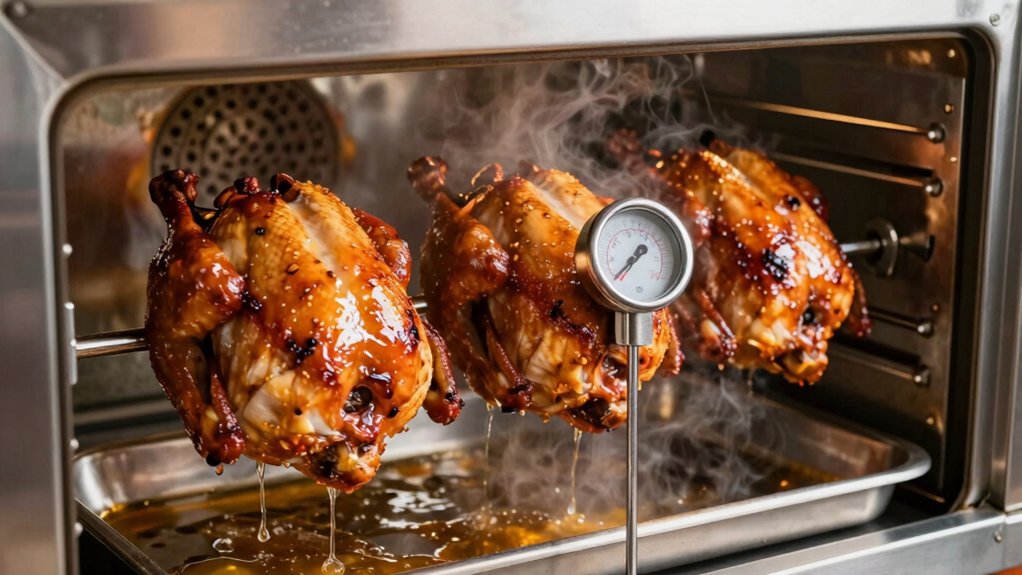
When you cook on a rotisserie, use a probe thermometer to verify safe internal temps: poultry 165–180°F (measure thickest part, breast and thigh separately).
Beef, pork and fish must reach 145°F with appropriate rest. Stuffing must reach poultry temps.
Calibrate probes regularly (ice and boiling checks) and note offsets. If the motor stalls or smells hot, cut power and troubleshoot wiring, coupling and overloads. Keep probes and motor maintained to ensure safe, even results; more practical tips follow.
Quick Overview
- Cook poultry to an internal temperature of 165–180°F, measuring at the thickest part (thigh/wing/breast).
- Ensure stuffing inside poultry reaches 165–180°F at its center before serving.
- Cook beef, pork, and fish to 145°F at the thickest part; then allow appropriate resting time.
- Use a calibrated probe thermometer (ice-water 32°F or boiling adjusted for elevation) and log readings.
- Probe breasts and legs separately and record temperatures. Replace probes that drift beyond acceptable limits.
Internal Temp Safety Chart
Anyone handling a rotisserie should use this internal temperature chart as your baseline safety guide. You’ll follow rotisserie safety by targeting validated internal temps: poultry 165°F (target thigh/wing/breast thickest part); bone-in poultry up to 180°F for complete doneness; beef/pork/fish 145°F with proper rest; and ground proteins higher (155–160°F).
Probe breasts and legs separately, record temps, and hold or rest per guidelines. Use a clean probe and preheat equipment to recommended oven/grill ranges to avoid extended cook times.
| Food Type | Target Temp°F | Placement/Note |
|---|---|---|
| Poultry | 165–180 | Thickest part; stuffing center |
| Beef/Pork/Fish | 145 | Thickest part; rest as required |
Probe Thermometer Calibration Guide
How do you know your probe is giving accurate readings when food safety depends on them? You need a simple probe calibration routine to ensure temp accuracy before each service. Follow this three-step check and document results.
- Ice-water method: Fill a glass with crushed ice and cold water. Insert a clean probe to the center; it should read 32°F (0°C) within 1–2°F (1°C).
- Boiling-water check: Boil distilled water. Insert the probe avoiding sides and expect ~212°F (100°C) adjusted for elevation.
- Offset adjustment: If readings deviate, use your thermometer’s calibration screw or note an offset and correct all recorded temps.
Calibrate regularly and log outcomes. Replace probes that drift beyond acceptable limits.
Rotisserie Motor Stall Troubleshooting
If the rotisserie motor won’t start or stalls during rotation, check the power supply and wiring first to rule out voltage or plug faults. Inspect for mechanical obstructions and binding on the spit. Additionally, smell for motor overheating; stop use immediately if you detect burning.
Address faulty capacitors, worn brushes, or cooling failures promptly. Alternatively, replace the motor to maintain safe, consistent cooking.
Motor Won’t Start
Wondering why the rotisserie motor won’t start? First, confirm power: check the outlet, plug, and any inline switches. Reset breakers and test the outlet with another appliance.
Inspect the rotisserie motor connection for loose wires or corrosion; tighten terminals and replace frayed leads. If the motor hums but won’t engage, the start capacitor or gearbox may be faulty: replace per manufacturer instructions.
Verify the mount and drive coupling aren’t obstructed by drippings or debris; clean and lubricate moving parts. For thermal cutouts, allow cool-down and test continuity with a multimeter.
If basic checks fail, consult the oven manual and replace the motor assembly rather than risk inconsistent rotation or food-safety hazards.
Stall During Rotation
Why is the rotisserie stalling mid-rotation? You’ll diagnose a stall during rotation by checking torque load, alignment, and power delivery first.
Inspect the spit and load: unevenly balanced poultry or oversized roast increases drag and triggers a rotisserie motor stall. Verify spit bearings and couplings move freely; seized bearings or misaligned forks cause intermittent stalls.
Confirm voltage and connections at the motor. Loose terminals or undervoltage reduce torque. Test with a known good motor or reduce load to isolate the fault.
Replace worn gears, brushes, or the motor if diagnostics point to internal wear. After repairs, rebalance the load and run a monitored cycle to ensure the stall during rotation no longer occurs.
Overheating Motor Smell
Smell burning? If you notice smell issues during rotisserie operation, stop the motor and remove power immediately. An overheating motor emits a hot, acrid odor and may slow or stall; do not keep the oven running.
Inspect vents for grease buildup, clear obstructions, and allow the motor to cool fully before testing. Check the drive coupling and load: oversized or imbalanced loads strain the motor and cause overheating motor conditions.
Replace worn bearings, frayed wires, or damaged insulation; these are common causes of smell issues and electrical heating. After repairs, run a short unloaded test while monitoring temperature and odor.
If the smell returns, take the equipment out of service and consult a qualified technician to prevent fire or food safety hazards.
Power Supply Issues
How should you approach a motor stall that seems tied to the power supply? First, cut power and visually inspect cords, plugs, and the outlet for damage or overheating. Verify voltage at the outlet with a meter; low or fluctuating voltage can cause stalls even if rotisserie horsepower looks adequate on the nameplate.
Check the circuit load; avoid shared high-draw appliances and reset tripped breakers or GFCIs. Confirm the motor’s plug seating and that wiring terminals are tight. Assess electrical grounding: a poor ground can create intermittent faults and motor protection trips.
If wiring and grounding pass, test the motor on a known-good circuit of appropriate capacity. If stalls persist, consult a qualified electrician or service technician rather than continuing operation.
Mechanical Obstructions
When a rotisserie motor stalls and the power supply checks out, suspect a mechanical obstruction and stop the unit immediately to prevent damage. You’ll want to inspect the spit, forks, bearings, and any accessory that contacts the load for binding, bending, or foreign objects.
You should visually and manually rotate the spit (with power off) to locate tight spots. Remove food debris, reposition uneven loads, and replace bent forks or worn bearings. Lubricate moving parts per manufacturer guidance during rotisserie maintenance to restore smooth operation.
After clearing obstructions, run unloaded tests at low speed to confirm normal torque and heat behavior. Document findings and repairs; an unresolved stall is a safety risk and can cause overheating, product contamination, or motor failure.
Frequently Asked Questions
Can I Cook Vegetables on the Rotisserie With Meat Safely?
Yes, you can cook vegetables on the rotisserie with meat safely if you manage vegetable safety and rotisserie layering. You will place dense vegetables (potatoes, carrots) closer to meat so they reach safe temperatures as meat cooks. Use a foil tray for smaller pieces, and avoid cross-contamination by keeping juices contained.
Check internal temps of both; stir or reposition vegetables mid-cycle for even cooking. Discard any undercooked pieces.
How Long Can Cooked Rotisserie Chicken Be Held Before Serving?
You can hot hold cooked rotisserie chicken safely for up to 4 hours if you keep it at 135°F (57°C) or higher. For longer holds, follow your facility’s food safety policy and cooling procedures.
Use a calibrated probe to check breast and leg temperatures. Record times and temps, and discard any chicken that’s been in the danger zone below 135°F for over 2 hours. Reheat to 165°F if needed before serving.
Can Vacuum-Packed Poultry Be Rotisseried Safely?
Yes, you can safely rotisserie vacuum-packed poultry if you follow vacuum pack safety and proper cooking controls. Don’t cook poultry in sealed plastic; remove packaging, pat dry, and truss if needed. Then roast on the rotisserie.
Verify poultry rotisserie internal temps reach 165°F (74°C) for safety; check breast and legs separately. Use a clean probe and record results. Cool, hold, or serve immediately per time-temperature rules.
Is It Safe to Baste With Alcohol-Based Marinades During Roasting?
Yes, you can baste with alcohol marinades if you follow basting safety: keep flames controlled, avoid high open flames, and allow alcohol to simmer off before glazing.
You should let alcohol reduce on the stovetop or apply sparingly late in roasting so alcohol fully evaporates and won’t flare. Use a clean probe to verify internal temps, baste away from direct heat, and record times to ensure safe, flavorful results.
Do Bone-In and Boneless Cuts Need Different Rotisserie Times?
Yes, bone in and boneless cuts need different rotisserie times. You’ll cook bone in cuts longer because bones slow heat penetration; so reduce rotisserie speed and allow extra minutes. Monitor breast and legs separately.
Boneless cuts cook faster and more evenly; therefore, you’ll use higher heat or shorter time to avoid drying. Always verify internal temperature with a clean probe and rest meat before carving for best results.
Conclusion
You’ve now got the essential rotisserie oven safety and troubleshooting steps: check internal temps with a calibrated probe, recalibrate the thermometer periodically, and diagnose motor problems quickly.
If the motor won’t start, inspect power and connections. If it stalls or smells hot, cut power, let it cool, and clear obstructions before testing again.
Regular maintenance and correct temperatures keep food safe and equipment reliable. Follow these guidelines every time you cook.
Related reading: Sous Vide Time and Temperature Basics Explained covers this topic in detail.