Toaster Oven Pan Sizes and What Fits
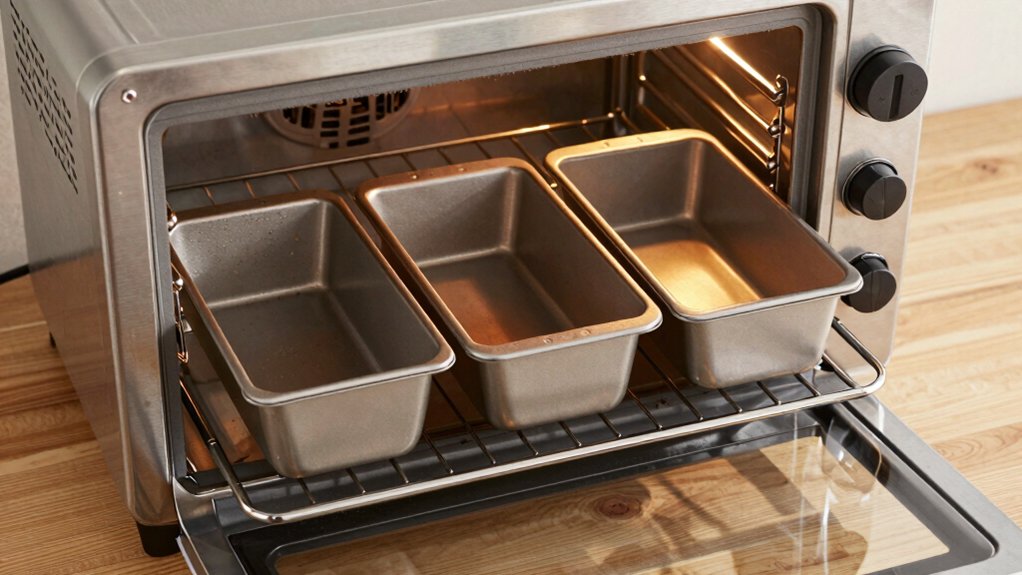
Measure your oven interior at the rack guides front-to-back and side-to-side. Then measure a pan’s inside diagonal and leave about ½” clearance for airflow and handling. Use the rack-installed diagonal, not wall-to-wall, and account for rounded bump-outs.
Check vertical clearance to the nearest element and allow 1½–2″ for covered dishes. Mind pan thickness, material heat rating, and warping risk. Keep low-profile pans if gaps are tight. More details follow below.
Quick Overview
- Measure interior width between rack guides and interior depth from rack front to oven back to determine usable pan footprint.
- Measure oven diagonal between rack guides at the intended level and subtract ½” for safe clearance when comparing pan diagonal.
- Check vertical clearance from lowest rack to nearest heating element. Allow 1½–2″ for covered dishes and ½” for uncovered pans.
- Verify pan thickness and material won’t block airflow or touch elements; thin aluminum or low-profile pans are safest.
- Always test-fit the pan on the installed rack (cold) and consult the oven manual for model-specific size and temperature limits.
Interior Rack Dimensions Chart
How wide, deep, and tall is your Toaster Oven‘s usable space? You measure wall-to-wall but press the tape against rack guides or pop-outs so your interior dimensions reflect true usable width. Measure back wall to glass door for depth; this excludes rounded bump-outs. Height is from the lowest rack position to the nearest upper heating element; watch for lower center elements.
| Dimension | What to measure |
|---|---|
| Width | Wall to wall at rack guides |
| Depth | Rack front to oven back |
| Height | Lowest rack to element |
Note accessory fit for pans and cast iron; count protruding handles and required clearance. Consult the manual for model-specific guidance and avoid assuming manufacturer-listed space includes side extensions.
Measure Pan Diagonal Length
Want to be sure a pan will clear the oven diagonally? You should measure the pan diagonal to check true pan fitment against the oven’s usable interior. Place the tape measure across opposing inside corners of the pan (interior edges only) and note that diagonal measurements reveal whether a rectangular or square pan will rotate or sit flat.
Compare that number to the oven’s diagonal between rack guides, not just wall-to-wall.
- Measure pan interior diagonal from inside edge to inside edge.
- Measure oven interior diagonal between rack guides at the intended rack level.
- Subtract recommended clearance (½ inch total) for safe airflow and handling.
- Confirm pan fitment by testing placement with the rack installed.
Max Safe Pan Thickness
Check the pan thickness against your oven rack clearance so a thick pan or cast-iron piece won’t block airflow or sit too close to the heating elements.
Consider material heat conductivity, warping risk, and the pan’s rated maximum temperature so you don’t get uneven cooking or structural failure at high heat. When in doubt, choose slightly thinner pans or confirm the manufacturer’s safe thickness and temperature limits for your specific toaster oven.
Oven Rack Clearance
Curious about how thick a pan you can safely use in your toaster oven? You’ll first check oven clearance and rack spacing. Measure from the rack guides (not just the walls) with the rack in its lowest and middle positions to find usable height.
Subtract at least 1½ to 2 inches for covered dishes; leave ½ inch side clearance for air circulation. For uncapped pans, a 1‑ to 1¼‑inch pan thickness usually fits most toaster ovens on the lowest rack. However, cast iron or lids with knobs may need extra room.
If you’re unsure, consult the owner’s manual and test fit pans cold before heating. Always avoid touching heating elements and allow airflow around pans.
Heating Element Proximity
How close can a pan safely sit to the heating elements in your toaster oven? You should measure from the cooking rack in its lowest position up to the nearest element, using your interior rack dimensions chart or a tape measure against the rack guides.
As a rule, allow at least 1½ to 2 inches from the top element for covered dishes. Uncovered sheet pans generally need ½ inch side clearance. Max safe pan thickness depends on that vertical gap: if the distance is only 1 inch, use low-profile pans (≤1 inch total height) or lower heat to avoid scorching.
Verify spacing for center elements that sit lower than others. Always consult the owner’s manual for model-specific heating element proximity limits.
Material Heat Conductivity
Why does pan material matter for maximum safe thickness? You need to match conductivity to toaster oven performance: high-conductivity metals (aluminum, thin steel) heat evenly at lower thicknesses, while low-conductivity materials (ceramic, stoneware) require thicker profiles to store heat. Thicker panserchange cooking times and may reduce airflow. Treat them like a different pan; they are not an irrelevant topic or unrelated concept.
Measure interior clearances and rack position before choosing a heavy pan. Thicker pans can sit closer to elements and reduce recommended clearances. Aim for pans no thicker than necessary: sheet pans ~1.0–1.2 mm aluminized steel; ceramic/stoneware should be thinner or used with lower temps. Test with an internal thermometer to confirm doneness and avoid guesswork.
Warping And Structural Integrity
When will a pan stop holding its shape under repeated toaster-oven heat cycles? You’ll notice warping once thin pans repeatedly heat and cool without enough mass or reinforcement.
Choose pans with higher warping resistance: thicker gauges, rolled edges, or stiffening ribs to keep a flat cooking surface. For toaster ovens, aim for mid-range thickness; too thin deforms, and too thick can be heavy and slow to respond.
Check for even structural durability across the pan; corners and long edges are common failure points. If a pan shows bowing, replace it. Compromised contact causes uneven cooking and hotspots.
Cast iron and heavy aluminized steel offer excellent structural durability, while coated thin sheet pans prioritize lightness over warping resistance.
Safe Temperature Ratings
Curious about how hot you can safely run a pan in your toaster oven? You should check manufacturer limits first; both oven and pan labels list a max safe temperature. Thin sheet pans (heavy-gauge aluminum, ~0.7–1.0 mm) heat fast but can warp above 450°F. Stay under 425–450°F for consistent results.
Thicker pans, cast iron, and carbon steel tolerate higher heat. Cast iron commonly handles 500°F+; however, account for longer preheat and thermal mass. Nonstick coatings usually top out around 450°F; exceeding that degrades coating and releases fumes. If you’re unsure, reduce temperature by 25–50°F and increase time.
Always avoid placing pans directly against heating elements and maintain recommended clearance to prevent hotspots and damage.
Frequently Asked Questions
Can I Bake a 9-Inch Round Cake in My Toaster Oven?
Yes, you can bake a 9-inch round cake in your toaster oven if the pan fits and clearance is adequate. Check bakeware compatibility by measuring from rack guides to guides and from the lowest rack to the heating element. You’ll need about 1½ to 2 inches above for covered pans.
Account for size constraints like pan handles or knobs. Confirm clearances in your owner’s manual before baking to ensure even heat and safe operation.
Will Glass Baking Dishes Fit Safely Without Cracking?
Yes, glass baking dishes can fit safely if you check dimensions and clearance. However, you’ve got safety concerns to manage. Measure from the rack (lowest position) to the heating element and allow 1½–2 inches above covered dishes. Keep ½-inch side clearance.
Avoid sudden temperature changes. Preheat with the dish inside when possible and consult your manual for element placement. Remove high knobs on lids if they’ll hit elements.
How Much Clearance Do Toaster Oven Doors Need to Open Fully?
You need about 18–24 inches of toaster oven clearance in front to allow full door swing clearance and safe access. Measure from the oven’s front face to any cabinets or counters; include space for hot pans and pulling racks out.
Leave additional room if the door drops low or if a handle extends forward. Always check your owner’s manual for model-specific door swing and clearance requirements.
Can I Use Silicone Pans or Liners in a Toaster Oven?
Yes, you can use silicone pans and liners in a toaster oven if they’re labeled for oven use and rated for the oven’s maximum temperature. Check silicone compatibility and avoid placing liners under direct broil or touching heating elements.
Give at least ½-inch clearance from walls and top elements for liner safety. Don’t use warped or thin silicone on grills. Follow manufacturer instructions and your oven’s manual for best results.
Are Convection Settings Safe With Cast Iron Cookware?
Yes, convection safety with cast iron suitability is fine if you manage heat and clearance. You should preheat cast iron in the oven to avoid thermal shock. Allow 1½–2 inches from top elements for lids or knobs and expect longer preheat times.
Convection fans circulate heat evenly; therefore, watch for faster browning and reduce temperature 25°F or shorten cooking time. Always check your oven manual for model-specific clearance and safety notes.
Conclusion
You now know how to check interior rack dimensions, measure pan diagonal length, and account for thickness and rack clearance so pans fit safely. Don’t forget heating element proximity, material conductivity, and warping risks; those affect cooking and longevity. Measure carefully, pick pans rated for your oven’s max temp, and leave adequate airflow around edges.
With those checks, you’ll avoid snug fits, uneven heating, and premature damage while getting reliable, even results every time.
Related reading: Oven Pan Fit Measurement Guide covers this topic in detail.