Countertop Oven Size Guide Interior Dimensions
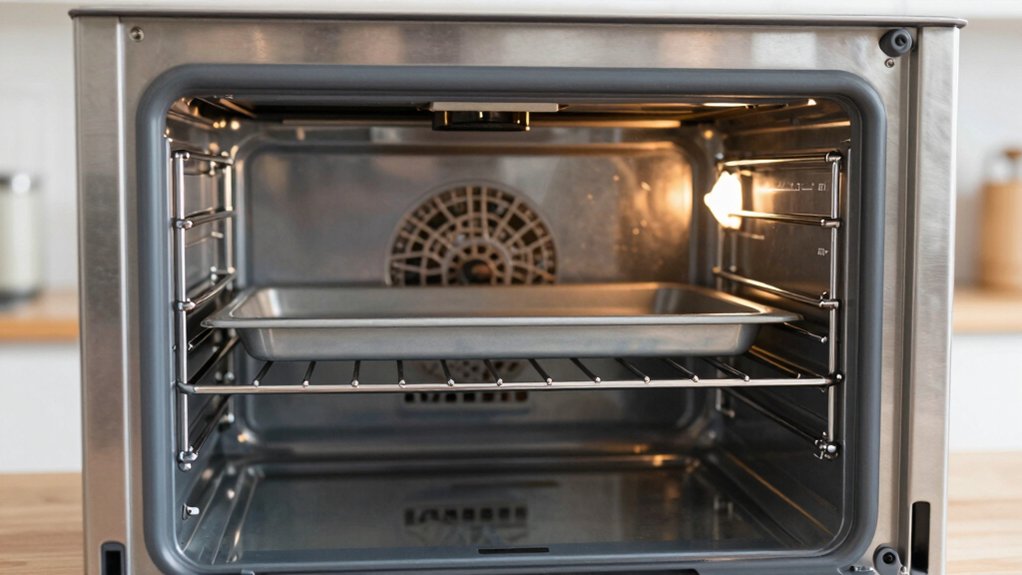
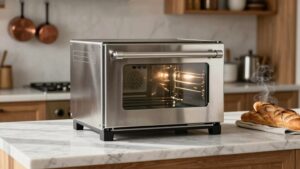
Pick a countertop oven by matching interior dimensions to your pans: Typical 2–4L minis are about 10–12″ W × 4–6″ H × 8–10″ D for single servings. Compact 14–32L models offer 13–22″ widths and deeper chambers for 9×13 pans.
Allow 2–4″ rear/side ventilation, 12–20″ front door swing, and check rack positions for clearance. Verify power (1,000–1,500W) and cord protrusion. Keep specs handy to avoid surprises and learn more about fit and placement.
Quick Overview
- Typical 2L countertop oven interiors measure about 10–12″ W × 4–6″ H × 8–10″ D, fitting 1–2 servings or small pans.
- Match pan length to interior width: 13″–22″ for larger countertop ovens to ensure flat seating and even cooking.
- Verify pan depth plus clearance. Shallow pans fit 8″–10″ chambers; deeper pans need interiors 12″+ tall.
- Allow ventilation clearances: minimum 2″ rear and side; 3–4″ recommended for larger models.
- Account for door swing and front clearance. The front clearance should be 12–20″ and 18–24″ for counter overhang before installation.
8–32 L Capacity Chart
Because 2 liters (≈0.07 cu ft) sits far below typical countertop-oven sizes, you’ll treat it as an ultra-compact or toaster-oven equivalent for single-serving use. You’ll expect about 10–12″W x 4–6″H x 8–10″D interior, 120V at 1000–1500W; capacity for 1–2 servings: toast, mini pizza, or reheats.
Don’t confuse it with standard 14–31L compact ovens.
| Spec | Typical for 2L |
|---|---|
| Interior W×H×D | 10–12″ × 4–6″ × 8–10″ |
| Use case | 1–2 servings; 2–4 slices; mini pans |
You’ll avoid irrelevant topics like full-sheet compatibility. Use two word discussion ideas (e.g., “fit testing”) to keep selection practical. Confirm vent clearance + power draw before purchase.
Rack Heights & Pan Fits
Want to know whether your pans will fit? You’ll check rack heights and pan fits against interior specs before buying or loading. Measure pan depth plus clearance to avoid contact with heating elements. Note that interior height varies from about 8″ to 12″ across models.
- Match pan length to interior width (13″–22″) so it sits flat without touching side walls.
- Confirm pan depth plus required top clearance: shallow pans fit most 8″–10″ chambers; deeper pans need 12″+ interiors.
- Verify rack adjustability: multiple positions let you position pans for even airflow and consistent browning.
- For full-size 9×13 pans, ensure width and depth accommodate the pan plus 1″ circulation space.
Use these checks to predict pan fits precisely.
Door Clearance Requirements
You’ll need to plan specific clearances for the door swing and surrounding surfaces to keep the oven usable and safe. Ensure a minimum gap behind the unit and side clearances per the manufacturer. Account for the full door swing arc, and check that any countertop overhang won’t obstruct opening.
Also, leave recommended ventilation gaps above and at the rear so heat and steam can escape without contacting cabinetry.
Minimum Clearance Behind
How much space should you leave behind a countertop oven? You should plan for the manufacturer’s specified minimum clearance behind the unit to maintain ventilation and safe door clearance. Most countertop ovens require 2 inches minimum clearance at the rear; some professional models demand 3–4 inches because of larger rear vents and heat-generating components.
Measure from the back-most external panel, not the interior cavity, and allow extra if the power cord or exhaust protrudes. This rear spacing ensures the door can fully open without obstruction and prevents heat buildup against walls or splashbacks. Verify the model-specific spec sheet before installation, and keep ventilation paths clear to preserve performance and avoid voiding warranties.
Side Clearance Requirements
After allowing the recommended rear clearance, check side and door clearance so the oven door and controls can open fully without hitting walls, cabinets, or adjacent appliances. Measure at least 2 inches of side clearance on both sides for compact units and 3–4 inches for larger or professional countertop ovens. This keeps ventilation slots unobstructed and lets you access controls. Factor in clearance behind for power cords, exhaust outlets, and any rear panels; add 1–2 inches beyond the minimum rear spec.
When planning built-in niches or tight counters, leave additional side clearance for heat dissipation and service access. Verify manufacturer specs for your model; they override general rules. Document measured clearances before final placement to avoid reinstallation.
Door Swing Arc
Wondering how much space your countertop oven door needs to open comfortably? Measure the full door swing arc from hinge to outer edge. Most countertop ovens need 12–20 inches of front clearance to open fully and allow tray removal. You’ll plan for the door arc plus room to stand in front and pull pans straight out.
For hinge-forward models, confirm minimum clearance in manufacturer specs. For drop-down doors, allocate vertical clearance so the door doesn’t hit low shelves. Use two word discussion ideas like “swing radius” and “clear zone” when noting required dimensions on plans. Always check the oven’s specified door swing and include that measurement in layout drawings to prevent restricted access or blocked airflow.
Counter Overhang Impact
Where should your countertop overhang finish so the oven door can open fully? Measure the door swing arc from the oven front: most countertop ovens require 18–24 inches of forward clearance. Position the counter overhang so its edge sits at least at the plane where the door reaches 0° (closed) and doesn’t intrude into the full swing path.
If your model has a downward-opening door, leave a 1–2 inch overhang setback to prevent strike at mid-swing. For pull-down or slide-out designs, verify manufacturer door swing radius and mark the counter edge accordingly. You’ll avoid blocked access and stress on hinges by aligning overhang placement with the specified door swing envelope rather than guessing by eye.
Ventilation Gap Needs
How much clearance does your countertop oven need for safe ventilation and door operation? You should follow manufacturer specs; however, a practical baseline is 2 inches clearance on the sides and 4 inches above the unit to maintain an adequate ventilation gap and prevent heat buildup. Leave at least 1.5–2 inches behind for exhaust ports and cords. Some professional models require deeper rear clearance.
When the door opens, ensure unobstructed space in front equal to the door swing plus 2–3 inches to avoid restricted airflow. If you recess the oven into cabinetry, add the specified clearances plus heat-resistant materials around the opening. Always verify the appliance manual: required gaps vary by model and are critical for safety and performance.
Frequently Asked Questions
How Do Convection Settings Affect Cook Time for Different Foods?
Convection settings speed cooking by circulating hot air, so you’ll reduce convection timing and make a temp adjustment. For roasts and baked goods, you’ll cut time about 10–25% and lower temperature 15–25°F.
For delicate items like custards or cookies, reduce temp less and trim time minimally. Use shorter checks early, rotate pans for even browning, and track internal temps for meats rather than relying on timer alone for consistent results.
Can Countertop Ovens Be Used Under Cabinets Safely?
Yes, you can use a countertop oven under cabinets if you follow clearance specs and manufacturer guidelines.
Position the oven for proper countertop placement; keep cabinet clearance (usually 2″ sides, 4″ top minimum or as specified) and allow rear ventilation space.
Don’t enclose the unit; avoid combustible materials above. Ensure airflow to prevent heat buildup. Check your model’s manual for exact clearance and installation recommendations.
What Maintenance Extends a Countertop Oven’s Lifespan?
You’ll extend a countertop oven’s lifespan by following maintenance tips: clean crumbs and grease after each use, descale or wipe heating elements per manual, check door seals and hinges, and replace worn racks.
Vent and filter areas regularly; don’t overload or block vents. Schedule annual inspections for wiring and thermostats. These steps boost long term durability, improve safety, and keep performance consistent so you get reliable results.
Are Professional Models Significantly Louder During Operation?
Yes, professional models are often louder during operation because they use bigger fans and stronger blowers for even cooking. You’ll notice more airflow noise compared with compact units.
Across multiple brands, noise levels vary; check specs for dB ratings when comparing models. If quieter use matters, choose units with lower-rated fans, sound-dampening features, or variable-speed blowers. You’ll trade noise for faster, more consistent performance in many pro ovens.
Do Wattage Differences Impact Baking Results?
Yes, wattage affects bake results. Higher-wattage countertop ovens reach high heat faster and recover temperature quicker when you open the door. Therefore, you’ll get more consistent browning and shorter preheat times.
Lower-wattage units heat slower; they may produce uneven results on large pans and require added time or convection assistance. Match wattage to your typical baking: choose higher wattage for frequent, high-heat roasting and reliable bake results.
Conclusion
You’ve got the data you need to pick a countertop oven that fits your space and cookware. Use the 8–32 L chart to match capacity; check rack heights for pan fit; and plan door swing and overhang clearance. Leave the minimum back and side clearances and ventilation gaps the manufacturer specifies.
Measure twice: ensure the interior dimensions and external clearances work with your counter, cabinet, and cooking habits before you buy.
Related reading: Air Fryer Oven Vs Basket Air Fryer Differences covers this topic in detail.