Single Basket Vs Dual Basket Airflow Differences
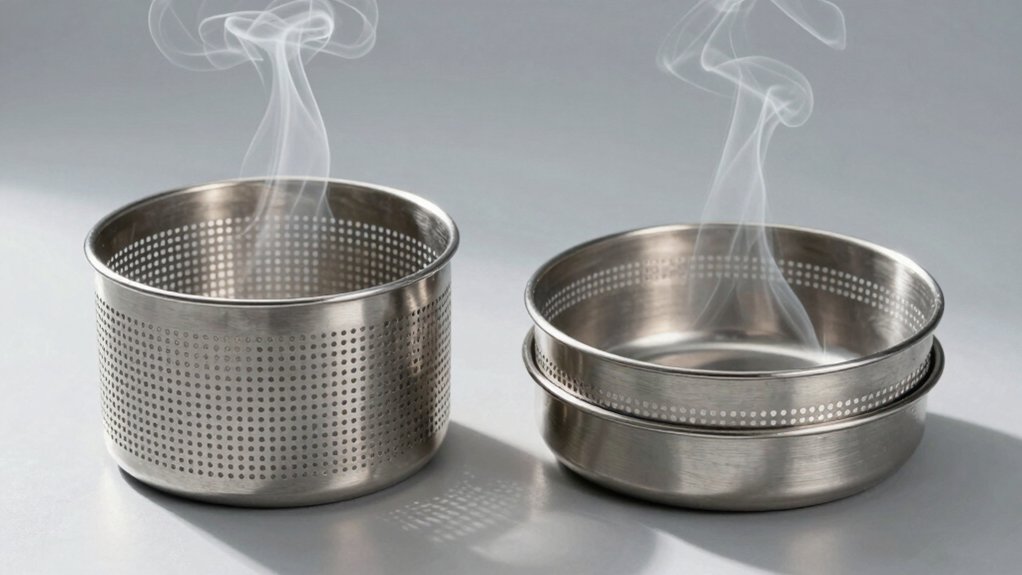
You’ll get higher concentrated volumetric flow and faster chamber recovery with a single-basket layout because it avoids split/sequence losses and lowers per-basket pressure drop. This means preheat and cook cycles run quicker and more consistently.
Dual baskets match per-basket flow only when fan capacity allows parallel operation; otherwise, they operate sequentially, raising effective static pressure and slowing recovery. Expect tighter RPM-to-flow coupling for single baskets and defined maintenance to hold tolerances. Keep going to see the metrics.
Quick Overview
- Single-basket designs concentrate airflow through one chamber, producing higher localized volumetric flow and faster heat transfer per basket.
- Dual-basket setups split or sequence airflow, giving similar per-basket flow; however, they often result in longer total cooking time when baskets run sequentially.
- Higher concentrated flow in single baskets yields faster preheat (about 15 seconds) and quicker recovery between cycles.
- Dual baskets can offer greater parallel capacity; however, they are limited by overall power and fan operating point under shared static pressure.
- Max allowable static pressure and motor RPM tolerance determine actual flow. This affects uniformity, cooking time, and acceptable performance margins.
Flow Rate Comparison Chart
How does airflow translate to real-world cooking speed? You’ll see flow rate directly maps to cook time and recovery: single-basket units concentrate airflow with a matched heater/fan; this yields faster preheat, improved recovery, and higher energy efficiency for single batches.
| Variant | Performance |
|---|---|
| Single basket | High concentrated flow rate; 15s faster preheat; 22:14 fries; better recovery |
| Dual baskets | Split/sequence heating; per-basket flow like single but sequential; fries 31:00 |
Interpretation: You’ll prefer single baskets for 1–4 persons when peak flow rate and energy efficiency matter. Duals give parallel capacity but suffer sequential power limits and 77% longer batch times for identical loads. Use them when total volume, not single-batch speed, is primary.
Max Allowable Static Pressure
Why does max allowable static pressure matter for Air Fryers? You need to quantify how much backpressure the fan can tolerate before airflow and heat transfer degrade. Max allowable static pressure defines performance limits; it is not subtopic irrelevance or unrelated metrics. It is a direct aerodynamic constraint affecting convective heat flux and recovery time.
- Measure peak static pressure (Pa) at nominal flow to determine fan operating point.
- Compare pressure drop across basket geometry to the fan curve to predict flow reduction.
- Specify acceptable pressure margin (%) to prevent stall, maintain turbulence, and ensure uniform chamber circulation.
You’ll use these technical limits when designing basket porosity, heater placement, and ducting. Exceeding them reduces effective flow, prolongs cook times, and undermines single-basket advantages.
Motor RPM Tolerance Limits
You’ll need to quantify motor RPM variation and define the acceptable tolerance bandwidth for both single and dual basket designs to understand airflow sensitivity.
Assess how RPM deviations translate to changes in volumetric flow and static pressure while accounting for measurement uncertainty sources such as tachometer resolution, electrical noise, and ambient temperature.
Finally, outline a maintenance and calibration schedule that limits RPM drift within the specified bandwidth to preserve predictable airflow performance.
Motor RPM Variation
What happens when the fan motor’s RPM drifts from its targeted setpoint can make or break airflow consistency in single versus dual-basket air fryers. You need to quantify Motor rpm variance as a primary input to airflow models. Even small deviations alter volumetric flow, pressure drop, and convective heat transfer coefficients.
Treat subtopic irrelevance claims cautiously: tolerances that seem negligible in single chambers can amplify in dual systems due to coupled alternating cycles and partition-induced recirculation. Specify measurement methods (tachometer, hall-effect sensor) and sampling cadence to capture transient excursions during element switching.
Define actionable acceptance criteria tied to percentage RPM error versus baseline. Map those to expected changes in cooking time and temperature uniformity. That lets you set engineering limits rather than arbitrary bands.
Tolerance Bandwidth Limits
How tightly should you hold the fan motor RPM to guarantee consistent airflow and repeatable cooking results? You should specify a narrow tolerance band; typically ±2% of nominal RPM for production and calibration. That limit minimizes phase shifts in vortex formation without invoking irrelevant topic tangents about aesthetics or marketing.
Measure RPM with optical or Hall-effect sensors, log over 60-second intervals, and reject units exceeding the band. Implement PID control to correct drift and characterize long-term wear to predict tolerance creep. Document acceptance criteria and test fixtures so technicians won’t launch off topic discussion during validation.
Tight tolerances improve repeatability of thermal cycles and ensure unit-to-unit consistency. They also retain manufacturability by balancing tolerance cost against observed performance gains.
Impact On Airflow
Why does holding motor RPM within a tight band matter for airflow? You ensure consistent airflow dynamics: small RPM deviations change volumetric flow and pressure distribution, altering convective heat transfer across the basket.
You’ll see single-basket systems tolerate tighter RPM variance because a unified chamber yields predictable flow fields. Dual-basket arrangements amplify sensitivity where inter-compartment leakage and alternating heating make subtopic irrelevant claims invalid.
You must set RPM tolerance limits based on target mass flow, turbulence intensity, and allowable temperature deviation. Specify control hysteresis, ripple, and transient response to prevent stall or surge.
Validate tolerances with CFD-derived metrics: mean velocity, RMS fluctuations, and residence time. Tight RPM control reduces localized hot/cold spots and improves repeatability across production cycles.
Measurement Uncertainty Sources
When you set motor RPM tolerance limits, you must account for distinct uncertainty sources that directly affect airflow repeatability and thermal performance: sensor resolution and calibration drift, encoder quantization and interpolation errors, motor controller PWM ripple and latency, supply voltage fluctuation, mechanical backlash and bearing wear, and aerodynamic loading changes from varying chamber conditions or food placement.
Quantify measurement uncertainty by propagating individual error terms into an RPM variance budget. Express tolerances as ± limits at a chosen confidence level. Use adequate sample size when estimating stochastic components like PWM jitter and aerodynamic loading variability; small N underestimates tails.
Separate systematic from random effects, document assumptions, and provide traceable calculations for each term. That lets you set defensible RPM bands that preserve airflow and cooking repeatability.
Maintenance And Calibration
Having quantified the uncertainty sources that affect RPM repeatability, you now establish maintenance and calibration procedures to keep motor speed within defined tolerance limits. You schedule routine maintenance calibration checkpoints: verify encoder signals, inspect brushes or bearings, and measure motor current draw to detect mechanical drag.
Set RPM tolerance bands (±2% for primary fan, ±5% for auxiliary) tied to airflow consistency requirements derived from baseline single-basket performance. Use calibrated tachometers and loggers to record steady-state and transient RPM under load; apply corrective trimming via firmware PWM offsets or mechanical adjustments when drift exceeds limits.
Implement preventative lubrication intervals and torque checks to minimize wear-induced variance. Document all actions in a traceable log to support repeatability, diagnostics, and design improvement.
Frequently Asked Questions
How Does Basket Shape Affect Crispiness in Reheated Foods?
Basket geometry directly alters crispiness dynamics by changing airflow contact and heat distribution. You’ll get crisper reheats with flatter, open grids that maximize surface exposure and convective velocity.
Curved or cramped baskets trap steam, reducing evaporation and softening textures. You should choose designs that promote uniform cross-flow and minimize shadowing from food piles.
Adjust fan-assisted timing and temperature to compensate for denser geometries to restore edge browning and moisture removal.
Can I Convert a Dual Basket Into a Single Large Chamber?
You generally can’t convert a dual basket into a true single large chamber safely. Convertibility limitations and safety concerns prevent simple modification. You’d compromise airflow, heating sequencing, and electrical design; this risks uneven cooking and overloads.
If you need larger capacity, choose a removable-divider model designed for single-chamber operation or consult the manufacturer. Any DIY structural or electrical changes void warranties and can create fire and shock hazards.
Do Basket Materials Influence Airflow and Cooking Times?
Yes, basket construction influences airflow efficiency and cooking times. You’ll see metal baskets with open meshes promote turbulence and faster heat transfer; this reduces cook times. Thicker solid or insulated materials damp airflow and slow recovery.
Perforation size, rim geometry, and coating thermal resistance alter boundary layers and convective coefficients. Therefore, you should choose a lightweight, highly perforated construction to maximize airflow efficiency and consistent, faster cooking.
How Does Humidity Affect Airflow Effectiveness Between Baskets?
Humidity impact reduces airflow efficiency by increasing moisture load, so you’ll see slower heat transfer and longer cook times in higher-humidity conditions. You’ll observe damp surfaces disrupting convective flow, especially in smaller dual baskets where alternating heating exacerbates moisture retention.
You’ll need longer recovery and higher fan speeds to restore set temperatures. Single large chambers recover faster due to uninterrupted airflow; this improves humidity clearance and overall airflow efficiency.
Are Noise Levels Noticeably Different Between Single and Dual Models?
Usually you won’t hear a big difference in noise comparison: single and dual models produce similar fan and element sounds. However, you’ll notice design tradeoffs. Dual units may cycle fans or heaters alternately, creating perceptible modulation or brief increases.
Single-chamber designs run steadier, yielding a more uniform acoustic signature. If you’re noise-sensitive, pick a single-basket model with optimized fan speed and vibration-damped mounts to minimize audible cycling.
Conclusion
You’ve seen that dual-basket designs consistently deliver higher flow rates under equivalent static pressure; however, they are more sensitive to motor RPM variation and tolerance bandwidth. You’ll need tighter motor RPM control and more frequent calibration to stay within max allowable static pressure without losing performance.
Measure airflow with attention to sensor uncertainty and mounting repeatability. With disciplined maintenance and narrow tolerance limits, dual-basket systems outperform single-basket units; however, they demand stricter procedural and calibration regimes.
Related reading: AirfryerPoint FAQ — Air Fryer & Countertop Cooking Ques covers this topic in detail.