Indoor Grill Plate Coating Care Guide
Match care to your grill plate: Steel plates need little coating care and resist warping.
Ceramic and PTFE need gentler temps and tools.
Hybrids balance both.
Check the manual for max temperatures and microwave compatibility.
Avoid empty-plate high heat and spot-test unknown coatings with a short low-power water cycle.
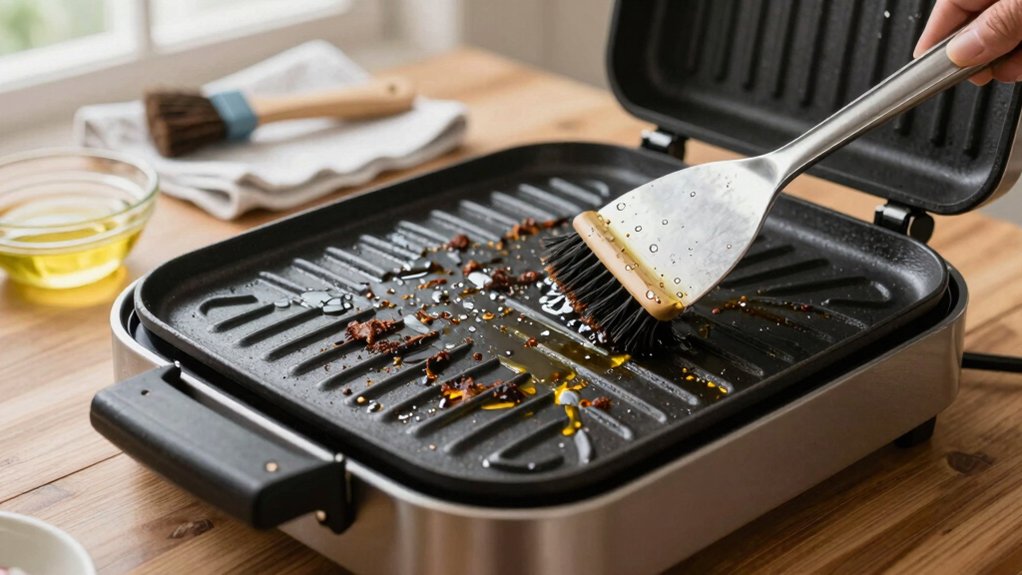
Use silicone, wood, or nylon utensils.
Clean residue promptly with nonabrasive sponges and inspect for scratches.
Keep going to learn specific test and cleaning steps.
Quick Overview
- Prefer coating-free steel plates for maximum longevity and resistance to warping under high heat.
- Match your plate’s max temperature (manual-stamped) to cooking tasks to avoid coating breakdown.
- Use silicone, wood, or heat-resistant nylon utensils to prevent scratches and remove food gently.
- Clean with warm soapy water; avoid abrasive pads. Immediately inspect for hairline scratches or coating loss.
- When unsure, spot-test microwave or unusual coatings with a short water-run and monitor for damage.
Nonstick Thickness Comparison
Compare nonstick options by focusing on plate build and real-world durability: stainless steel’s 5 mm, coating-free plates resist warping and last longest. Ceramic and PTFE rely on thin layered finishes that give excellent release but wear faster. You’ll judge by thickness durability and coating free advantages when picking a griddle.
Stainless gives supreme longevity and heat stability, but needs oil for release. Ceramic and PTFE give immediate nonstick performance; expect gradual wear and gentler cleaning. Hybrids balance heft with release. Match use: high-heat searing favors steel; low-fat frying suits ceramic/PTFE. Below’s a simple visual to compare mass versus finish so you can prioritize lifespan or slick release.
| Feature | Quick glance |
|---|---|
| Steel | 5 mm, longest life |
| Ceramic | Thin layers, good release |
| PTFE | Thinnest, easy clean |
| Hybrid | Heavy base, balanced |
Temperature Limits Checklist
Wondering how hot you can safely run your Indoor Grill plate? You should check the temperature limits stamped in the manual and match them to the coating type to protect coating durability. Stick to recommended max temps: ceramic around 200°C, PTFE/Teflon about 230°C, and treat titanium as more tolerant but not infinite. Avoid open flames or empty-plate preheating that spikes surface temperature.
Confirm the plate’s rated max temp before each heavy use. Use a reliable surface thermometer to verify actual cooking temps. Reduce heat if you spot discoloration, peeling, or rapid wear.
Following these steps preserves nonstick performance, extends service life, and prevents irreversible coating damage.
Microwave-Safe Coating Exceptions
Check the manufacturer label first to confirm microwave compatibility and any listed limits. If the label’s unclear, spot-test a short, low-power heating cycle with a cup of water and inspect the coating for changes. Then avoid metal utensils during both testing and regular use.
Always clean any residue thoroughly after microwave use to prevent buildup that can accelerate wear.
Check Manufacturer Label
Why should you always read the manufacturer’s label before putting an indoor grill plate in the microwave? You should check manufacturer instructions because not all coatings tolerate microwave energy or rapid temperature changes. The coating label will state microwave safety, maximum temperatures, and any special handling: ceramic often has lower heat limits than PTFE or titanium.
If the label lacks microwave guidance, assume it’s unsafe. Metallic layers, certain finishes, or glued components can spark or delaminate. Follow explicit warnings about removing detachable handles or avoiding covered steaming that traps heat.
Keep the label’s care symbols and written limits handy; they guide safe reheating and cleaning choices. When in doubt, contact the manufacturer for confirmation rather than guessing.
Spot-Test Before Use
Before you microwave an indoor grill plate, do a quick spot-test to confirm the coating won’t react to microwave energy or rapid heating. Pick a small, inconspicuous area and heat it briefly: 10–15 seconds on low power. Then check for unusual smells, discoloration, bubbling, or hot spots. If you notice any of those signs, don’t microwave the plate; label it as non-microwave-safe.
Record the result for future reference. A proper spot test targets coating safety without risking the whole surface. For new or uncommon coatings (ceramic blends, reinforced non-stick, enamel finishes), repeat the test at slightly longer intervals if initial signs are clear. Keep manufacturer guidance handy and prioritize coatings that pass the spot test for microwave use.
Avoid Metal Utensils
If your spot-test showed the coating handled brief microwave heating, keep in mind metal utensils can still cause trouble even with microwave-safe surfaces. You should avoid metal tongs, forks, and spatulas because scraping or sudden knocks will chip or scratch coatings over time.
Use silicone, wood, or heat-resistant nylon tools to preserve the surface and prevent localized abrasion that fails durability testing. When you handle food, lift rather than slide metal implements across the plate.
Inspect regularly for hairline scratches after each cleaning cycle; any abrasion accelerates wear and reduces non-stick performance. If you notice dull spots or flaking, stop using metal immediately and run a focused durability testing routine: gentle cook cycles followed by visual and tactile checks to decide whether repair or replacement is needed.
Short, Low-Power Heating
Curious whether you can briefly zap your indoor grill plate in the microwave? Short, low-power heating can be safe for some coated plates, but you need to check the manufacturer’s guidance first. If the plate’s label explicitly says microwave-safe, use short bursts at low power to avoid thermal shock.
Avoid metallic trims, screws, or embedded magnets; those’ll spark. Keep sessions under a minute and let the plate cool between bursts. Rapid temperature changes can delaminate certain coatings.
Ceramic and some branded non-stick surfaces sometimes tolerate this treatment, but Teflon/PTFE products can degrade if overheated. When in doubt, don’t microwave: opt for stovetop reheating at low heat. Document any discoloration or warping and stop using the plate if you see damage.
Clean Residue Thoroughly
When you spot baked-on food or greasy residue, scrub it away promptly using only soft, non-abrasive tools and a mild detergent so the coating, and any microwave-safe claim, doesn’t get compromised.
For microwave-safe coatings, note exceptions: some labels resist microwave heat but won’t tolerate strong scrubbing or soaking in harsh cleaners. Let the plate cool, then soak briefly in warm soapy water to loosen deposits. Use a silicone brush or soft sponge to clean residue without scratching. Rinse thoroughly and dry immediately to prevent water spots or trapped grime.
If stubborn spots remain, repeat soak cycles rather than abrasive action. Keep a routine of thorough cleaning after each use to preserve non-stick performance and the manufacturer’s microwave-safe assurances.
Frequently Asked Questions
How Do I Remove Burnt-On Grease Without Damaging the Coating?
You soak the plate in warm, soapy water to loosen burnt on grease. Then, use a soft sponge or silicone scraper to lift residues; avoid abrasive scrubbers that harm the coating.
For stubborn spots, make a paste of baking soda and water, apply briefly, then wipe gently. Rinse thoroughly and dry.
Regular cleaning after use prevents buildup and is essential coating care to extend non-stick performance and longevity.
Can I Use Metal Spatulas for Quick Flipping Occasionally?
You shouldn’t use metal spatulas for quick flipping on coated surfaces; they’ll risk scratching and accelerating wear. For occasional quick flipping, use silicone, wooden, or nylon utensils that flex and protect the coating.
If you must use metal spatulas, limit contact, angle them gently, and avoid scraping. Inspect the coating after use; replace pans showing scratches or peeling. Treat coated plates gently to maximize non-stick life and safety.
Is It Safe to Use Dishwasher Detergent on Coated Plates?
Yes, you can use dishwasher detergent, but avoid frequent dishwasher cycles to protect discoloration prevention and coating durability. Dishwashers and harsh detergents accelerate wear on ceramic and PTFE coatings; they dull finishes and may cause staining.
Hand-wash with mild detergent and a soft cloth for best results. If you occasionally run the dishwasher, choose gentle cycles, avoid high heat drying, and inspect the coating regularly for scratches or loss of non-stick performance.
How Long Should I Rest the Plate Before Cleaning?
You should let the plate rest about 10–15 minutes before cleaning. That rest time lets temperatures drop to safe handling levels and prevents thermal shock that can damage coatings.
For ceramic, aim closer to 15 minutes; for PTFE or titanium, 10 minutes is usually fine. Use the cleaning timing to wait until the surface is warm, not hot. Then wipe with a soft cloth and mild detergent to preserve the coating.
Can I Re-Season a Nonstick Indoor Grill Plate?
Yes, you can re-season the coating on some nonstick plates, but it depends on the coating type. For ceramic or PTFE surfaces, a light re-seasoning with a thin oil layer helps restore slipperiness; avoid heavy polymerizing fats.
Be gentle when cleaning before re-seasoning: wipe with a soft cloth and mild detergent, rinse, and dry thoroughly. Don’t use abrasive scrubbers or high heat. Skip re-seasoning if the surface is scratched or flaking.
Conclusion
You’ve learned how coating thickness, temperature limits, and manufacturer instructions affect indoor grill plate safety and lifespan. Before using microwave settings, always spot-test and avoid metal utensils to prevent scratches.
Use short, low-power heating cycles when the label allows. Clean residue thoroughly right after cooling to preserve the nonstick finish. Follow these practical steps consistently, and your grill plates will perform better, stay safer, and last noticeably longer.
Related reading: Ptfe Vs Ceramic Nonstick Coatings Explained covers this topic in detail.