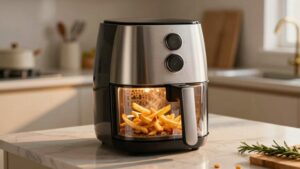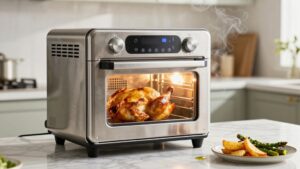
How Air Fryers Work
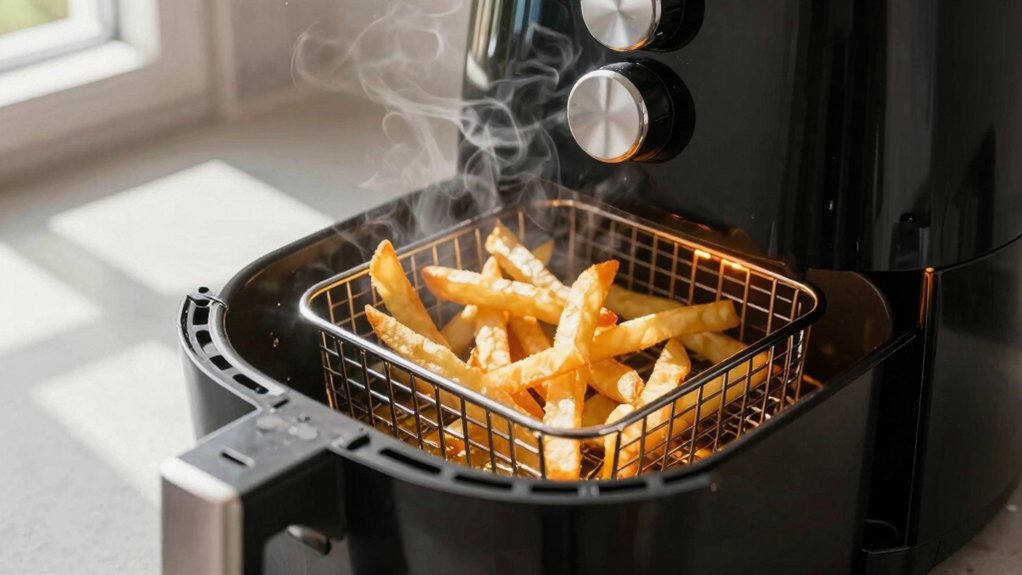
An Air Fryer uses a high-speed convective heat flow inside a small, hot chamber to crisp food with minimal oil. It circulates air over a heating element and fan, so surfaces brown rapidly while interiors cook evenly. You’ll reduce conventional oven temps by about 5–10°C; you can cut times roughly 20–25% for similar results.
Avoid overcrowding, flip halfway, and preheat 2–5 minutes for best browning. Keep going to see precise temp-time and load guidance.
Quick Overview
- Air Fryers circulate very hot air rapidly around food using a powerful fan and heating element to create convective browning and crisping. High air speed and concentrated heat remove surface moisture quickly; this produces Maillard reactions similar to shallow frying without submerging in oil.
- Food placement and airflow matter: leave gaps and avoid overcrowding so hot air reaches all surfaces evenly for uniform crispness. Adjust temperature and time from oven recipes: reduce temp 5–10°C and cut time ~20–25%. Preheat 2–5 minutes for best results.
- Wattage and basket load affect performance: lower-watt units or larger loads need longer times. Therefore, cook in batches rather than overfilling.
Cooking Time vs Temperature
How should you adjust time and temperature when moving recipes to an Air Fryer? You will reduce temperature by 5–10°C (25–50°F) and cut cooking time about 20–25% from oven recipes. Use higher temperature for rapid surface browning. Use lower temperature to finish interiors without drying. Preheat 3–5 minutes when precision matters. Check 5 minutes early and use a meat thermometer per USDA. Avoid overcrowding to maintain airflow. Flip or shake halfway for uniform results.
| Use case | Temperature guidance | Time guidance |
|---|---|---|
| Frozen items | 350°F (175°C) typical | Start mid-range; check early |
| Thin/sliced | 380–400°F (193–204°C) | Short times (6–10 min) |
| Dense/whole | 325–380°F (163–193°C) | Increase time 10–20% |
Basket Capacity & Wattage
Adjusting time and temperature for air-fryer recipes also means matching the appliance’s basket capacity and wattage to your cooking goals. You should size loads to the basket capacity to preserve airflow; overcrowding reduces convective heat transfer and increases cook time.
Check the manufacturer’s wattage limits; many domestic units range 1200–1800 W because available power governs how quickly the element reaches and sustains set temperatures.
- Match load to basket capacity: maintain gaps for air circulation to ensure uniform Maillard reactions.
- Respect wattage limits: lower-watt units require longer dwell times and may have reduced peak temperatures.
- Scale recipes: increase batches rather than density to keep heat flux consistent and avoid underbrowned interiors.
Use wattage and capacity data to predict time adjustments precisely.
Preheat Recommendations and Timings
You should preheat an Air Fryer when recipes require rapid surface browning or when large frozen items need an initial high-temperature exposure. Typical preheat times range 2–5 minutes at the target cooking temperature. Smaller chambers and higher wattages reach setpoints faster; adjust time based on appliance capacity and wattage.
Some foods, such as thin vegetables and small battered items, skip preheat to prevent over-browning. Quick techniques like running the fryer empty at target temp for 2 minutes or using a brief high-power burst can equalize chamber temperature faster.
When To Preheat
When should you preheat an Air Fryer? Preheating benefits include faster attainment of target chamber temperature and more predictable heat flux at food surfaces. You should preheat when a recipe specifies higher precision for browning or when starting from a cold unit.
Preheat is nonessential for many frozen items that already contain surface ice crystals; however, it’s recommended for fresh proteins or batter-coated foods to initiate rapid Maillard reactions. Because the chamber is small and the heating element plus fan deliver rapid air changes, preheating time is shorter than ovens.
Use preheat for consistency when scaling recipes between models with different thermal mass. Skip preheat to save time only when minor variance in surface crispness is acceptable or when recipe testing tolerates greater variability.
How Long To Heat
How long should you preheat an Air Fryer to reach stable cooking conditions? You’ll typically need 3–5 minutes for small, well-insulated chambers and 5–8 minutes for larger models to reach steady-state air temperature and stable airflow effects. Measure with a thermocouple at the basket level. A plateau in temperature and consistent fan RPM indicate readiness.
Short preheats under 2 minutes often reflect preheat myths rather than physics; they don’t allow the heating element and surrounding air mass to equilibrate. For consistent Maillard initiation and predictable cook times, use the manufacturer-recommended preheat or the 3–8 minute guideline. Adjust slightly for loaded vs. empty baskets because food mass alters thermal inertia and convective distribution.
Temperature Versus Time
Having established appropriate preheat durations for stable chamber conditions, let’s quantify how target temperatures and hold times interact to produce reliable cooking outcomes. You should treat set temperature and time as a coupled control problem: higher temperatures (180–200°C) reduce required hold times for surface browning, while lower temperatures (140–165°C) extend time to achieve Maillard reaction without over-drying.
Use topic pair one to denote fixed-temperature protocols and topic pair two for time-adjusted protocols when scaling batch size or product thickness. Empirical observations show a 10–20% time increase when load mass doubles; a 5–10°C temperature raise can offset that without compromising interior doneness. Preheat until chamber stabilizes; then apply the selected temperature–time pair and monitor internal temperature for repeatable results.
Foods That Skip Preheat
Curious which foods you can cook without preheating? You can skip preheat for thin, uniform items that respond quickly to Rapid Air Technology: frozen fries, pre-cooked proteins, thin fish fillets, vegetables cut to
These items reach target surface temperature rapidly because the small chamber and high-speed fan deliver immediate convective heat flux. This process preserves texture while reducing total cycle time. For raw thick cuts or whole poultry, you should preheat to ensure Maillard reaction thresholds (140–165°C) are met internally.
Skipping preheat improves energy efficiency for short-cycle foods, lowering standby heat loss and total energy per portion. Always avoid overcrowding; maintain airflow channels so modeled heat transfer rates remain valid and cooking is uniform.
Quick Preheat Techniques
Want to shave minutes off cooking without sacrificing browning? Preheat 2–3 minutes at target temperature for small-capacity air fryers (1.5–3.5 L) and 4–5 minutes for larger units. This minimizes startup delays while delivering the chamber temperature needed for efficient Maillard kinetics.
Don’t fall for preheating myths that insist on 10–15 minutes; thermal mass and Rapid Air Technology shorten warm-up time. Use the preheat function if available, or run at temperature with an empty basket until internal probe reads setpoint. For frozen foods or dense items, add 1–2 minutes to recommended preheat to stabilize surface temperature.
Track timings with a thermometer. Consistent, minimal preheat improves reproducibility and avoids unnecessary energy use without compromising crispness.
Frequently Asked Questions
Do Air Fryers Produce Harmful Fumes or Emissions?
You’re unlikely to get dangerous emissions from a properly used air fryer. Emission concerns focus mainly on overheating, burnt food, or nonstick coating degradation. Fume safety improves by using recommended temperatures, avoiding overheated oils, and discarding scratched Teflon baskets.
Maintain ventilation, clean regularly, and follow manufacturer limits. Studies show typical operation emits far fewer volatile compounds than deep frying. However, occasional acrid fumes can occur with misuse.
Can I Use Metal Foil or Parchment in the Basket?
Yes, you can use foil safely and parchment usage in Air Fryer Baskets, but follow limits. Use heavy-duty foil to secure vents and avoid blocking airflow; don’t line the entire basket.
Parchment with perforations is safe at typical temperatures (up to about 220°C) if you weigh it with food to prevent lift. Never let either touch the heating element or fan. Improper placement can cause smoking, uneven cooking, or fire risk.
Do Air Fryers Work at High Altitude?
Yes, air fryers work at high altitude, but high altitude affects air fryer performance. You’ll see faster evaporation and longer cooking times for some foods. Additionally, there is potentially reduced Maillard browning because lower atmospheric pressure lowers boiling points and changes heat transfer.
Compensate by increasing temperatures slightly and extending cook times. Avoid overcrowding to maintain airflow. Monitor internal temperatures with a probe for precision and adjust recipes empirically for consistent results.
Are Air Fryer Parts Dishwasher-Safe and Bpa-Free?
Yes, many air fryer manufacturers design dishwasher safe components and use BPA free materials for parts that contact food. You should check your model’s manual: baskets, trays, and removable drawers are often safe for top-rack dishwashers. The heating elements and fan assemblies aren’t safe for dishwashing.
Verify labels and certifications for BPA free materials. If unspecified, hand-wash with mild detergent to avoid degrading coatings or seals and to ensure longevity.
Can I Bake Delicate Items Like Custards or Soufflés?
Yes, you can, but expect limits: custard failure and soufflé risks rise due to rapid, uneven airflow and high surface dehydration. You should use water baths, reduced temperature, and gentle steam to slow Maillard-driven drying.
Monitor internal temperature precisely. Avoid direct high-velocity air on surfaces, and shield with foil or vents. With careful controls and trial runs, you’ll minimize texture defects and achieve acceptable custards or soufflés in an air fryer.
Conclusion
You’ll want to match time and temperature to your recipe, accounting for basket size and wattage. Higher wattage and smaller loads cook faster. Preheat when recipes call for it: typically 3–5 minutes for most air fryers to stabilize internal air temperature. Skip preheat for thin, quick-cooking items like frozen fries or small veggies.
Use the shortest effective preheat and adjust time downward if you start with a hot unit to prevent overcooking.
Related reading: Air Fryer Oven Vs Basket Air Fryer Differences covers this topic in detail.